




FDA Updates EVOH Packaging Migration Guide
On July 12, 2026, the U.S. FDA released a revised migration guidance for EVOH-based multilayer food-contact packaging, adding new migration limits for acetaldehyde and caprolactam under retort conditions at 121°C for 30 minutes and under microwave heating, while also requiring verification data showing interlayer peel strength of at least 1.8 N/15mm. Because the revision took effect immediately and applies to all manufacturers exporting EVOH high-barrier packaging to the U.S., it is relevant not only to packaging producers but also to exporters, procurement teams, testing service providers, and delivery planning functions that depend on compliant technical documentation.
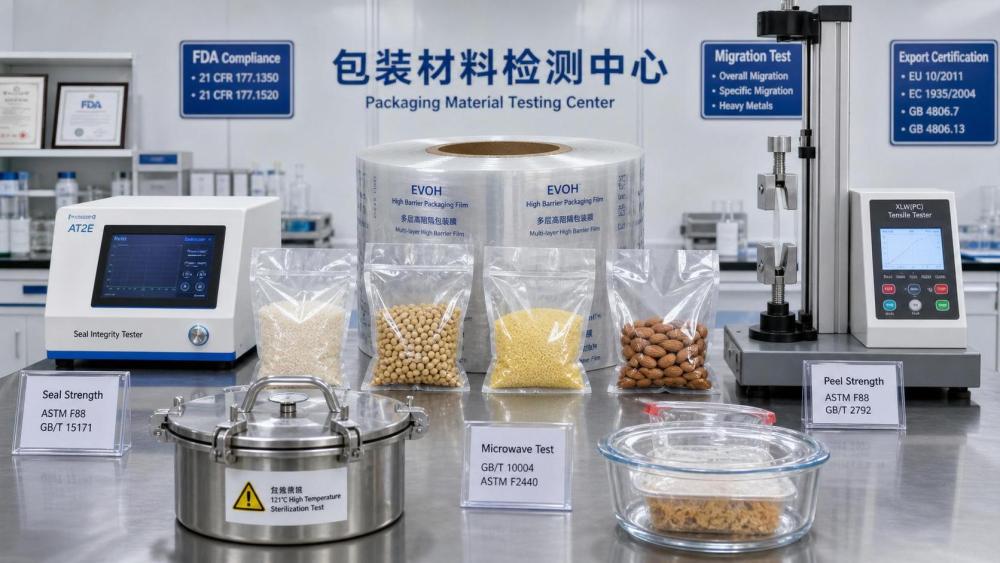
What the revised FDA guidance now requires
The confirmed update is that the FDA issued a revised document titled Food-Contact Substances: EVOH-Based Multilayer Packaging Migration Guidance on July 12, 2026.
According to the provided event summary, the revision introduces migration limits for acetaldehyde and caprolactam in two use scenarios: retort processing at 121°C for 30 minutes and microwave heating.
The same update also requires verification data demonstrating interlayer peel strength of no less than 1.8 N/15mm.
The rule took effect on the date of release and affects all manufacturers exporting EVOH high-barrier packaging to the U.S.
Where the immediate pressure is likely to appear
Export-facing packaging manufacturers
These companies are the most directly exposed because the updated guidance applies to EVOH high-barrier packaging shipped to the U.S. From an operational perspective, the main pressure points are likely to be product compliance review, test readiness for the newly named heating scenarios, and the availability of supporting verification records for peel strength.
What deserves closer attention is whether existing technical files, declarations, and test materials are sufficient to match the revised FDA wording, especially where products are marketed for retort or microwave use.
Procurement and sourcing teams
For buyers of multilayer packaging, the rule change may alter supplier screening and purchasing criteria. Analysis shows that procurement teams may need to pay closer attention to whether suppliers can provide documentation tied to the newly specified migration items and the interlayer strength threshold, rather than relying only on earlier qualification materials.
The practical impact is likely to appear in supplier approval, specification alignment, and order confirmation, particularly where delivery commitments depend on compliance evidence being available before shipment.
Testing and compliance support functions
Testing service providers and internal compliance teams may see a change in workload because the revised guidance points to specific migration and structural verification requirements. From an industry perspective, the issue is not only whether testing is performed, but whether reports and technical documents clearly correspond to the retort and microwave conditions named in the update.
This matters for document review, customer submissions, and any certification or compliance workflow that relies on complete and current supporting evidence.
Trade and delivery coordination roles
Export coordination, customer service, and delivery planning teams may also be affected because the rule is already in force. Observably, any gap between product claims, test records, and shipment documentation could create friction during order execution, customer approval, or pre-delivery review.
The main point to watch is whether customers begin requesting revised compliance packages, updated specifications, or additional confirmation before accepting production or shipment schedules.
What companies should check first
Revisit product-to-use-condition matching
Companies selling EVOH high-barrier packaging into the U.S. market should first review which products are intended for retort or microwave applications. Analysis shows that the regulatory relevance of the update is tied to those specified use conditions, so product positioning and application descriptions now matter more in compliance review.
Review technical files and test documentation
Manufacturers and exporters should check whether existing records address acetaldehyde and caprolactam migration under the stated conditions and whether interlayer peel strength verification at or above 1.8 N/15mm is documented clearly. If the current document set does not map cleanly to the revised guidance, that gap may affect customer acceptance or shipment preparation.
Watch for changes in customer documentation requests
Because the update is already effective, it is reasonable to expect more attention to declarations, testing reports, product specifications, and supporting technical statements. What deserves closer attention is not an assumed enforcement outcome, but the likelihood that commercial counterparties may start adjusting their own review checklists quickly.
Align delivery and sourcing schedules with compliance readiness
For products already in production or scheduled for export, companies should pay attention to whether revised compliance materials can be assembled without delaying delivery. From an industry perspective, this is especially relevant where procurement cycles, customer approval steps, or supplier qualification depend on complete documentation rather than on product availability alone.
How this change is best understood at this stage
Observably, this is more than a routine wording update because it introduces new migration limits for named substances in named heating scenarios and adds a measurable interlayer peel strength verification requirement. At the same time, the current input does not provide more detailed enforcement instructions, interpretive notes, or implementation examples.
It is more appropriate to understand this as an already effective compliance signal with immediate documentation and testing implications, while still recognizing that market practice, customer requirements, and execution details may continue to develop after the publication date.
Why the market should treat it as an execution issue now
The practical meaning of this update is that EVOH high-barrier packaging for the U.S. market now sits under a more specific compliance frame for retort and microwave applications. Analysis shows that the most immediate issue is not broad market forecasting, but whether companies can align testing scope, technical evidence, and shipment documentation with the revised guidance without disrupting orders or customer review.
For that reason, the update is better read as a rule change that has already landed, with further observation needed on how buyers, testing bodies, and trade counterparts translate it into day-to-day requirements.
Basis of this article and what still needs verification
This article is based on the user-provided news title, event date, and event summary concerning the FDA revision to guidance for EVOH-based multilayer packaging.
For developments of this type, relevant source categories typically include official regulatory notices, regulator-issued guidance documents, customs or trade authority information, industry association updates, standards organization materials, and reporting by established professional media.
No specific official source link was provided in the input, so the exact official publication link still needs to be verified on an ongoing basis.
Further observation is also needed regarding any detailed implementation language, certification and testing interpretation, customer-side specification changes, tender document updates, industry feedback, and how affected companies execute the new requirements in practice.
Related News
- 00
0000-00
How glass fiber flame retardant engineering plastics affect part warpage - 00
0000-00
How UV curable bonding materials protect electronics from thermal stress - 00
0000-00
When reinforced thermoplastics make sense for lightweighting in Africa - 00
0000-00
How to size a plastic extrusion line for recycling output targets - 00
0000-00
When do sustainable polymers for automotive meet crash-safety needs?
Tag