




Reinforced Thermoplastics for Medical: Sterilization and Strength Trade-offs
Why the trade-off matters now
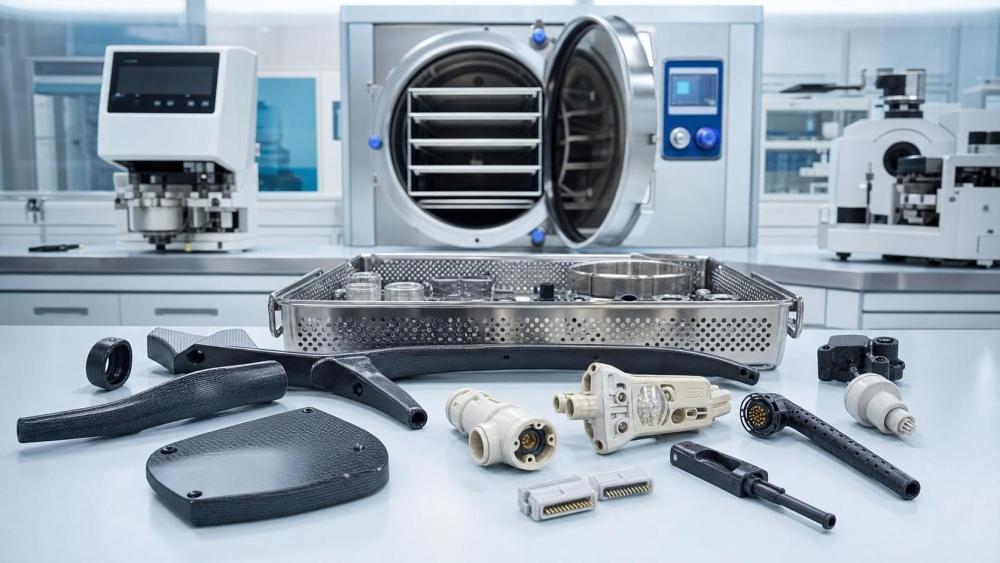
Reinforced thermoplastics for medical applications sit at a difficult intersection.
They must survive sterilization, hold tight tolerances, and keep mechanical performance predictable over time.
That sounds straightforward until repeated steam, radiation, or chemicals begin changing the polymer structure itself.
In practice, the best material is rarely the one with the highest strength on a datasheet.
What matters is retained strength after processing, assembly, sterilization, transport, and actual use.
This is why reinforced thermoplastics for medical remain a live decision area across devices, instrument housings, trays, connectors, and structural components.
Across advanced materials markets, pressure is moving in two directions at once.
Products are expected to become lighter and more durable, while compliance demands are becoming tighter and more document-driven.
That makes material selection less about a single property and more about system behavior.
APIM often frames this clearly: formulation, compounding quality, and processing control shape whether a medical-grade polymer performs consistently in the field.
What reinforcement changes in a medical polymer
A base thermoplastic can be reinforced with glass fiber, carbon fiber, mineral fillers, or hybrid systems.
Each option changes more than stiffness.
It affects shrinkage, warpage, surface quality, wear, dimensional stability, mold flow, and long-term aging.
For reinforced thermoplastics for medical, that broader impact matters because sterilization can magnify weak points created during molding or compounding.
Glass fiber is common where rigidity and cost balance are important.
Carbon fiber can improve stiffness-to-weight ratio, but cost, conductivity, and appearance may limit use.
Mineral-filled systems may offer dimensional control, yet they do not always deliver the same fatigue performance as fiber-reinforced grades.
The matrix resin is equally decisive.
PEEK, PPS, high-performance polyamides, and certain polyesters are often considered when repeated sterilization is required.
Polycarbonate blends or reinforced nylons may fit single-use or lower-cycle applications, depending on the sterilization route.
The hidden role of interfaces
The bond between filler and polymer matrix is often where reliability is won or lost.
If adhesion is weak, repeated heat or moisture can trigger microcracking, fiber pull-out, or loss of impact resistance.
That is why coupling chemistry, additive compatibility, and dispersion quality deserve close attention.
Sterilization does not attack every material in the same way
When people discuss sterilization resistance, they sometimes treat it as a single pass or fail issue.
It is more complex than that.
Steam sterilization brings high temperature and moisture.
Ethylene oxide adds chemical exposure and aeration concerns.
Gamma and e-beam can create chain scission, discoloration, or embrittlement in sensitive polymers.
Reinforcement can help or hurt depending on the system.
A stiffer composite may hold shape better under autoclave conditions.
The same composite may also become more notch-sensitive after radiation aging.
Moisture uptake is another common issue.
In reinforced thermoplastics for medical, absorbed moisture can shift dimensions, change modulus, or accelerate hydrolysis in certain resins.
That means retained properties after ten, fifty, or one hundred sterilization cycles tell a better story than initial tensile strength alone.
Where strength helps, and where it creates new risks
Higher reinforcement levels usually improve stiffness, load-bearing capacity, and dimensional stability.
Those are clear benefits for handles, housings, fixation elements, and structural supports.
Still, a stronger composite is not automatically safer.
Excessive fiber loading may reduce weld line strength.
It can also raise anisotropy, making performance direction-dependent.
In thin-wall parts, that may lead to unexpected crack paths after sterilization cycling.
Surface wear is another concern.
Exposed fibers may increase abrasion, create particulate concerns, or complicate cleaning validation.
This is especially relevant where components slide, lock, or contact delicate instruments.
So the real question is not how to maximize strength.
It is how to achieve enough strength with stable behavior across the complete service environment.
Typical decision points
- Cycle count expected over the product life
- Whether failure would be brittle, visible, or latent
- Tolerance sensitivity after heat and moisture exposure
- Need for low particulates or smooth cleanable surfaces
- Interaction with inserts, adhesives, coatings, or overmolding
Processing quality often decides field performance
Reinforced thermoplastics for medical can fail because of poor processing rather than poor resin choice.
That distinction matters in audits and root-cause reviews.
Fiber breakage during compounding lowers expected reinforcement efficiency.
Uncontrolled drying raises hydrolysis risk before a part even reaches sterilization.
Poor mold design can concentrate stress around gates, weld lines, or corners.
APIM’s broader materials coverage is useful here because compound quality and equipment control are directly linked to downstream consistency.
Screw design, residence time, filtration, feeding accuracy, and cooling conditions are not abstract production details.
They influence fiber length distribution, dispersion, and void content, all of which affect sterilization durability.
For that reason, incoming inspection and lot release should connect resin certification with process evidence.
What should be checked beyond the datasheet
- Fiber content tolerance and actual lot-to-lot variation
- Moisture limits before molding and before sterilization testing
- Mechanical retention after representative sterilization cycles
- Visual changes, odor, extractables, and surface cracking
- Dimensional drift at critical interfaces
- Traceability for additives, colorants, and formulation revisions
How application context changes the material choice
Not every medical part needs the same balance.
A reusable surgical instrument handle may prioritize autoclave endurance and grip stability.
A diagnostic housing may care more about dimensional accuracy, chemical wipe resistance, and appearance.
A sterilizable tray may need toughness and low warpage across large surfaces.
An implant-adjacent device component may face tighter scrutiny on biocompatibility and particulate behavior.
This is where reinforced thermoplastics for medical should be evaluated by use case, not by generic category.
The same reinforced PA grade can be acceptable in one setting and unsuitable in another.
Sterilization method, geometry, contact profile, and validation pathway all change the answer.
A practical way to judge options
A useful review process starts with the sterilization pathway, not the polymer family.
Then map the part’s actual loading, geometry, expected lifetime, and critical failure mode.
After that, compare candidate materials using retained performance data, not just initial values.
For reinforced thermoplastics for medical, three layers of evidence are especially useful.
- Material evidence: resin pedigree, additive disclosure, biocompatibility scope, and sterilization history
- Process evidence: molding window, drying control, fiber preservation, and dimensional capability
- Use evidence: accelerated aging, repeated cycle testing, and failure analysis under realistic loads
That approach reduces the chance of selecting a grade that looks robust in procurement documents but weakens in service.
It also supports clearer discussions with suppliers about what data is relevant and what remains unproven.
Where to focus next
The strongest decision framework for reinforced thermoplastics for medical is built around retained function, not nominal strength.
That means ranking materials by sterilization route, cycle count, dimensional sensitivity, and failure consequences.
It also means reviewing compound consistency, additive transparency, and process control as part of material risk.
A short list becomes more reliable when each option is checked against real post-sterilization data and part-specific validation.
From there, the next step is usually straightforward: define the sterilization profile, narrow the candidate resin systems, and test the actual geometry under representative conditions.
That is where material intelligence becomes practical, and where better choices usually start to separate from attractive assumptions.
Have questions about this sector analysis, or seeking best practices specific to your niche? Drop us a line below and let the senior consultants at APIM assist you.
We respect your privacy. Your information is strictly confidential.
Related News
- 00
0000-00
How does washing affect contamination in post-consumer recycled PP resins? - 00
0000-00
How does feedstock affect depolymerization equipment selection? - 00
0000-00
US Sets 213.44% Preliminary Antidumping Deposit on Chinese PTMEG - 00
0000-00
When should epoxy be used as a thermal interface material for semiconductors? - 00
0000-00
US Midterm Results Unlikely to Quickly Shift Recycled Plastics Market or Legislation