




Coextruded Films for Vacuum Packaging: Barrier vs Cost Comparison
Why does the barrier-versus-cost question matter so much?
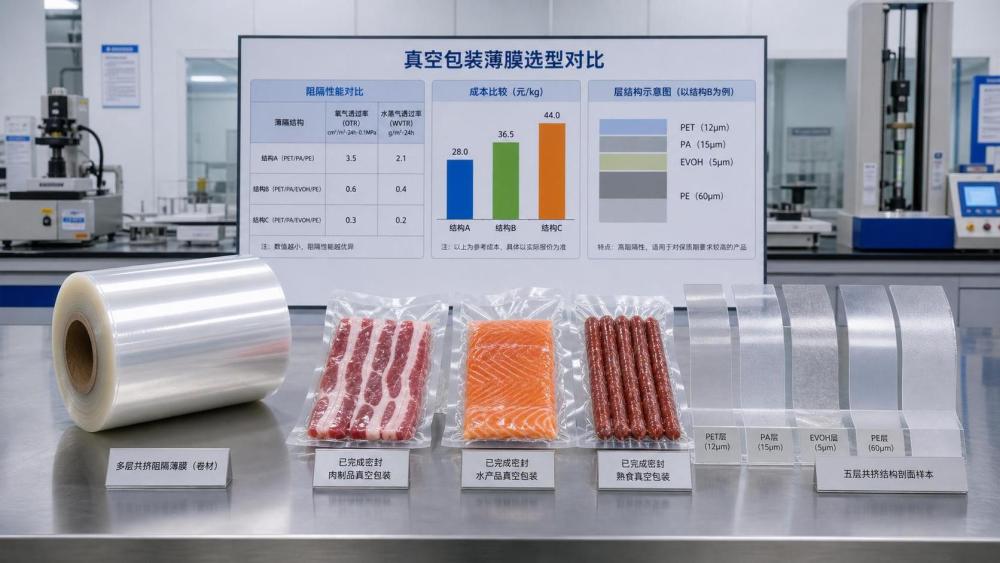
Choosing coextruded films for vacuum packaging is rarely a simple material comparison.
The real decision usually sits between shelf-life protection, conversion stability, and delivered packaging cost.
That is why coextruded films for vacuum packaging are discussed so often in food, medical, and industrial packaging sourcing.
A higher barrier structure can reduce oxygen ingress and product loss.
But if the packed product does not need that level of protection, the added layer complexity may only increase cost.
In practical terms, film value comes from fitness for the application, not from the most advanced specification on paper.
This is also where APIM-style material analysis becomes useful.
Structured comparisons of polymers, co-extrusion design, and processing behavior make it easier to judge what really affects performance.
For vacuum packaging, that often means asking a better question.
Not “Which film has the highest barrier?”
Instead, “Which coextruded films for vacuum packaging protect the product enough without creating avoidable cost or supply risk?”
What exactly should be compared in coextruded films for vacuum packaging?
Barrier is important, but it is only one part of the sourcing picture.
Coextruded films for vacuum packaging are multilayer structures, often combining PE, PA, EVOH, tie layers, and seal layers.
Each layer changes both performance and cost.
A useful comparison usually includes the following points:
- Oxygen barrier under real storage conditions, not only lab values.
- Moisture resistance if the product faces chilled, wet, or humid distribution.
- Seal integrity across machine speed and temperature variation.
- Puncture resistance for sharp edges, bones, or rigid components.
- Thickness consistency and forming behavior on the packaging line.
- Unit price, yield, scrap rate, and supply continuity.
The common mistake is to compare only price per kilogram.
In actual operations, price per packed unit is often the better number.
A slightly higher-cost film may lower leaks, rework, and product returns.
On the other hand, a premium barrier structure may be overbuilt for short-cycle products.
That is where disciplined film comparison becomes more valuable than broad supplier claims.
A quick comparison table buyers often need
The table below summarizes how common structure choices usually behave in sourcing discussions.
When does higher barrier actually pay back?
Higher barrier pays back when product loss is more expensive than film cost.
That sounds obvious, but it is often missed during quotation review.
For oxygen-sensitive proteins, cheese, prepared meals, or sensitive medical components, a barrier upgrade can be easy to justify.
The same is true for longer export routes or mixed-temperature logistics.
In these cases, coextruded films for vacuum packaging support product stability, appearance, and usable shelf life.
The return is not only fewer spoiled units.
It may also include lower complaint rates, more predictable inventory rotation, and less safety stock.
Still, high barrier should not be treated as a default upgrade.
If shelf life targets are modest, turnover is fast, and storage exposure is controlled, a mid-barrier structure may be enough.
More common than expected, the best result comes from matching film to distribution reality rather than to worst-case assumptions.
This is why APIM’s broader coverage of barrier films, processing conditions, and application logic matters.
Material performance is rarely independent from the line, product geometry, and supply chain route.
Where do lower-cost options make sense without creating risk?
Lower-cost coextruded films for vacuum packaging are not automatically low-value.
They can be the right choice when the application is stable and well-defined.
Short domestic distribution cycles are one example.
Products with low oxygen sensitivity are another.
Some industrial components also need vacuum packaging mainly for cleanliness, bundling, or corrosion-control support.
In those cases, extreme barrier may not create measurable value.
A reasonable cost-down review usually checks four things first:
- Actual shelf-life requirement versus internal habit.
- Real leak and puncture history on the current line.
- Storage humidity and temperature exposure.
- Whether thinner or simpler layers affect machine uptime.
The last point deserves attention.
A cheaper film that runs poorly can erase the expected savings through downtime, scrap, and sealing defects.
For that reason, converter trial data matters as much as datasheet pricing.
What cost drivers are usually hidden in film quotations?
The headline film price rarely tells the full story.
With coextruded films for vacuum packaging, hidden cost often sits in process losses and technical mismatch.
Several factors deserve a separate line of review:
- Yield by usable area, not only roll weight.
- Seal window width and sensitivity to temperature drift.
- Gauge tolerance and consistency between lots.
- Lead time stability for specialty resins such as EVOH grades.
- Scrap from wrinkles, curl, haze, or forming inconsistency.
- Compliance documents, migration data, and traceability support.
A low quotation becomes less attractive when one missed shipment stops a packaging line.
The same applies when a structure requires tighter machine control than the plant can reliably hold.
In co-extrusion, resin selection, layer ratio, tie-layer quality, and process control directly affect consistency.
That connection between materials and extrusion technology is one reason technical sourcing should not be reduced to price comparison alone.
A practical screening checklist before switching suppliers
What mistakes are common when comparing coextruded films for vacuum packaging?
One common mistake is buying barrier that the product never uses.
Another is cutting specification too far and discovering the loss only after field complaints.
There are also softer mistakes that cause slow cost leakage.
For example, comparing structures without reviewing line conditions.
Or assuming all PA/PE and EVOH-based films behave similarly across converters.
In reality, formulation quality and co-extrusion control can change results significantly.
It is also risky to ignore sustainability direction.
Some applications are moving toward recyclable or simplified structures, even when barrier targets remain demanding.
That does not mean every existing format should change immediately.
It does mean future sourcing should monitor material availability, regulatory pressure, and redesign feasibility.
APIM follows these broader material shifts because packaging film choices increasingly connect performance, processing, and circular design.
So how should the final decision be made?
The best decision framework is usually simple.
Start with the product’s real barrier need.
Then test whether the proposed coextruded films for vacuum packaging hold seal, puncture, and runnability under normal plant conditions.
After that, compare total packed-unit cost, not just resin or roll price.
The final review should include shelf-life target, transport route, machine behavior, documentation support, and supply resilience.
If two structures perform similarly, the simpler one often offers the better sourcing position.
If performance gaps appear, the extra barrier cost should be measured against product risk, not against film cost alone.
A disciplined comparison usually prevents both overbuying and underprotecting.
The next step is to build a short evaluation sheet.
List required barrier level, seal range, puncture threshold, target cost per pack, and acceptable lead time.
That approach makes discussions with film suppliers faster, more technical, and easier to verify.
Have questions about this sector analysis, or seeking best practices specific to your niche? Drop us a line below and let the senior consultants at APIM assist you.
We respect your privacy. Your information is strictly confidential.
Related News
- 00
0000-00
Do polyolefin hot melt adhesives bond well to polyethylene? - 00
0000-00
Korean Study Finds PLA Barely Degrades in Landfill After 320 Days - 00
0000-00
How to assess batch consistency from a thermal potting compounds supplier - 00
0000-00
How much weight can carbon fiber reinforced plastics save in cars? - 00
0000-00
Switching from PS to ABS Sheet Extrusion: Equipment Checks