




Underwater Pelletizing Equipment: Common Failures and Throughput Fixes
When underwater pelletizing equipment loses stability, what usually changes first?
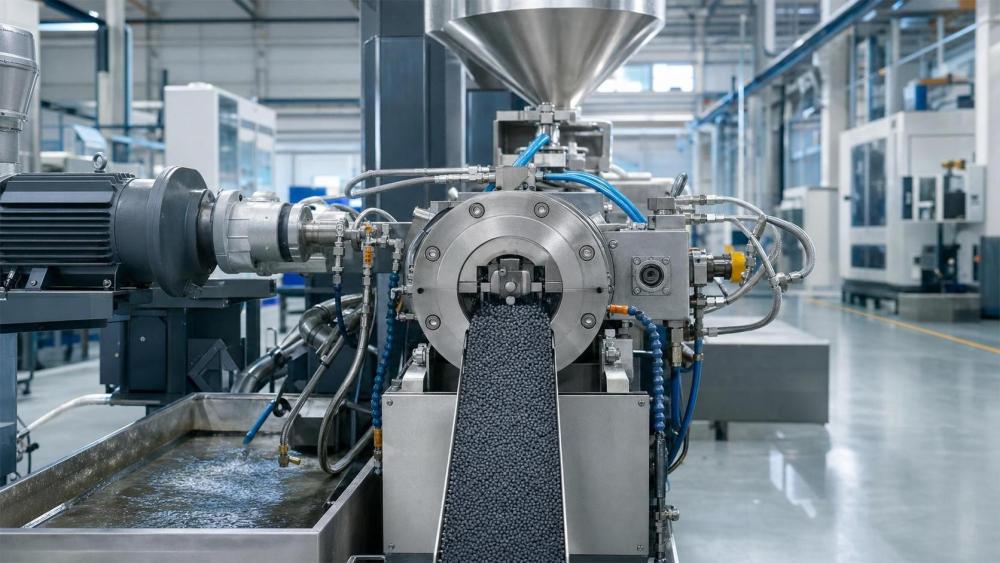
Unstable cutting rarely begins with one dramatic failure. More often, underwater pelletizing equipment starts drifting through small signals.
Pellets may become slightly oval. Motor load may rise. Melt pressure may pulse. Water temperature may look acceptable, yet sticking increases.
That pattern matters because output loss is often a combined process issue, not only a pelletizer issue.
In polymer compounding lines, pellet quality depends on die condition, melt consistency, knife sharpness, cooling balance, and flow stability upstream.
This is why APIM often frames pelletizing performance as a system-level control topic within extrusion technologies, not a standalone maintenance event.
If the line handles reinforced PA, TPU, PET, recycled PP, or filled engineering plastics, sensitivity becomes even higher.
Different polymers react differently to shear, moisture, thermal history, and cooling speed. The same symptom can hide different causes.
A useful first check is simple: ask whether the defect follows the die face, the water loop, or the upstream melt.
That separation shortens troubleshooting time and prevents repeated knife changes that never solve the real bottleneck.
Is poor pellet shape really a cutter problem, or is the melt already unstable?
Not every bad cut comes from the cutter hub. In actual operation, unstable pellet shape often starts before the polymer reaches the die plate.
If melt pressure fluctuates, strand emergence becomes uneven across die holes. The knives then cut an already inconsistent flow front.
This is common when screen packs are partially blocked, feeding rates are drifting, or a melt pump is slipping under load.
A second clue is whether poor pellets appear across all holes or only in selected zones of the die face.
Local defects usually point to die blockage, uneven heating, or knife contact inconsistency. Full-face defects suggest a broader melt or water issue.
The quick comparison below helps narrow the failure path before parts are replaced.
For underwater pelletizing equipment, the best throughput fixes often begin with trend data, not assumptions.
Why do pellets stick even when water flow looks normal?
Pellet sticking is one of the most misleading failures in underwater pelletizing equipment because visible water movement does not guarantee effective cooling.
The critical factor is heat removal at the die face and immediately after cutting, not just pump circulation volume.
If water temperature creeps up a few degrees, soft resins can remain tacky long enough to agglomerate.
This becomes more severe with elastomeric compounds, recycled blends, adhesive-related formulations, and impact-modified materials.
Another overlooked issue is water distribution. One side of the chamber may have dead zones, scale buildup, or partial nozzle restriction.
When that happens, pellets from certain die rows stay hotter and start clumping downstream in the dryer or pipeline.
It also helps to check resin condition. Moisture variation, additive bleed, or thermal degradation can make sticking look like a cooling failure.
For example, PET and bio-based blends are highly sensitive to moisture history. TPU and hot-melt style compounds respond strongly to cooling timing.
A practical response is to review these points together:
- Actual water temperature at inlet and return, not only setpoint
- Flow balance across chamber passages and spray points
- Die face cleanliness and localized hot spots
- Recent resin lot change, filler loading shift, or moisture deviation
- Dryer efficiency after pellet discharge
That combined review usually reveals whether sticking is thermal, hydraulic, or material-driven.
What usually causes throughput decline before a shutdown becomes necessary?
Throughput rarely drops in one step. Most underwater pelletizing equipment loses capacity through friction, restriction, and control drift.
Knife wear is one obvious factor, but it is often only part of the story. Dull blades increase cut resistance and generate more fines.
At the same time, a worn die face changes strand presentation. The operator may increase pressure to compensate, which raises thermal stress.
Water system fouling can also quietly reduce output. Scale, polymer carryover, and fines deposition change cooling efficiency and backpressure behavior.
The upstream side matters just as much. In compounding lines covered by APIM, output losses are often linked to screen contamination and unstable feeding.
Filled compounds, glass fiber systems, flame-retardant grades, and recycled materials create higher wear and contamination risk than standard virgin resin.
When throughput starts sliding, it helps to compare process trends over a short window instead of reacting to one alarm.
The earlier these signals are linked, the easier it is to recover output without damaging the die system.
Which maintenance checks actually restore underwater pelletizing equipment performance fastest?
Fast recovery comes from sequence, not speed. Random part replacement usually extends downtime and weakens failure analysis.
Start with parts that directly affect cut geometry and flow continuity. Then move upstream and outward.
A reliable service sequence often includes these steps:
- Inspect knife sharpness, wear pattern, and holder runout.
- Confirm die face flatness, hole cleanliness, and thermal uniformity.
- Measure water inlet temperature, return temperature, and flow balance.
- Review extruder pressure trend, screen condition, and melt pump stability.
- Check recent changes in resin grade, filler content, moisture, or additive package.
This order works because underwater pelletizing equipment sits at the end of a chain. The final symptom is often not the original disturbance.
In high-value engineering plastics, short unplanned stops can also affect material history, color stability, and lot consistency.
So the maintenance goal is not only to restart. It is to restart with predictable output and acceptable pellet quality.
How can recurring failures be reduced instead of solved one batch at a time?
Recurring faults usually survive because teams track alarms, not causes. A better approach is to connect defect patterns with material, wear, and process history.
For underwater pelletizing equipment, that means building a short fault map around four variables: resin family, die life, knife life, and water loop condition.
Once those records exist, repeated issues become easier to predict. TPU may show sticking after a narrow water temperature rise. Glass-filled PA may shorten blade life.
Recycled polyolefins may push contamination faster than virgin grades. PET may react strongly to drying variation before pelletizing symptoms appear.
That broader context is exactly where APIM is useful. It links processing behavior with polymer type, compound design, and equipment realities across global material applications.
A practical next step is to standardize a troubleshooting sheet for every event. Include pressure trend, water temperatures, knife hours, die zone condition, resin lot, and defect photos.
After several runs, the pattern usually becomes clearer than any one shutdown report.
In short, underwater pelletizing equipment performs best when maintenance, process control, and material knowledge are reviewed together.
If pellet shape drifts, sticking grows, or throughput falls, begin with symptom separation, then verify melt stability, die condition, and cooling balance in sequence.
That method makes it easier to compare failure modes, prioritize fixes, and set practical service intervals before the next output loss appears.
Have questions about this sector analysis, or seeking best practices specific to your niche? Drop us a line below and let the senior consultants at APIM assist you.
We respect your privacy. Your information is strictly confidential.
Related News
- 00
0000-00
How does washing affect contamination in post-consumer recycled PP resins? - 00
0000-00
How does feedstock affect depolymerization equipment selection? - 00
0000-00
US Sets 213.44% Preliminary Antidumping Deposit on Chinese PTMEG - 00
0000-00
When should epoxy be used as a thermal interface material for semiconductors? - 00
0000-00
US Midterm Results Unlikely to Quickly Shift Recycled Plastics Market or Legislation