




Can PPS Withstand Continuous Exposure to Sulfuric Acid?
Can PPS handle continuous exposure to sulfuric acid? Often, yes, but only when the operating conditions stay within a suitable range. Polyphenylene sulfide (PPS) is widely selected for chemical-resistant parts because its polymer structure is inherently stable against many acids, solvents, and industrial fluids. However, “sulfuric acid resistant” is not the same as “suitable for every sulfuric acid process.” Acid concentration, temperature, pressure, mechanical load, cycling, and part design can all change the result.
For a lightly loaded component exposed to sulfuric acid at a stable, moderate temperature, PPS may be a practical option. For a pressurized pump component, a hot acid transfer line, a stressed valve part, or a system with concentration changes, the decision needs more discipline. The material may resist visible chemical attack while still losing dimensional control, stiffness, sealing performance, or long-term reliability.
Why PPS is considered for acidic service
PPS is a semi-crystalline engineering polymer with strong thermal stability and generally low moisture uptake. In practical terms, it tends to retain its shape and mechanical behavior better than many common plastics when exposed to harsh chemicals. This makes it relevant for chemical-processing equipment, electrical components near corrosive media, pump and valve parts, battery-related hardware, filter housings, and industrial assemblies where metal corrosion is also a concern.
Its resistance comes from the polymer backbone rather than from a surface coating. That distinction matters. A coated metal component can fail when its protective layer is scratched or poorly bonded. A correctly selected PPS part has chemical resistance throughout its molded or machined section. Still, the final part is not defined by neat PPS alone. Fillers, reinforcements, pigments, processing quality, weld lines, voids, inserts, seals, and molded-in stresses all affect how it behaves in service.
The useful starting position is therefore: PPS can be a strong candidate for continuous sulfuric acid exposure, but it should be specified as a system material, not selected from a generic chemical-resistance label.
Conditions that change the answer
Sulfuric acid does not present one fixed environment. A dilute aqueous solution, a concentrated acid stream, and a process that moves between different concentrations may create very different demands. The most important variables are closely connected.
Temperature is usually the first condition that turns a simple material-selection question into a design-validation issue. PPS is known for heat resistance, yet long-term sulfuric acid exposure at elevated temperature deserves more scrutiny than room-temperature contact. The concern is not only chemical degradation. A part may soften relative to its required stiffness, creep under a gasket load, or lose the dimensional stability needed to maintain a seal.
Mechanical loading deserves equal attention. A PPS cover, bracket, sensor body, or protective guard may tolerate an acidic atmosphere well because it carries little load. A threaded fitting, pump impeller, bearing cage, valve seat, flange, or pressurized housing operates under a different risk profile. Stress concentrations around threads, sharp corners, weld lines, and metal inserts can become the first locations where a chemically exposed component shows damage.
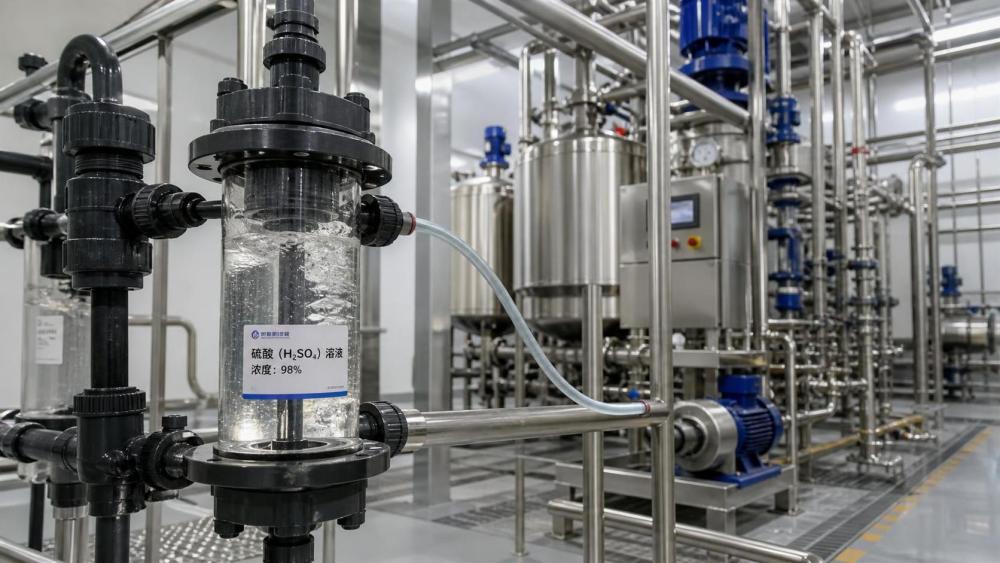
Continuous immersion is not the same as occasional contact
It is easy to overestimate compatibility by using a material that performs well during brief spills, routine cleaning, or external splashing. Continuous immersion gives sulfuric acid more time to act at the polymer surface and at vulnerable construction details. It also means that any small dimensional change can accumulate into a functional problem.
For example, a PPS chemical tank fitting may not visibly dissolve or discolor, yet a small change in flatness under bolt load can reduce gasket compression. In a fluid-handling assembly, that can lead to leakage before the bulk polymer appears seriously degraded. The practical question is not simply whether PPS survives contact; it is whether the part continues to meet its sealing, alignment, strength, and safety requirements throughout the intended service interval.
Flowing acid can add another consideration. High flow velocity, suspended solids, pressure pulses, or turbulence can combine wear with chemical exposure. PPS may be chemically appropriate but still need a different grade, greater wall thickness, a smoother flow path, or a redesigned geometry to manage abrasion and stress.
Choose the PPS grade for the actual function
Unfilled PPS, glass-fiber-reinforced PPS, mineral-filled PPS, and specially compounded grades do not behave identically. Reinforcement can improve stiffness, heat performance, and dimensional stability, which is useful in structural or precision parts. At the same time, reinforced materials require careful review when a component is in direct acid contact, particularly if exposed cut edges, molded surfaces, aggressive flow, or complicated stress patterns are involved.
Fiber reinforcement also makes molding direction important. Glass fibers tend to align with melt flow during injection molding, so shrinkage and mechanical behavior can differ by direction. In a simple enclosure, that may be manageable. In a thin chemical-facing cover, flange, or sealing surface, directional behavior can affect flatness and load distribution. A material specification should therefore be linked to the part geometry and molding method, not chosen only by comparing a resin data sheet.
Do not assume that a flame-retardant, conductive, lubricated, recycled-content, or color-modified PPS compound has the same sulfuric acid performance as a standard grade. Additives and fillers are selected to solve particular manufacturing or functional requirements, but they can also alter surface behavior, moisture response, electrical properties, mechanical retention, or processing consistency.
Where PPS is more likely to fit
PPS is commonly worth evaluating for acid-adjacent electrical insulation, chemical sensor housings, pump and valve components, filter assemblies, fixtures, fasteners, protective covers, and precision parts that need more heat resistance than commodity plastics can provide. Its combination of chemical resistance and processability can be especially useful when a metal alternative adds unacceptable weight, corrosion risk, machining cost, or electrical conductivity.
It is less straightforward for large pressure vessels, heavily loaded structural parts at sustained high temperature, thick sections with difficult cooling control, or critical sealing interfaces with little tolerance for creep. In those cases, higher-performance fluoropolymers, PEEK, lined metal systems, ceramics, or a different component architecture may be more appropriate. The better choice depends on the complete operating environment rather than on a material hierarchy.
Common selection mistakes
- Using a short-term compatibility result for long-term service. Exposure duration changes the risk, especially when the part is under load.
- Specifying “PPS” without naming the grade. Resin formulation, reinforcement, and processing requirements need to be part of the specification.
- Ignoring temperature excursions. A process may operate steadily most of the time but experience hotter startup, cleaning, or upset conditions.
- Testing only the material plaque. A flat plaque does not reproduce molded-in stress, threads, weld lines, inserts, sealing faces, or complex part geometry.
- Reviewing the body but not the assembly. O-rings, gaskets, adhesive bonds, coatings, metallic inserts, and joining methods can fail before the PPS component does.
- Assuming concentrated acid is always the harshest condition. Dilution events and changing concentrations may create a different compatibility challenge from the normal process fluid.
A practical validation path before release
For a non-critical, low-load component, supplier chemical-resistance guidance and a clear description of service conditions may be enough to narrow the material choice. For continuous sulfuric acid service in a critical assembly, validation should be closer to the real use case.
- Define the fluid condition, including sulfuric acid concentration, contaminants, expected concentration changes, and whether the component sees liquid, vapor, splash, or continuous flow.
- Record normal and abnormal temperatures, pressure, mechanical load, vibration, thermal cycling, and the intended service duration.
- Select a specific PPS grade rather than a polymer family label, then review its reinforcement, additives, processing guidance, and documented chemical-use limits.
- Evaluate the finished-part design. Focus on sealing faces, thin walls, sharp transitions, threaded regions, weld lines, joints, and interfaces with other materials.
- Use representative testing where failure consequences are meaningful. Useful checks may include mass change, appearance, dimensional retention, retained mechanical behavior, leakage resistance, and function under load after exposure.
This sequence avoids a frequent procurement problem: approving a resin based on a generic property table, then discovering during qualification that the finished part cannot maintain fit or sealing performance. Material intelligence is most useful when chemical resistance, compounding choices, processing conditions, and end-use geometry are assessed together.
Questions to put to a material supplier
A productive technical discussion starts with the service environment rather than a request for the “most acid-resistant PPS.” Provide the sulfuric acid condition, temperature profile, exposure duration, part function, pressure, and assembly details. Then ask whether the recommended grade has been considered for comparable chemical exposure, whether reinforcement or additives create any design limits, and what test method would best represent the intended use.
For molded components, it is also reasonable to discuss gate position, fiber orientation, wall-thickness changes, annealing needs, and acceptable regrind practice. These manufacturing details may influence residual stress and dimensional consistency, both of which matter more when the part must operate continuously in a corrosive environment.
FAQ
Is PPS resistant to dilute sulfuric acid?
PPS is generally regarded as a chemically resistant engineering polymer and may be suitable for dilute sulfuric acid exposure. The final decision still depends on temperature, exposure duration, load, and the exact PPS compound used.
Can glass-filled PPS be used in sulfuric acid?
It can be appropriate when added stiffness and dimensional stability are needed, but the complete grade and part design should be reviewed. Reinforcement, fiber orientation, exposed surfaces, and mechanical loading can influence long-term behavior.
Is PPS suitable for sulfuric acid tanks?
PPS may be suitable for selected fittings, internal components, covers, and hardware. A full tank or pressure-containing structure requires a broader assessment of temperature, wall design, joint construction, load, and long-term chemical exposure.
What should be tested after sulfuric acid exposure?
Inspect the properties tied directly to failure risk: dimensions, mass, surface condition, cracking, retained strength or stiffness, sealing performance, and operation under the intended mechanical load.
For continuous sulfuric acid exposure, PPS is best treated as a credible candidate rather than an automatic approval. A specific grade, a defined process environment, and a part-level validation plan turn a broad chemical-resistance claim into a reliable material decision.
Related News
- 00
0000-00
What to verify before choosing a reinforced polymer compounds supplier - 00
0000-00
How filler selection affects low warpage compound formulation - 00
0000-00
What to verify before choosing a carbon fiber reinforced compounds supplier - 00
0000-00
How flame retardant battery housing materials affect thermal runaway safety - 00
0000-00
When carbon fiber reinforced compounds justify their cost in lightweight parts