




How does feedstock affect depolymerization equipment selection?
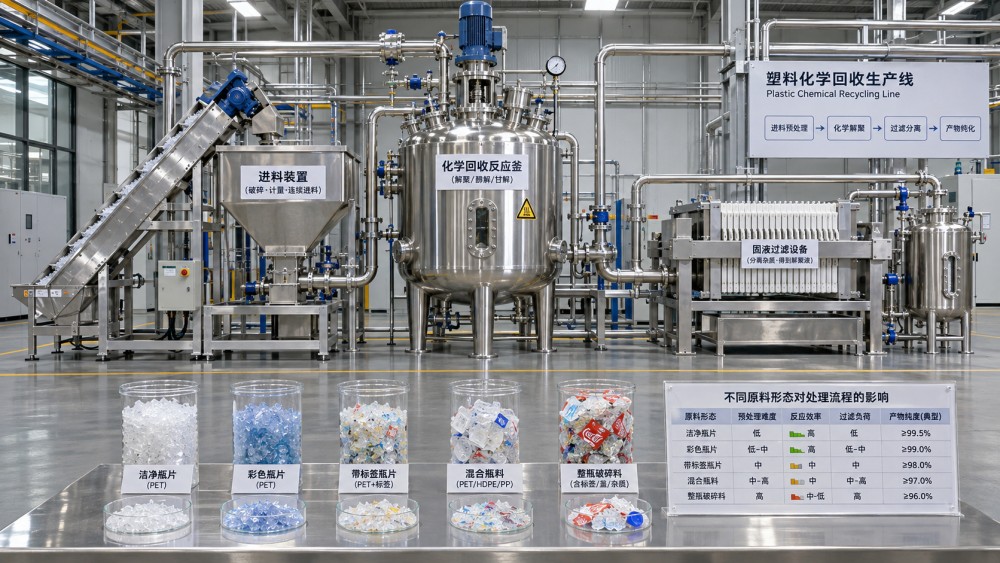
Feedstock characteristics are the starting point for selecting chemical recycling depolymerization equipment. Polymer chemistry determines which reactions are plausible; composition, contamination, moisture and additives determine whether those reactions can be run reliably and whether the products can be recovered economically. A reactor that performs well on clean production scrap may require a very different front end and purification train when fed post-consumer packaging or reinforced engineering plastics.
The practical question is not simply whether a technology can process PET, polyamide or polyurethane. It is whether the complete system can accept the material as delivered, handle its variability and produce an output that has a credible downstream use.
Start with polymer chemistry, not the reactor brochure
Depolymerization routes are usually designed around particular chemical bonds. PET, for example, can be broken down through glycolysis, methanolysis or hydrolysis, with different reactants, operating conditions and recovery requirements. A glycolysis process may target intermediates such as BHET, while hydrolysis can recover terephthalic acid and ethylene glycol. Those product choices affect crystallization, filtration, solvent handling and purification equipment—not just the reactor specification.
Polyamides require a separate assessment. PA6 can be depolymerized toward caprolactam under suitable conditions, but a process demonstrated on PA6 should not automatically be assumed to work equally well on PA66 or a mixed-polyamide stream. Polyurethane waste is more variable still: glycolysis and other routes may recover polyol-containing products, but foams, coatings and adhesives can differ substantially in crosslinking and formulation.
PE and PP are a useful boundary check. They lack the readily cleavable ester bonds found in PET, and their processing commonly involves thermal or catalytic cracking rather than the same type of bond-specific depolymerization. Pyrolysis equipment may be appropriate for a particular polyolefin stream, but its product slate and purification needs should not be compared as though it were a PET-to-monomer system.
Before comparing vendors, define the target product: a monomer, an intermediate, a recovered polyol, a hydrocarbon mixture or something else. “Chemical recycling output” is too broad a specification for equipment selection.
The feedstock label rarely tells the whole story
A bale described as PET may contain bottles, labels, caps, residual liquids, colors and small amounts of other polymers. Polyester textile waste can contain cotton, elastane, dyes and finishes. Multilayer packaging may combine PET with polyolefins, barrier layers, inks and adhesives. Each stream can be mostly the same polymer and still present a different processing problem.
This is where equipment boundaries matter. A supplier may report that its reactor tolerates a certain contaminant, while expecting the customer to remove most of it upstream. Ask whether the quoted feed specification applies to incoming waste, washed flake or a prepared material entering the reactor. Otherwise, two proposals may appear comparable while excluding very different sorting, washing and drying costs.
For multilayer films, identify what happens to every significant layer. A PET-selective reaction may leave other polymers as solids or residues; those materials can affect mixing, clog filters or carry valuable product into the waste stream. The answer depends on the formulation and process, so a trial with representative film is more useful than a generic statement that the system accepts “flexible packaging.”
The same discipline applies to engineering plastics. A glass-fiber-reinforced polyamide is not equivalent to unfilled PA pellets. Fibers, mineral fillers, flame retardants and stabilizers may remain as solids, influence reaction performance or complicate purification. APIM’s materials and processing coverage provides useful context here: formulation is part of the feedstock specification, not a footnote to the resin name.
Pretreatment changes the size and reliability of the whole line
Sorting, size reduction, washing and drying are often treated as auxiliary operations. In a variable waste stream, they may determine whether the reaction section can operate consistently at all. Film can bridge in a hopper; flakes with uneven size can feed inconsistently; residual food or paper can increase fouling and residue loads. The appropriate shredder, feeder and washing system therefore depend on physical form as much as polymer identity.
Moisture requires particular care. It may be an intentional reactant in hydrolysis but an unwanted variable in another route. Wet feed can also affect heat demand, vapor handling and solvent balance. A supplier should state the acceptable moisture range at the relevant battery limit and explain how excursions are detected and managed. Buying a dryer without understanding where and how moisture is measured is an expensive way to leave the underlying uncertainty unresolved.
Particle size presents a similar trade-off. Smaller pieces can improve handling or contact in some systems, but finer grinding consumes energy and may create dust, losses or separation difficulties. The right specification is the one supported by the reactor and feeder design, not simply the smallest particle size a shredder can produce.
A useful comparison is the total preparation required to reach a stable feed window. If one process accepts a wider range of material but needs a more elaborate downstream separation system, the apparent pretreatment saving may move elsewhere in the plant.
Match the reactor and materials of construction to the actual mixture
The reaction mixture may contain molten polymer, solvent, catalyst, dissolved products, suspended solids and gases. Its behavior affects mixing, heat transfer, residence time and discharge. A vessel suitable for a relatively clean liquid feed may struggle with a viscous slurry or accumulating fibers. Continuous operation can offer an attractive production model, but only if feeding, solids removal and cleaning can support sustained operation on the proposed material.
Batch equipment may be easier to isolate and clean between variable feed lots, although changeovers and downtime must be included in capacity calculations. Continuous equipment should be assessed for start-up, shutdown and off-specification events, not just steady-state throughput. In both cases, ask how the supplier has handled fouling in comparable trials and which components are accessible for inspection.
Corrosion and wear are feedstock issues too. Reactants, catalysts, decomposition products and contaminants can affect seals, piping and vessel materials. Abrasive fillers or glass fiber may shorten the life of pumps, valves and separation equipment. Materials of construction should be selected against the complete chemical and solids profile, including cleaning conditions, rather than the polymer alone.
Product recovery can be the deciding factor
A high reported conversion is not the same as a high yield of saleable product. Conversion may describe how much original polymer reacts; the product of interest can still be lost in side reactions, wash streams, residues or purification steps. Compare proposals using a clearly defined mass balance from incoming feed through to recovered product, including any returned solvent and material sent for disposal.
Colorants, additives and degradation products can make purification difficult even when the main reaction works. Depending on the route, the process may need filtration, distillation, crystallization, decolorization or wastewater treatment. Each step has its own utilities, maintenance demands and losses. A product that meets a supplier’s demonstration target may still need further treatment to meet an intended buyer’s specification.
This is particularly relevant when the proposed outlet is a demanding polymer application. Confirm which impurities the downstream customer will test, how frequently product quality must be checked and whether the recovery process can accommodate feed variation without producing excessive off-specification material. Where a buyer has not yet qualified the output, treat the outlet as an open technical and commercial risk.
Build the supplier trial around variation, not a perfect sample
A clean laboratory sample can establish that a reaction is possible. It does not establish that an industrial line will run reliably on a year-round supply. Sampling should reflect the intended sourcing model: separate lots where composition varies by supplier, season, collection method or product format, and document preparation before testing.
Agree on the trial questions before material is shipped. At a minimum, the test plan should identify feed characterization, operating period, product sampling, residue collection and the method used to calculate yield. If the supplier blends or further sorts the sample, that preparation should be recorded and costed as part of the proposed process.
The most revealing supplier discussions often center on these points:
- Which polymer grades and contaminant combinations have actually been tested, and at what scale and duration?
- What feed variability can be tolerated without changing throughput, cleaning frequency or product quality?
- Where do fillers, fibers, labels, additives and unrecovered polymer leave the process, and how are those streams handled?
- Are energy, reactant consumption and yields reported for the reactor alone or for the complete preparation and recovery system?
- What evidence supports the proposed maintenance interval, and what happens when the feed falls outside specification?
Ask for results on an agreed feed basis and distinguish measured trial outcomes from projections. A short pilot run can reveal reaction behavior and separation problems, but it may not expose long-term corrosion, gradual fouling or seasonal variability. Those uncertainties should remain visible in the engineering and commercial assessment.
Make the decision at the system boundary
The best equipment choice is not necessarily the process with the broadest claimed feed tolerance or the highest quoted reactor throughput. It is the configuration that can be supplied with a realistic feed, operated within a defensible window and connected to a product outlet with defined quality requirements.
Before selecting a supplier, put the feed specification, pretreatment assumptions, mass balance, utility requirements and product specification on the same comparison sheet. Include residues and planned downtime. If a proposal depends on exceptionally clean material, verify that the supply chain can deliver it consistently; if it accepts a dirtier stream, verify where the additional separation burden appears. That is often where the meaningful difference between two depolymerization projects becomes visible.
Have questions about this sector analysis, or seeking best practices specific to your niche? Drop us a line below and let the senior consultants at APIM assist you.
We respect your privacy. Your information is strictly confidential.
Related News
- 00
0000-00
How does feedstock affect depolymerization equipment selection? - 00
0000-00
US Sets 213.44% Preliminary Antidumping Deposit on Chinese PTMEG - 00
0000-00
When should epoxy be used as a thermal interface material for semiconductors? - 00
0000-00
US Midterm Results Unlikely to Quickly Shift Recycled Plastics Market or Legislation - 00
0000-00
When should you choose carbon fiber over glass fiber composites for lightweight parts?