




How to choose a low outgassing plastics supplier for vacuum parts
Choosing a low outgassing plastics supplier for vacuum parts is rarely a simple sourcing exercise. In vacuum systems, even a small amount of residual volatiles can become a contamination source, affecting pumps, sensors, optics, seals, and long-term process stability. For technical evaluators, the real question is not just “who can supply the resin?” but “who can consistently supply parts that behave cleanly in a vacuum environment?”
That distinction matters because vacuum parts often sit in conditions that expose weak material control very quickly: heat cycling, pressure changes, long dwell times, and strict cleanliness requirements. A supplier may look capable on paper, yet still fall short if compounding is inconsistent, drying is poorly controlled, or test data is incomplete. The supplier you choose should reduce uncertainty, not add to it.
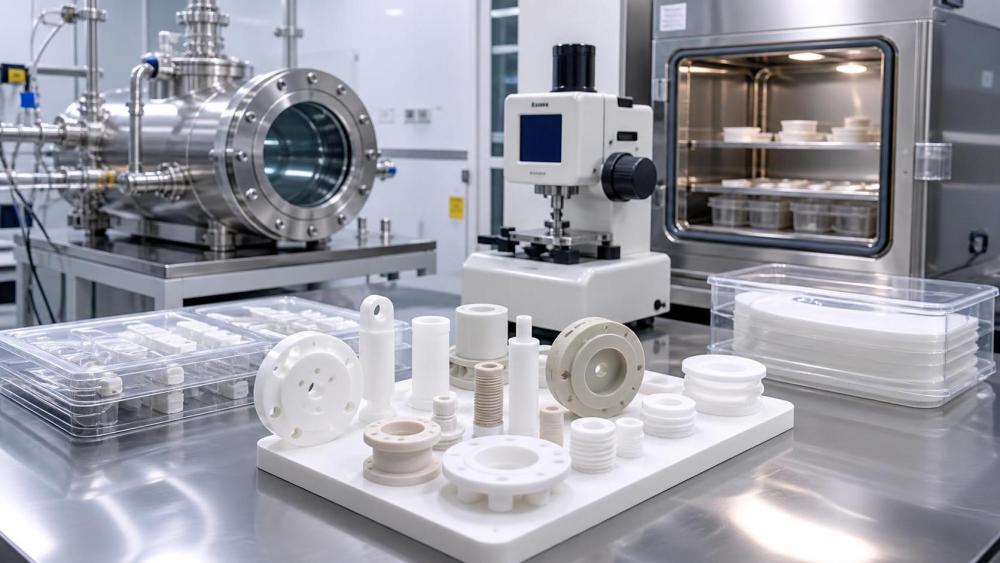
What “low outgassing” really means in practice
Low outgassing plastics are materials formulated and processed to release very small amounts of volatile substances under vacuum. That sounds straightforward, but the supplier side is where the real variation appears. Two parts made from the same base polymer can behave differently depending on additives, fillers, moisture history, processing temperature, and contamination during handling.
For vacuum parts, the supplier should be able to explain more than resin family names like PEEK, PPS, PTFE, PA, or high-performance blends. They should understand how molecular cleanliness, thermal stability, surface preparation, and post-processing affect the final part. If the conversation stays at the level of generic “high performance plastic,” that is usually a warning sign.
Start with the material system, not the sales claim
When reviewing a low outgassing plastics supplier, begin by asking how they select and modify materials for vacuum service. Some applications need unfilled polymers because fillers may increase variability or trap moisture. Others may accept carefully engineered compounds if dimensional stability or wear resistance is critical. The right answer depends on the part geometry, operating temperature, and the cleanliness threshold of the system.
A reliable supplier should be able to discuss whether the application is better served by virgin resin, a modified compound, or a reinforced grade. They should also be able to explain the trade-off between mechanical performance and contamination risk. In vacuum applications, “stronger” is not automatically “better.”
Review processing control as seriously as the material
Vacuum performance is influenced heavily by extrusion and molding discipline. Even a suitable resin can become problematic if residence time is too long, temperature control is unstable, or drying is incomplete. That is why technical evaluators should ask about compounding lines, vacuum degassing systems, filtration, pellet cleanliness, and moisture control before they ask for a quote.
Pay special attention to the supplier’s approach to batch consistency. If the same part must perform reliably over long production runs, then variation in additive loading or processing history can become a real issue. A strong supplier will treat process stability as part of the product, not as an internal manufacturing detail too small to discuss.
Ask for test data, but read it carefully
Many suppliers say their materials are “vacuum compatible” or “low outgassing,” but those phrases mean little without supporting evidence. Request relevant test information such as total mass loss, collected volatile condensable materials, moisture behavior, and any application-specific cleanliness data. If the supplier has data from internal testing, ask how the samples were prepared, conditioned, and measured.
The most useful suppliers are transparent about test scope and limitations. They do not hide behind a single label or a selective result. Instead, they help you understand how the material behaves under conditions similar to your actual use case. That kind of openness saves time during qualification and reduces surprises later.
Also check whether their testing reflects the part, not only the resin. A vacuum part can fail qualification because of machining residue, molding release agents, packaging contamination, or storage exposure. Supplier discipline across the full chain matters.
Look at upstream cleanliness and downstream handling
In vacuum environments, contamination is often introduced long before the part reaches the system. Resin storage, drying equipment, tooling maintenance, cutting fluids, packaging materials, and warehouse conditions all influence final cleanliness. A dependable low outgassing plastics supplier should be able to describe how they control these variables.
For machined vacuum parts, ask whether they have a clean handling workflow after machining. For molded parts, ask about mold release practices and post-mold conditioning. For compounded materials, ask whether the supplier uses dedicated lines or runs vacuum-grade materials alongside more general industrial grades. Cross-contamination risk is easy to underestimate until it becomes a field issue.
Engineering support is often the real differentiator
Technical buyers do not only need a supplier; they need a partner who can help narrow down choices. Good suppliers can suggest whether to prioritize low outgassing, thermal resistance, dimensional stability, or abrasion resistance based on the part’s actual role in the system. That guidance is especially useful for vacuum chambers, insulation components, spacers, support blocks, connector housings, and precision fixtures.
When a supplier understands the application context, they can also flag risks early. For example, a resin that performs well mechanically may still be unsuitable if it absorbs moisture too readily or needs a processing window that is too narrow for stable production. These are the kinds of issues that only come out during serious technical discussions.
Typical red flags during supplier evaluation
Some warning signs show up quickly. The supplier is vague about test methods. They cannot explain additive packages. They avoid questions about drying or contamination control. They offer the same recommendation for every vacuum application. Or they speak confidently but cannot provide clean, traceable technical documentation.
Another common issue is overpromising on universal suitability. Vacuum systems vary widely, and no single plastic is ideal for every environment. A serious supplier will ask follow-up questions before making recommendations. That curiosity is usually a better sign than instant certainty.
A practical way to compare suppliers
Instead of comparing suppliers only by price or resin name, evaluate them across four dimensions: material integrity, process control, test transparency, and application understanding. If one of those areas is weak, the risk often appears later in qualification, not during the initial purchase.
For teams working across multiple product lines, it also helps to build a supplier shortlist by application class. A supplier that is strong in general engineering plastics may not be the best fit for ultra-clean vacuum parts. On the other hand, a supplier with deep experience in high-performance polymers, modified compounds, and controlled extrusion may be better positioned to support demanding programs.
The goal is not to find the “best” supplier in the abstract. It is to find the supplier whose material discipline matches the sensitivity of your vacuum system.
In that sense, choosing a low outgassing plastics supplier is really a risk-management decision. The right partner makes contamination control easier, supports stable production, and gives engineers more confidence when a part must perform quietly and reliably in a demanding environment.
Have questions about this sector analysis, or seeking best practices specific to your niche? Drop us a line below and let the senior consultants at APIM assist you.
We respect your privacy. Your information is strictly confidential.
Related News
- 00
0000-00
Do polyolefin hot melt adhesives bond well to polyethylene? - 00
0000-00
Korean Study Finds PLA Barely Degrades in Landfill After 320 Days - 00
0000-00
How to assess batch consistency from a thermal potting compounds supplier - 00
0000-00
How much weight can carbon fiber reinforced plastics save in cars? - 00
0000-00
Switching from PS to ABS Sheet Extrusion: Equipment Checks