




Which anti fingerprint display film materials retain clarity after wear?
Selecting anti fingerprint display film materials is not a matter of choosing the surface with the highest initial water contact angle or the lowest visible smudge level. For a display that will be touched, wiped, pocketed, mounted in a vehicle, or used in an industrial environment, the more important question is what happens after the surface has been mechanically and chemically stressed.
A film may look exceptionally clear when new but develop haze, gloss non-uniformity, fine scratches, or uneven fingerprint resistance after repeated cleaning and abrasion. In many display programs, the visible failure is not total coating loss. It is a gradual change in surface appearance: local shiny areas on a matte film, rainbow-like reflections, smudge contrast that becomes more obvious under angled light, or a decline in touch smoothness before the underlying substrate has visibly failed.
For technical evaluation, the most durable anti fingerprint display film materials are usually not defined by one polymer alone. They are systems combining a dimensionally stable optical substrate, a hardcoat with adequate abrasion resistance and flexibility, and a low-surface-energy topcoat that remains anchored after wear. The balance between these layers determines whether optical clarity is retained in real use.
Clarity after wear is a system-level property
Anti-fingerprint performance is generally created by lowering the surface energy of the display-facing layer. Oils from skin then spread less readily, are easier to wipe away, and leave less visible residue. Fluorinated surface chemistries have historically been effective for this purpose, while silicone-based and non-fluorinated low-energy chemistries are also used, particularly where supply-chain, environmental, or formulation considerations affect material choice.
However, anti-fingerprint chemistry is normally very thin. It cannot independently withstand substantial abrasion. Its durability depends on how well it is chemically bonded, crosslinked, or otherwise integrated with a harder underlying coating. A durable film therefore has at least three relevant functions:
- an optical substrate that provides transparency, dimensional stability, and processability;
- a hardcoat that resists micro-scratching and protects the substrate;
- an anti-smudge top layer that preserves easy-clean behavior and desirable touch feel.
When evaluators compare samples only at time zero, they may select a film with excellent initial fingerprint repellency but poor retention. The more revealing comparison is the relationship between abrasion exposure and changes in haze, gloss, transmission, surface friction, water or oil repellency, and fingerprint visibility.
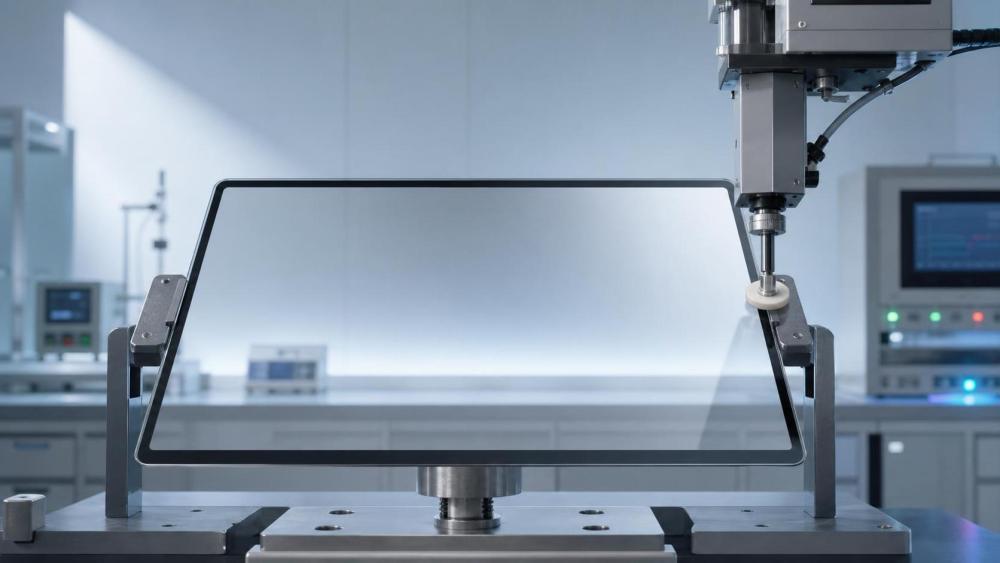
Hard-coated PET remains the reference material for many flat displays
For conventional flat display protection films, hard-coated polyethylene terephthalate (PET) remains one of the most broadly practical material platforms. Optical-grade PET offers high light transmission, established roll-to-roll coating compatibility, comparatively predictable dimensional behavior, and a mature supply base. It is widely used in consumer electronics, appliance interfaces, point-of-sale equipment, industrial controls, and some automotive display assemblies.
Its limitation is that uncoated PET scratches relatively easily. Clear retention after wear therefore depends heavily on the hardcoat. UV-cured acrylate hardcoats, often containing inorganic or organic-inorganic hybrid components, are common because they can improve pencil hardness and abrasion resistance without requiring a thick coating that compromises flexibility.
A well-designed hard-coated PET film with a durable anti-fingerprint top layer can retain good transparency after repeated cleaning and moderate touch abrasion. It is especially suitable when the surface remains protected by cover glass, or when the film itself is not exposed to severe particulate abrasion. In these cases, PET offers an attractive balance of optical performance, converting efficiency, and cost.
The weakness appears in demanding exposed-film applications. If the display surface is routinely contacted with contaminated gloves, exposed to sand or metal dust, cleaned aggressively, or installed where temperature cycling is severe, standard PET hardcoat systems can show progressive micro-scratch haze. A high initial hardness value alone does not eliminate this risk. Very rigid hardcoats may crack or lose adhesion under bending, edge stress, or thermal cycling.
Optically clear hardcoat films outperform basic PET when wear is the main concern
For applications requiring a visibly cleaner surface after prolonged use, the most reliable option is often an optical PET or similar clear substrate carrying a multifunctional hardcoat rather than a basic anti-fingerprint overcoat. Hybrid hardcoats based on acrylic, siloxane, urethane-acrylate, or inorganic-organic network chemistries can be engineered to improve scratch resistance while maintaining adhesion and some flex tolerance.
The useful distinction is between “hard” and “wear-stable.” A coating can pass a short hardness or pencil-scratch screening test and still become optically degraded during repeated sliding contact. Human touch introduces oils, moisture, variable pressure, and fine particles. Cleaning adds surfactants, alcohols, cloth fibers, and occasionally stronger chemicals. A robust coating must resist both physical damage and chemical changes at the surface.
Hardcoat systems with well-dispersed nanoscale inorganic components can provide better scratch resistance than purely organic coatings. Yet dispersion quality is critical. Agglomerates, coating defects, or particle-size mismatch can create haze, sparkle, or local optical distortion even before abrasion testing begins. For high-resolution displays, a technically strong abrasion result is not enough if the film adds visible grain or degrades black-state appearance.
These films are generally the strongest candidates for handheld electronics, premium appliance displays, medical device interfaces, and high-use industrial touch panels, provided the coating is validated with the intended adhesive, cover lens, printing system, and lamination process.
Anti-glare and anti-fingerprint surfaces require a different trade-off
Many projects combine anti-fingerprint functionality with anti-glare performance. This is often necessary in vehicle cockpits, outdoor terminals, office displays, factory HMIs, and retail equipment. Yet anti-glare texture is one of the main reasons a surface may lose perceived clarity after wear.
Anti-glare surfaces reduce specular reflection through controlled surface roughness or light-scattering structures. That texture can reduce mirror-like reflections, but it also introduces haze and can reduce contrast. When the highest points of the texture are worn down, the surface may become non-uniform: frequently touched zones become glossier, while untouched zones remain matte. The resulting “polished spot” can be more objectionable than uniform fingerprinting.
For this reason, an anti-glare anti-fingerprint film should not be assessed solely by initial haze and gloss targets. Technical teams should examine whether gloss changes locally after simulated finger rubbing, cleaning cycles, and abrasion. A low-haze fine-texture surface may preserve display sharpness better than a heavily textured matte surface, but it can be less forgiving of wear. A coarser texture may hide surface damage more effectively while reducing image crispness.
In applications where image quality is central, such as navigation displays or high-pixel-density consumer devices, fine anti-glare texture combined with a durable low-energy topcoat is usually preferable to aggressive matte embossing. In industrial outdoor displays, a somewhat higher haze level may be justified if it produces more stable glare control and fewer visible wear zones.
Cyclo-olefin and acrylic films have specific optical roles
Cyclo-olefin polymer and cyclo-olefin copolymer films are valued in some optical applications for low birefringence, low moisture absorption, and good optical clarity. Their use can be attractive where optical uniformity, low retardation, or reduced sensitivity to humidity is important. They can serve as substrates for hardcoat and anti-fingerprint layers, although their suitability depends on coating adhesion, thermal requirements, and the chosen lamination process.
Compared with commodity optical PET, cyclo-olefin-based films may offer advantages in specialized display constructions, but they are not automatically the best answer for exposed-surface durability. Their practical value depends on whether the hardcoat bonds reliably and whether the system can be processed without distortion. Cost, availability, qualification history, and converter capability also need to be considered.
Polymethyl methacrylate (PMMA) films and sheets provide excellent inherent optical clarity and can be attractive in decorative or rigid display cover applications. However, PMMA is relatively vulnerable to scratching unless protected by a suitable hardcoat. It can also be sensitive to stress cracking under certain chemical exposures. For a surface expected to receive frequent cleaning, PMMA should be evaluated with the exact cleaning agents and assembly stresses rather than assumed to be durable because of its high gloss and initial transparency.
Polycarbonate (PC) offers impact resistance and is widely used for formed or ruggedized display windows. Its natural scratch resistance is lower than that of glass, and it relies heavily on hardcoating for exposed surfaces. Hard-coated PC can work well in shaped components, instrument clusters, and industrial enclosures, but thermal expansion, coating flexibility, and chemical compatibility deserve more attention than in a flat PET construction. A hardcoat that performs well on PET may not transfer directly to PC without adhesion or forming-related compromises.
Glass-like coatings offer abrasion benefits but can introduce brittleness
Sol-gel-derived, silica-rich, and other inorganic-organic hardcoat technologies are often selected when micro-scratch resistance and clarity retention are priorities. These systems can create a denser, more glass-like surface than conventional organic coatings. In a suitable multilayer design, they can preserve optical appearance better under repeated wiping and fine-particle abrasion.
The trade-off is brittleness. A highly inorganic coating can crack when applied to a flexible substrate, when the film is bent during converting, or when assembled over a contour. Cracking may begin at cut edges or locations of local strain and may only become visible after thermal-humidity exposure. Therefore, a coating optimized for a rigid touch-panel cover may be unsuitable for flexible films, curved displays, or post-forming processes.
For flat and rigid display constructions, silica-modified hardcoats with a durable anti-fingerprint layer are among the more credible choices where long-term clarity matters. For flexible or foldable constructions, a more elastic hardcoat system usually provides better practical durability, even if its laboratory scratch rating is lower.
Flexible and foldable displays need elastic recovery, not maximum hardness
In flexible displays, the conventional goal of maximizing surface hardness can be misleading. Repeated folding subjects the surface stack to tensile and compressive strain. A coating that resists abrasion but cannot accommodate strain may craze, delaminate, or develop optical defects along the bending zone.
Thermoplastic polyurethane (TPU), colorless polyimide (CPI), and other flexible optical film platforms may be used where bendability is necessary. Their anti-fingerprint performance depends on elastic hardcoats or topcoat architectures designed to recover after deformation. The surface may not match the scratch resistance of rigid glass or a highly mineralized hardcoat, but it can retain functional clarity better over a realistic folding life.
Evaluation should include bend cycling at the actual radius, followed by anti-fingerprint and optical measurements. Testing a flat specimen only before folding does not reveal whether the low-surface-energy layer will survive strain. Crease-zone gloss, haze, coating continuity, and touch friction should all be monitored.
How to evaluate clarity retention without relying on a single test
There is no universal pass/fail sequence that fully represents every display application. Taber abrasion methods, including those described in ASTM D1044 for transparent plastics, can provide useful comparative information, but wheel type, load, cycle count, specimen mounting, and cleaning condition strongly affect outcomes. Steel-wool rub tests are common in development and supplier qualification, but they are particularly sensitive to grade, load, motion, and operator or equipment setup.
A credible evaluation plan should combine several measurements rather than treat one abrasion number as decisive:
- Optical transmission and haze: Measure before and after abrasion, cleaning, and environmental exposure. Absolute haze matters, but the change in haze often better indicates field-aging risk.
- Gloss and local gloss mapping: This is particularly important for anti-glare surfaces, where localized polishing may be the dominant visual failure.
- Fingerprint visibility: Assess deposited artificial sebum or controlled touch marks under specified lighting and viewing angles. Water contact angle alone does not measure visible smudge contrast.
- Cleanability: Record the wiping force, number of wipes, cloth type, and residual streaking after cleaning. A surface can repel water yet still show oily streaks.
- Coefficient of friction or subjective touch glide: Changes in finger drag may indicate topcoat loss before obvious visual failure appears.
- Adhesion and coating integrity: Check after heat, humidity, thermal cycling, and chemical exposure, especially near edges and printed areas.
Cleaning chemistry should be defined early. Isopropyl alcohol, diluted detergent, glass cleaner, hand sanitizer residues, sunscreen, skin-care oils, and vehicle interior cleaners can produce very different results. A material that performs well in a consumer device may fail prematurely in a hospital, factory, or automotive environment because the cleaning regime is fundamentally different.
Common selection mistakes that lead to premature visual failure
One frequent mistake is specifying only an initial contact angle. This is useful for quality control, but it does not confirm abrasion durability, fingerprint visibility, or chemical resistance. Another is requiring maximum pencil hardness without considering bend radius, impact exposure, or thermal expansion mismatch.
It is also risky to compare films with different anti-glare levels using only haze data. A low-haze film may deliver sharper images initially but develop more visible polished zones after use. Conversely, a higher-haze matte film may maintain a more uniform appearance while compromising contrast from the start. The acceptable balance depends on display brightness, pixel density, lighting geometry, and user viewing distance.
Finally, qualification should include the converted part, not only the supplied roll. Die-cutting, laser processing, printing, adhesive lamination, thermoforming, and protective-liner removal can change surface stress or contaminate the coating. A film that performs well in supplier samples can behave differently after assembly.
Material choice by service condition
The most defensible selection is rarely the film with the best isolated specification. It is the surface system that maintains acceptable haze, gloss uniformity, cleanability, and touch behavior after a test sequence that reflects actual handling, contamination, cleaning, temperature, and mechanical stress. For most exposed flat displays, durable hybrid hard-coated PET remains the practical baseline. Where optical precision, extreme abrasion, curvature, or repeated flexing changes the requirement, substrate choice and coating elasticity become as important as anti-fingerprint chemistry itself.
Have questions about this sector analysis, or seeking best practices specific to your niche? Drop us a line below and let the senior consultants at APIM assist you.
We respect your privacy. Your information is strictly confidential.
Related News
- 00
0000-00
Do polyolefin hot melt adhesives bond well to polyethylene? - 00
0000-00
Korean Study Finds PLA Barely Degrades in Landfill After 320 Days - 00
0000-00
How to assess batch consistency from a thermal potting compounds supplier - 00
0000-00
How much weight can carbon fiber reinforced plastics save in cars? - 00
0000-00
Switching from PS to ABS Sheet Extrusion: Equipment Checks