




Which Protective Films Resist Chemical Solvents Without Damage?
Yes. Protective films can resist chemical solvents without visible damage, swelling, loss of adhesion, or surface haze, but no film is resistant to every solvent under every condition. The right choice depends on the solvent family, contact time, temperature, mechanical stress, and whether the film must remain removable, optically clear, electrically insulating, or permanently bonded.
This matters because a film that survives a brief wipe with isopropyl alcohol may fail during repeated exposure to ketones, aromatic solvents, fuel components, aggressive cleaning agents, or hot chemical splashes. In many failures, the film substrate is only part of the problem. The adhesive layer, printed surface, edge seal, or protective topcoat fails first.
Which film materials offer the strongest solvent resistance?
For demanding industrial use, fluoropolymer films are usually the first material family to consider. Films based on PTFE, FEP, PFA, or ETFE are valued for their broad chemical inertness. They are commonly considered where surfaces encounter aggressive cleaning chemicals, acids, bases, fuels, process liquids, or repeated solvent contact. Their limitations are practical rather than purely chemical: they can be more expensive, may be difficult to bond, and may not provide the optical finish, conformability, or removable adhesion required by a temporary protective application.
Polyimide film is another strong option when solvent exposure occurs alongside elevated temperature. It is widely used in electronics, insulation, masking, and high-temperature processing. Polyimide can tolerate many industrial chemicals, but its performance still depends on the specific solvent and adhesive system. A polyimide backing with a standard adhesive should not automatically be treated as a fully solvent-resistant construction.
Polyester, especially PET film, is often a practical middle-ground choice. It offers good dimensional stability, clarity, and resistance to many oils, mild cleaners, and some alcohol-based chemicals. PET is frequently used for surface protection, labels, display layers, release liners, and industrial laminates. However, strong alkaline solutions, some chlorinated solvents, and certain ketones can create problems depending on exposure duration and temperature.
Polypropylene and polyethylene films may be suitable for moisture, dilute acids, dilute alkalis, and many water-based chemicals. They are useful where flexibility and low cost matter, such as temporary protection, packaging-related handling, or broad-area coverage. Their weakness is that some organic solvents can cause swelling, stress cracking, softening, or loss of surface performance. They also have lower heat resistance than PET, polyimide, and fluoropolymer films.
PVC films can provide useful resistance to some acids, alkalis, and oils, particularly in flexible protective applications. Yet plasticizer migration, temperature exposure, and contact with certain solvents may affect appearance or mechanical integrity. PVC is therefore a material to assess carefully for long-duration chemical contact rather than a universal solvent barrier.
The solvent is not the only chemical exposure to define
A material request that simply says “solvent-resistant protective film” is incomplete. The chemistry must be identified with enough precision to make a useful selection. “Alcohol” could mean occasional contact with an alcohol-based cleaner or repeated exposure to a concentrated alcohol blend. “Paint solvent” may include ketones, esters, aromatic hydrocarbons, or mixed proprietary formulations with very different effects on film and adhesive layers.
Ask for the chemical name or safety data sheet, then define how contact occurs. Is the surface wiped once per shift? Is the film exposed to vapor? Does liquid pool around edges? Is the component immersed? Does the solvent remain on the film for minutes, hours, or days? These conditions change the result even when the same film is used.
Temperature is equally important. A film that remains stable during room-temperature cleaning may soften, curl, discolor, or lose adhesion when the same chemical is used on a warm production line. Mechanical pressure also matters. Solvent can soften a surface, while abrasion, flexing, or part movement then turns minor chemical attack into cracking or delamination.
Why adhesive failure is often mistaken for film failure
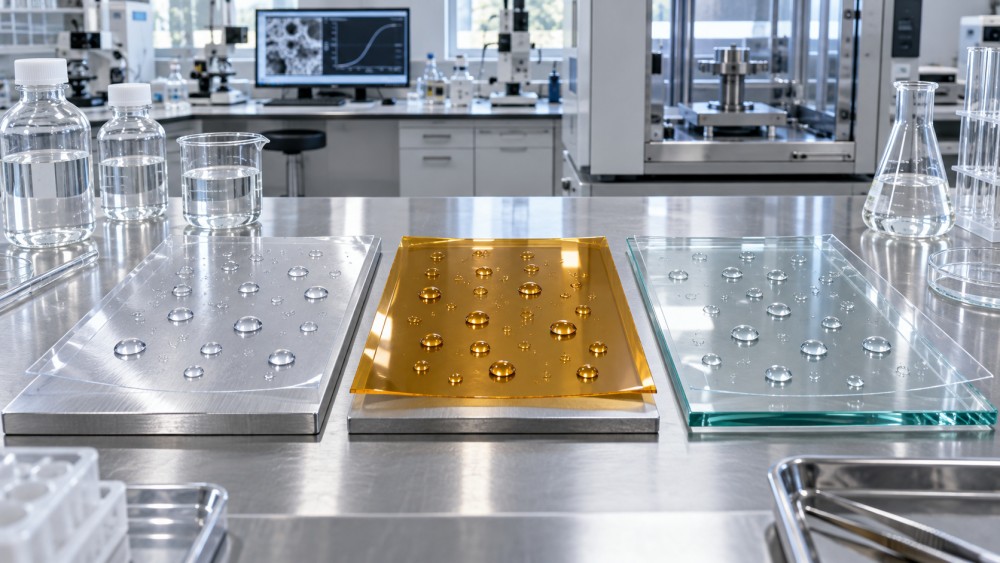
Many protective films are multilayer constructions: a functional face film, a primer or coating, an adhesive, and a release liner. Chemical resistance claims must apply to the complete construction, not just the base polymer.
A PET or polyimide face film may remain visually intact while the pressure-sensitive adhesive softens, bleeds at the edge, becomes brittle, or leaves residue after removal. In other cases, solvent travels through an unsealed edge and attacks the adhesive from underneath. The protective layer then lifts even though the visible film has not dissolved.
For temporary protection, removable acrylic or rubber-based adhesives can be convenient during assembly and transport, but solvent contact can alter removal behavior. Silicone adhesives are often selected for temperature performance and difficult-to-bond surfaces, yet they also require chemical compatibility review. For permanent protection, a laminated barrier layer, chemically resistant coating, or mechanically retained film may be more appropriate than relying on an exposed pressure-sensitive adhesive.
Printing, surface treatments, and hard coats deserve the same scrutiny. A clear protective film may resist a solvent while its matte coating turns glossy, an anti-fingerprint treatment loses function, or printed identification becomes unreadable. When appearance, traceability, or optical clarity matters, specify the entire exposed surface system.
How to choose a solvent-resistant protective film for the actual job
Start with the protected substrate, not only the film. Painted metal, anodized aluminum, coated glass, polycarbonate, acrylic, electronic displays, and textured plastics can react differently when trapped solvent sits beneath a film. A chemically resistant film that leaves adhesive residue or damages a sensitive coating has not solved the application problem.
- Identify the solvent or chemical mixture. Include cleaners, process fluids, oils, inks, fuels, disinfectants, and any chemical vapor that may be present.
- Define exposure severity. Record concentration, temperature, contact time, frequency, splash versus immersion, and whether abrasion occurs during exposure.
- Decide what “without damage” means. It may mean no cracking, no haze, no color change, no loss of adhesion, no residue after removal, or no impact on an optical or electrical function.
- Assess the complete film construction. Review backing film, coating, adhesive, edge behavior, printing, and removal method.
- Test on the real substrate. A short material compatibility check is more useful when it reflects the production process, cleaning cycle, dwell time, temperature, and removal requirements.
Thickness should be selected for the job rather than treated as a simple measure of resistance. A thicker film may improve puncture resistance and slow solvent permeation, but it can be harder to conform around corners, recesses, and tight radii. Thick films can also create lifting at edges when applied over textured surfaces. In contrast, a thin film may conform well but offer less protection against abrasion or mechanical impact.
Common selection mistakes
The most common mistake is choosing from a generic “chemical-resistant” description. This term may refer to resistance against water-based cleaners, oils, weak acids, or short-term alcohol wiping. It does not establish performance against acetone, methyl ethyl ketone, toluene, xylene, chlorinated solvents, strong alkaline wash solutions, or mixed industrial cleaners.
Another mistake is relying on a brief visual check. A film may look unchanged immediately after exposure but later develop stress whitening, curl, adhesive migration, cracking, or reduced peel strength. Long-term service conditions should be considered when the film is expected to remain in place through transport, storage, curing, cleaning, or repeated use.
Edge design is often overlooked. Flat laboratory coupons do not reproduce real parts with cutouts, seams, deep draws, sharp corners, or exposed edges. If chemicals can collect along an edge, the application may need overlap, sealed margins, a formed cover, or a different protection method.
It is also risky to assume that a high-performance polymer will make the whole assembly robust. A fluoropolymer top layer paired with an unsuitable adhesive can still fail. The supplier discussion should focus on the finished construction and the actual exposure sequence.
When a film may not be the right protective solution
Protective films are useful when the goal is to preserve a surface during processing, assembly, transport, cleaning, or controlled chemical exposure. They are less suitable when the part faces continuous immersion, high-pressure solvent spray, severe abrasion in a wet environment, or repeated exposure to chemicals that undermine the adhesive or penetrate exposed edges.
In those conditions, consider whether a durable coating, molded fluoropolymer component, laminated chemical barrier, replaceable mechanical cover, or change in equipment design provides a more reliable answer. The best solution may protect the component by preventing chemical contact rather than asking a removable surface film to perform as a permanent barrier.
Questions worth asking before requesting samples
Engineering and procurement teams can avoid unproductive sample rounds by providing a clear application brief: chemical list, contact method, operating temperature, expected service duration, substrate type, part geometry, optical requirements, surface finish, adhesive requirement, and removal expectations. Suppliers can then narrow the choices between PET-based laminates, polyimide constructions, fluoropolymer films, coated films, and specialized adhesive systems.
For complex applications, a structured materials review is useful because film performance is tied to polymer chemistry, coating design, adhesive behavior, converting quality, and processing conditions. APIM’s coverage of specialty films, industrial adhesives, and high-performance polymer applications can help teams frame these comparisons around service conditions rather than broad material labels.
Frequently asked questions
Can a standard clear protective film resist acetone?
Usually, this should not be assumed. Many common clear protective films and their adhesives can haze, soften, swell, or lose adhesion when exposed to acetone. A chemically resistant construction selected specifically for acetone exposure is needed.
Is PET film resistant to isopropyl alcohol?
PET often performs well with routine alcohol-based wiping, especially at moderate temperature and short contact times. The adhesive, coating, printed layer, and frequency of cleaning still need to match the application.
Does a thicker protective film always resist solvents better?
No. Thickness can improve physical durability and delay chemical penetration, but it does not change the base polymer’s chemical compatibility. A thicker incompatible film can still fail, while a thinner compatible film may perform better.
Can solvent-resistant film be removed cleanly after use?
It can, but clean removal depends mainly on the adhesive, substrate condition, temperature, dwell time, and chemical exposure. This requirement should be tested alongside solvent resistance, not treated as a separate issue.
The practical answer is that protective films do exist for demanding solvent environments, especially fluoropolymer, polyimide, and purpose-designed coated film constructions. Select them based on the exact chemical exposure and the full multilayer system. A film that survives the solvent but damages the protected surface, loses its adhesive, or cannot be removed as required is not the right protective solution.
Have questions about this sector analysis, or seeking best practices specific to your niche? Drop us a line below and let the senior consultants at APIM assist you.
We respect your privacy. Your information is strictly confidential.
Related News
- 00
0000-00
Do polyolefin hot melt adhesives bond well to polyethylene? - 00
0000-00
Korean Study Finds PLA Barely Degrades in Landfill After 320 Days - 00
0000-00
How to assess batch consistency from a thermal potting compounds supplier - 00
0000-00
How much weight can carbon fiber reinforced plastics save in cars? - 00
0000-00
Switching from PS to ABS Sheet Extrusion: Equipment Checks