




What matters most when selecting specialty film materials for displays
In display development, film selection rarely fails in obvious ways at the beginning. A sample may look clear on the bench, pass an initial visual check, and even run through lamination without drama. Problems tend to appear later: haze becomes noticeable under angled light, surface scratches show up after assembly, curl disrupts registration, or thermal cycling reveals dimensional movement that was not visible in prototype builds. That is why selecting specialty film materials for displays is less about finding a film that looks acceptable in a datasheet and more about understanding how the material behaves across the entire product and process window.
For technical evaluation teams, the real task is to connect film properties with application risk. A display film may serve as an optical layer, protective surface, carrier, diffuser, release interface, hard-coated outer layer, or structural substrate. Each role changes what “good” means. In one project, clarity is the main concern. In another, the film must survive heat, adhesive contact, die-cutting stress, and long-term exposure without losing flatness or surface quality. The best choice comes from matching material behavior to actual use conditions, not from chasing one headline property.
When teams compare specialty film materials for displays, five areas usually matter most: optical performance, surface functionality, dimensional and thermal stability, converting compatibility, and supply consistency. These are interconnected. Improving one attribute can create trade-offs elsewhere, so evaluation should be practical rather than purely theoretical.
Optical performance is more than transparency
Display projects often begin with light transmission, haze, and clarity. Those metrics are essential, but they do not tell the full story. A film can show high transmission in a technical sheet and still create visual issues in a real display stack. Reflection behavior, birefringence, gloss level, color neutrality, and surface uniformity can influence the final appearance just as much as nominal transparency.
For example, in touch displays, cover films and optical layers must maintain image sharpness while minimizing distortion from multiple bonded interfaces. In backlit systems, diffusion and light management films need controlled scattering rather than simple clearness. In automotive interiors or premium electronics, low haze alone is not enough; engineers may also need to check how the film behaves under directional lighting, dark backgrounds, and curved assemblies.
Evaluation should therefore move beyond single-point lab values. Teams should ask:
- Does the film maintain optical uniformity across width and lot?
- Is there visible color shift under different viewing angles?
- How does the film interact with coatings, adhesives, and neighboring substrates?
- Does thickness variation affect display brightness or lamination appearance?
Common display-related films such as PET, PC, PMMA-based films, and coated multilayer constructions can all meet optical targets in different ways. The choice depends on whether the application values rigidity, impact resistance, heat resistance, polish, or process economy. A technically attractive material may still be a poor fit if its optical behavior changes after coating, embossing, or curing.
Surface performance often determines user perception
Many display failures are not optical in the strict sense. They are surface failures that users notice immediately: scratches, fingerprints, abrasion marks, inconsistent texture, poor anti-glare effect, or coating delamination. In practical selection work, surface properties deserve the same weight as base film properties.
Hard coating is one obvious factor. If the display layer is exposed to repeated touch, cleaning, or assembly handling, surface hardness and abrasion resistance become critical. But hardness alone is not the target. A very hard surface that cracks during bending or converting may be less useful than a balanced system with moderate hardness and better toughness.
Surface energy matters as well. It influences printability, coating adhesion, adhesive bonding, and contamination sensitivity. Corona-treated, chemically treated, and primer-coated films may behave very differently over storage time. A technically qualified film can become difficult in production if treatment decay reduces bond consistency.
Texture is another decision point. Matte, anti-glare, velvet-touch, and high-gloss surfaces each change both user experience and downstream process behavior. A textured film may reduce reflections but also complicate optical bonding. A glossy film may enhance image depth but show every scratch and fingerprint.
For technical teams, this is where lab testing should resemble real use. Taber abrasion, pencil hardness, adhesion checks, chemical wipe resistance, and handling trials are more informative when combined with actual assembly conditions rather than evaluated in isolation.
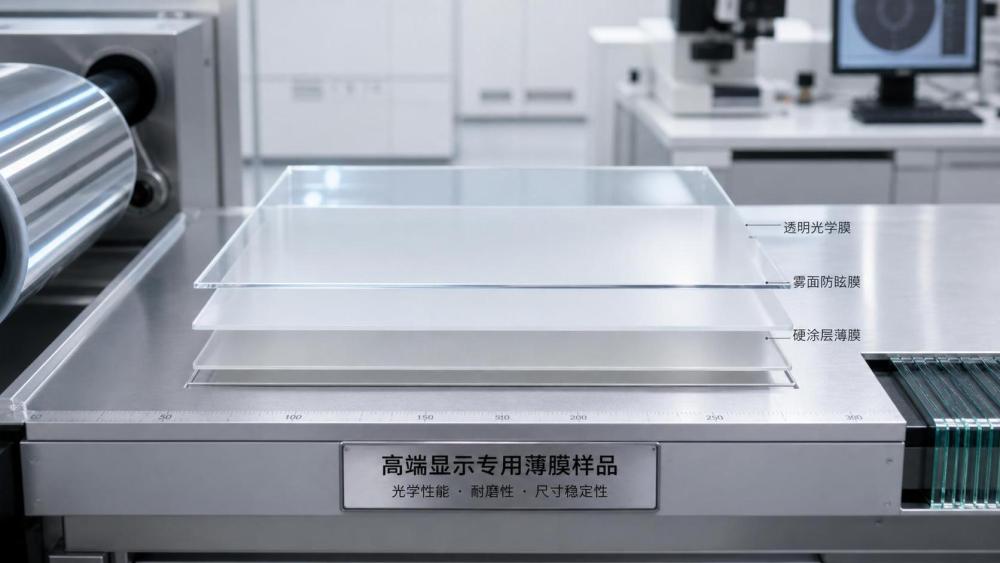
Dimensional stability is easy to underestimate until registration starts drifting
In display converting and lamination, dimensional movement creates expensive problems. Films expand, shrink, relax stress, absorb moisture, and respond to heat history. If the selected material lacks adequate dimensional stability, the consequences may include poor die-cut accuracy, misalignment in multilayer stacks, edge lift, bubble formation, or cosmetic defects after environmental aging.
Polyester films are often chosen for their balanced dimensional stability, but even within PET families, orientation level, coating structure, and thermal history can change performance significantly. Polycarbonate may offer other advantages, especially in thermoformable or impact-sensitive designs, but it can bring different thermal and moisture-related considerations. PMMA-based optical films may support excellent surface and visual quality in some applications, while requiring careful handling around brittleness or process conditions.
When comparing specialty film materials for displays, technical evaluators should review:
- Coefficient of thermal expansion in the relevant temperature range
- Heat shrinkage after exposure to lamination, curing, and service temperatures
- Moisture sensitivity and its impact on dimensions or flatness
- Curl behavior before and after coating or adhesive application
- Stress relaxation over time in rolled and sheeted formats
This becomes particularly important in large-format displays, narrow-tolerance optical stacks, and applications involving repeated heat cycles. A small dimensional change may be invisible in a simple sample panel but unacceptable in scaled production.
Thermal resistance should be defined by process reality, not just material reputation
Display teams often use broad labels such as “high-temperature resistant” or “suitable for electronics,” but selection decisions need narrower definitions. The real question is: resistant to what temperature, for how long, and during which step?
A film may tolerate short-term peak heat in coating or drying but deform under longer lamination dwell times. Another may survive service conditions well yet yellow after UV-assisted processing. Some films handle solder-adjacent assembly environments better than others, while certain coated structures lose performance because the coating, not the base film, becomes the limiting factor.
It helps to separate three thermal scenarios:
- Processing temperature exposure during coating, printing, curing, thermoforming, or lamination.
- Assembly temperature exposure when the film is combined with adhesives, light guides, sensors, or cover components.
- End-use temperature exposure under sunlight, backlight heat, enclosed-device operation, or automotive cabin conditions.
Once teams define those windows, material comparison becomes more meaningful. A lower-cost film that meets only one of the three may increase downstream rejection or warranty risk. Technical buyers benefit from asking not only for temperature limits, but for property retention after heat aging.
Converting compatibility can decide whether a “good film” is usable at scale
Specialty films for displays do not exist as standalone materials for long. They are coated, slit, laminated, printed, embossed, die-cut, thermoformed, bonded, and assembled. A film that performs well in theory may still create low yield if it is difficult to convert consistently.
This is where processing teams and sourcing teams need to work closely. Questions worth asking early include:
- Does the film run flat through web handling systems?
- How sensitive is it to tension variation?
- Does it generate static that attracts dust in clean assembly areas?
- Can it withstand die-cutting without edge cracking or particle generation?
- Is the release behavior stable if the film is paired with adhesives or liners?
- Are there known issues with laser cutting, thermoforming, or embossing?
Film thickness tolerance is especially important here. In display stacks, even modest gauge variation can influence bonding pressure, optical performance, and fit with adjacent parts. Uniformity across width and along roll length often matters more than nominal thickness alone.
Technical platforms such as APIM increasingly emphasize this link between material science and process control because film selection is rarely just a chemistry decision. It is also a manufacturing stability decision. Understanding how extrusion quality, orientation control, coating consistency, and surface treatment affect downstream converting helps evaluators distinguish between similar-looking offers.
Reliability depends on the whole stack, not only the film grade
One of the most common selection mistakes is evaluating a display film in isolation. Reliability emerges from interaction: film with adhesive, coating with cleaning chemical, substrate with backlight heat, surface treatment with storage conditions. A film that looks excellent as a standalone sample may fail when paired with a specific pressure-sensitive adhesive or UV-curing optical adhesive.
That is why compatibility testing matters. Rather than asking whether a film is “good,” teams should ask whether it is stable inside the intended structure. Potential failure modes include:
- Delamination at treated surfaces
- Silvering or haze after lamination
- Yellowing under UV or heat exposure
- Blocking in roll storage
- Microcracking after forming or repeated touch use
- Chemical attack from cleaners, inks, or adhesive components
For higher-value display applications, short-term qualification should be followed by stress testing that reflects the actual environment. Thermal cycling, humidity exposure, abrasion, solvent contact, and aging under light are not excessive precautions; they are often the only way to see hidden risk before scale-up.
Supplier capability matters more than many teams admit
Even well-defined material specifications do not eliminate supply-side variation. In specialty display films, consistency from lot to lot is a technical issue, not merely a purchasing concern. Coating uniformity, cleanliness, particulate control, roll winding quality, treatment stability, and documentation support all affect production confidence.
Technical evaluators should review supplier capability in a structured way:
- Can the supplier explain how the film is produced and controlled?
- Are key optical and physical properties measured consistently?
- Is there traceability for coated and treated lots?
- Can the supplier support change notification and qualification planning?
- Do they understand the display application, not just the base resin?
For many buyers, this is the difference between a source that ships material and a source that supports a display program. APIM’s industry coverage reflects this broader evaluation logic: advanced materials should be assessed through performance, process fit, and supply chain reliability together, especially in sectors where tolerances are tight and cosmetic defects are costly.
A practical decision framework for specialty film materials for displays
When multiple films appear technically viable, a useful approach is to narrow the decision through layered screening rather than chasing the “best” material in abstract terms.
Start with non-negotiables: optical requirements, service temperature, form factor, and essential surface function. Then screen for process fit: lamination behavior, converting yield, thickness consistency, and compatibility with adhesives or coatings. After that, compare reliability evidence and supplier support.
In practice, the winning material is often not the one with the most impressive individual specification. It is the one that creates the fewest surprises across pilot runs, qualification tests, and long-term production. For technical teams, that is what good selection looks like: fewer hidden trade-offs, clearer process windows, and a film that behaves as expected when the display moves from concept to manufacturing.
Choosing specialty film materials for displays is ultimately an exercise in disciplined matching. Optical beauty matters, but so do flatness, adhesion, thermal behavior, handling, and consistency. Teams that evaluate those factors together are far more likely to make decisions that hold up outside the lab, where real displays are judged not by one property, but by the total experience they deliver.
Have questions about this sector analysis, or seeking best practices specific to your niche? Drop us a line below and let the senior consultants at APIM assist you.
We respect your privacy. Your information is strictly confidential.
Related News
- 00
0000-00
Do polyolefin hot melt adhesives bond well to polyethylene? - 00
0000-00
Korean Study Finds PLA Barely Degrades in Landfill After 320 Days - 00
0000-00
How to assess batch consistency from a thermal potting compounds supplier - 00
0000-00
How much weight can carbon fiber reinforced plastics save in cars? - 00
0000-00
Switching from PS to ABS Sheet Extrusion: Equipment Checks