




Specialty Film Materials for Protective Surfaces: Key Selection Factors
Choosing specialty film materials for protective surfaces rarely comes down to gauge alone. In current industrial programs, film selection sits between product reliability, appearance control, processing efficiency, and cost discipline.
That is why specialty film materials for protective surfaces matter across electronics, automotive interiors, appliances, displays, packaging, and fabricated industrial parts. A poor match can create scratches, haze, residue, rework, or downstream bonding failures.
A better match protects value through the full manufacturing chain. It also reduces uncertainty when teams compare suppliers, validate performance, and plan for changing environmental or regulatory demands.
What Protective Surface Films Really Need to Do
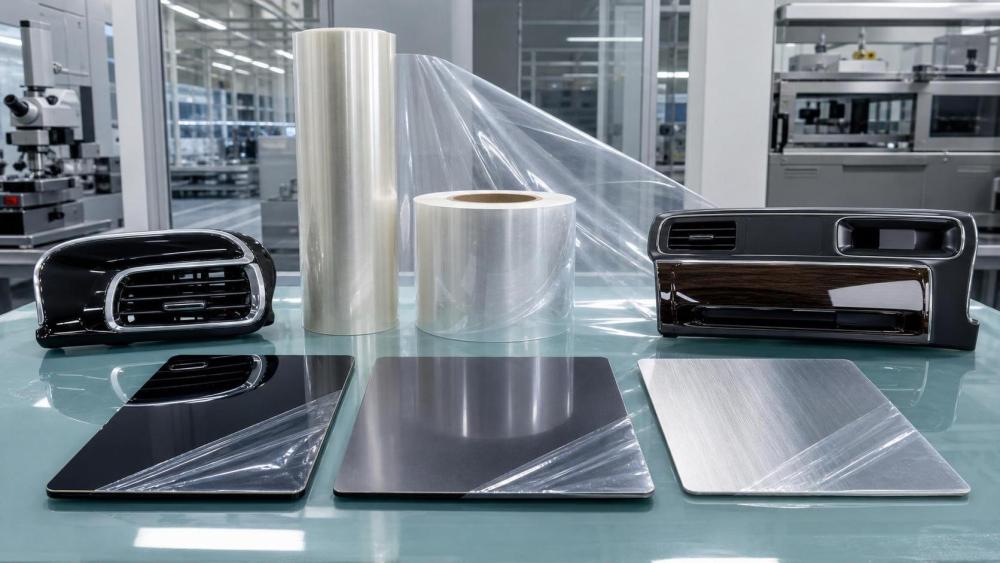
Protective films are often treated as temporary layers, but their function is more complex. They must shield a surface during storage, transport, converting, assembly, or installation without creating new defects.
In practice, specialty film materials for protective surfaces may need to resist abrasion, absorb minor impact, prevent contamination, and preserve gloss or optical clarity. Some also support die-cutting, lamination, thermoforming, or clean removal.
The base film may be PET, PE, PP, TPU, PVC-free alternatives, or multilayer constructions. The right choice depends on whether the protected substrate is metal, coated plastic, glass, painted parts, PC sheet, PMMA sheet, or sensitive electronic surfaces.
This is also where APIM’s coverage becomes useful. Protective surface performance cannot be separated from polymer behavior, converting conditions, adhesive interaction, and global supply consistency.
Why Selection Has Become More Demanding
Protective films now serve products with tighter tolerances and higher visual standards. A light scratch on a decorative panel or display window can quickly become a rejected component.
At the same time, surfaces themselves are changing. Soft-touch coatings, high-gloss finishes, anti-fingerprint layers, textured polymers, and thin optical substrates each respond differently to pressure, heat, and peel force.
More demanding production lines also raise the bar. Film unwind behavior, static control, roll consistency, thickness tolerance, and adhesive stability all affect output quality.
Sustainability is another pressure point. Many companies now review recycled content, mono-material strategies, halogen-free constructions, and end-of-life handling alongside traditional performance metrics.
Core Selection Factors That Change Real Outcomes
When evaluating specialty film materials for protective surfaces, several factors shape long-term results more than simple unit cost.
Surface Compatibility
The first question is always the substrate. A film that performs well on stainless steel may fail on acrylic, coated polycarbonate, or painted aluminum.
Surface energy matters because it affects wetting, adhesion level, and clean removal. Chemical sensitivity matters because some surfaces can stain, craze, or lose gloss after contact.
Mechanical Protection
Thickness still matters, but only in context. A thicker film may improve puncture resistance, yet it can reduce conformability on curved or textured parts.
Tensile strength, elongation, tear resistance, and elastic recovery often provide a better picture of real handling performance.
Optical and Visual Performance
For displays, gloss panels, decorative sheets, and transparent covers, haze and light transmission are critical. Even a small visual shift can undermine product acceptance.
Film clarity must be stable under storage and processing conditions, not just in a fresh sample roll.
Temperature and Chemical Resistance
Some protective films face short baking cycles, outdoor exposure, cleaning chemicals, or humid transport conditions. Others must survive laser cutting, thermoforming, or long warehouse dwell times.
A film should be evaluated under the actual thermal and chemical profile of the process, not only standard laboratory conditions.
Adhesive Behavior and Peel Profile
Many failures come from the adhesive system rather than the carrier film. Pressure-sensitive adhesives must hold securely, then release without residue, edge lift, or substrate damage.
Peel force should stay within a controlled window across time, temperature, humidity, and line speed. That stability is especially important for global production programs.
How Material Families Fit Different Use Cases
Different film families solve different protection problems. The comparison below helps frame early screening work.
These categories are only starting points. Actual performance depends on resin grade, additives, co-extrusion design, surface treatment, and adhesive pairing.
Processing Conditions Deserve Equal Attention
A technically strong material can still fail if processing realities are ignored. That is why specialty film materials for protective surfaces should be reviewed together with line conditions.
Film extrusion quality affects thickness tolerance, internal stress, and roll uniformity. Converting quality influences slitting accuracy, edge cleanliness, release behavior, and die-cut repeatability.
APIM’s focus on extrusion and compounding is relevant here. Screw design, melt filtration, cooling control, and surface treatment stability can all shape downstream protection performance.
In practical sourcing work, sample approval should reflect production-scale variables. Pilot rolls, storage simulation, and line-speed trials often reveal issues that bench tests miss.
Where Evaluation Often Goes Wrong
Several recurring mistakes delay decisions or create hidden cost later in the program.
- Selecting by thickness without checking substrate sensitivity and peel behavior.
- Testing only fresh material, while ignoring storage aging and transport conditions.
- Approving a film on flat samples, even though the final part includes bends, embossing, or deep draw geometry.
- Comparing price per roll instead of total cost from yield, scrap, claims, and rework.
- Treating the film as separate from adhesives, coatings, and downstream assembly steps.
Usually, the better approach is to convert selection criteria into a short validation matrix. That keeps technical, commercial, and supply chain factors aligned.
A Practical Way to Narrow the Options
Teams screening specialty film materials for protective surfaces can simplify the process by ranking requirements in layers rather than chasing every property at once.
Start with the surface and environment
Map the substrate type, coating chemistry, exposure temperature, humidity range, and contact duration. This removes unsuitable film families early.
Define the damage risk
Separate cosmetic protection from structural handling risk. A film for anti-scratch shipping protection is different from one used during forming or machining.
Check process compatibility
Review unwind, lamination, cutting, forming, and removal steps. If the film interrupts flow, nominal performance gains may not matter.
Validate supply reliability
Batch stability, documentation quality, change control, and regional availability deserve early review, especially for multi-site manufacturing programs.
What to Review Before the Next Material Decision
The strongest decisions usually come from a structured shortlist. That means comparing specialty film materials for protective surfaces against actual use conditions, not catalog claims alone.
A useful next step is to build a comparison sheet around substrate compatibility, protection level, optical impact, adhesive profile, processing fit, and supplier consistency. Include sustainability criteria if they affect qualification or customer expectations.
For organizations tracking advanced polymers, films, adhesives, and converting technologies, this wider view matters. Protective surface films are rarely isolated materials; they are part of a broader performance system that influences quality, throughput, and commercial risk.
When those variables are reviewed together, material selection becomes clearer, supplier discussions become more precise, and the final specification is easier to defend through the life of the project.
Have questions about this sector analysis, or seeking best practices specific to your niche? Drop us a line below and let the senior consultants at APIM assist you.
We respect your privacy. Your information is strictly confidential.
Related News
- 00
0000-00
How does washing affect contamination in post-consumer recycled PP resins? - 00
0000-00
How does feedstock affect depolymerization equipment selection? - 00
0000-00
US Sets 213.44% Preliminary Antidumping Deposit on Chinese PTMEG - 00
0000-00
When should epoxy be used as a thermal interface material for semiconductors? - 00
0000-00
US Midterm Results Unlikely to Quickly Shift Recycled Plastics Market or Legislation