




Polycarbonate Sheet Grades Compared: Which Type Works Best for Guards, Covers, and Panels?
Polycarbonate Sheet Grades Compared for Guards, Covers, and Panels
Choosing the right polycarbonate sheet is rarely a simple price comparison.
For guards, covers, and panels, grade selection affects safety, uptime, fabrication yield, and replacement frequency.
That matters even more when projects involve compliance targets, visibility requirements, or aggressive operating conditions.
The challenge is that polycarbonate is not one uniform material.
Different sheet grades are engineered for different risks, from impact and flame exposure to UV weathering and chemical contact.
In practical buying decisions, the best option is usually the grade that balances performance with processing simplicity and total cost.
This guide compares the main polycarbonate sheet types used in industrial applications and highlights where each one fits best.
Why Polycarbonate Is Common in Industrial Protection
Polycarbonate remains popular because it combines high impact strength with low weight and strong design flexibility.
Compared with glass, it is easier to machine, safer when struck, and less demanding during installation.
Compared with acrylic, polycarbonate generally offers much better toughness, especially in safety guards and machine covers.
That said, not every polycarbonate sheet performs equally well in every environment.
Some grades prioritize optical clarity. Others focus on flame performance, abrasion resistance, weatherability, or easier forming.
From a sourcing perspective, this means the word polycarbonate alone is not enough for reliable selection.
The Main Polycarbonate Sheet Grades
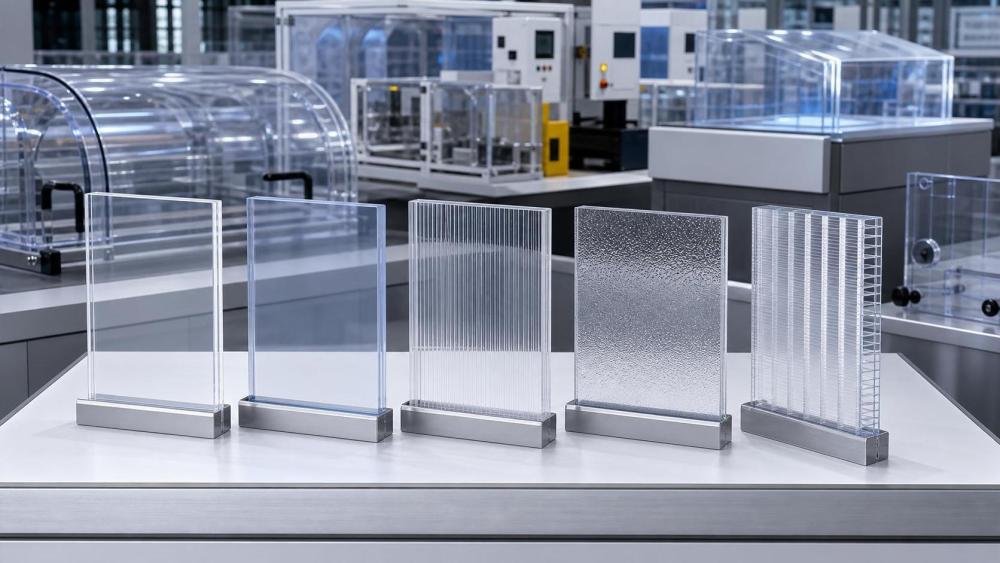
Most industrial projects compare five common polycarbonate sheet categories.
1. General-Purpose Clear Polycarbonate
This is the standard starting point for indoor guards, covers, and transparent panels.
It offers strong impact resistance, good light transmission, and broad fabrication compatibility.
It works well for machine enclosures, inspection windows, and protective barriers with moderate service demands.
Its limitation is surface scratching and reduced outdoor life without added UV protection.
2. UV-Resistant Polycarbonate Sheet
This grade is designed for sunlight exposure and long-term outdoor use.
A UV-protective layer or formulation helps reduce yellowing, embrittlement, and optical loss over time.
It is often selected for exterior covers, skylight-related panels, transport shelters, and outdoor equipment protection.
For outdoor projects, standard indoor polycarbonate can become a false economy.
3. Flame-Retardant Polycarbonate Sheet
When electrical safety or transportation standards matter, flame-retardant polycarbonate deserves closer attention.
These grades are formulated to meet stricter fire behavior targets such as UL 94 performance levels.
They are commonly used in electrical covers, control panels, battery-related housings, and public equipment interiors.
The trade-off may include higher cost or slight differences in clarity and processing behavior.
4. Hard-Coated Polycarbonate Sheet
Hard-coated polycarbonate is chosen when scratching, cleaning cycles, or chemical splashes are serious concerns.
The coated surface improves abrasion resistance compared with untreated polycarbonate sheet.
This makes it useful for operator screens, public-facing covers, and panels that need repeated wipe-downs.
It is especially relevant where clarity must remain stable after months of use.
5. Multiwall or Structured Polycarbonate Sheet
This format is different from solid polycarbonate sheet.
It offers lower weight and better insulation through internal chambers, rather than maximum transparency.
It is more common in building envelopes, partitions, and large-area panels than in precision safety guards.
If visibility detail is critical, solid polycarbonate usually remains the better fit.
How to Match the Grade to the Application
The most effective polycarbonate choice starts with the actual failure risk, not the catalog headline.
In real projects, guards, covers, and panels face very different performance priorities.
For Machine Guards
Impact resistance is usually the first requirement.
General-purpose clear polycarbonate often works for indoor equipment with limited chemical exposure.
If operators clean the guard often or metal chips may scratch the surface, hard-coated polycarbonate is stronger long term.
For Equipment Covers
Covers usually balance visibility, shape complexity, and environmental exposure.
Thermoformed covers often favor polycarbonate grades with stable forming behavior and good dimensional consistency.
For outdoor units, UV-resistant polycarbonate is usually the safer option.
For Control Panels and Electrical Shields
Flame-retardant polycarbonate becomes more relevant when fire performance, electrical insulation, or regulatory approval drives the decision.
In these cases, a lower-cost standard polycarbonate sheet may increase approval risk later.
For Large Panels and Enclosures
Weight, span, and thermal performance become more important as panel size increases.
Structured polycarbonate can reduce load while keeping useful toughness and insulation value.
Key Decision Factors Before You Buy
A good polycarbonate decision usually depends on six practical checks.
- Impact load: Define whether the sheet must stop tools, debris, or accidental contact.
- Optical needs: Decide if high transparency, glare control, or simple light diffusion matters most.
- Surface life: Check for scratching, cleaning frequency, and expected appearance retention.
- Heat and flame: Review service temperature and any required fire classification.
- Outdoor exposure: Confirm whether UV-resistant polycarbonate is necessary.
- Fabrication route: Match the sheet grade to cutting, bending, drilling, printing, or thermoforming plans.
These questions help prevent over-specifying and under-specifying at the same time.
That is often where unnecessary cost or premature field failure starts.
Quick Comparison Table
Common Buying Mistakes With Polycarbonate
One common mistake is treating all clear sheets as functionally identical.
Another is buying a high-spec polycarbonate grade without checking whether the application actually benefits from it.
A third issue is overlooking fabrication details, especially drilling stress, edge finishing, coating sensitivity, or forming temperature limits.
In business terms, these mistakes show up as slower approvals, extra scrap, or higher replacement cost.
The better approach is to evaluate the polycarbonate sheet as part of the full application system.
A Practical Selection Path
- Define the application as a guard, cover, or panel.
- List the main risks: impact, UV, flame, scratches, or chemicals.
- Set the optical requirement, from full clarity to simple light transmission.
- Review fabrication needs and sheet thickness options.
- Check standards, approvals, and supplier technical documentation.
- Compare total service life, not only purchase price.
That process makes polycarbonate selection more predictable and easier to defend internally.
When the application is clear, the right grade usually becomes obvious very quickly.
For most projects, the best polycarbonate is not the most advanced sheet on paper. It is the one that fits the operating risk, fabrication method, compliance target, and replacement cycle with the least compromise.
Have questions about this sector analysis, or seeking best practices specific to your niche? Drop us a line below and let the senior consultants at APIM assist you.
We respect your privacy. Your information is strictly confidential.
Related News
- 00
0000-00
How does washing affect contamination in post-consumer recycled PP resins? - 00
0000-00
How does feedstock affect depolymerization equipment selection? - 00
0000-00
US Sets 213.44% Preliminary Antidumping Deposit on Chinese PTMEG - 00
0000-00
When should epoxy be used as a thermal interface material for semiconductors? - 00
0000-00
US Midterm Results Unlikely to Quickly Shift Recycled Plastics Market or Legislation
Tag