




PET vs. PI Dielectric Insulation Plastics for Display Electronics
PET vs. PI Dielectric Insulation Plastics for Display Electronics
Selecting dielectric insulation plastics for display electronics requires more than comparing dielectric strength. Thermal exposure, dimensional stability, film thickness, and processing compatibility can determine long-term reliability. Polyethylene terephthalate (PET) offers a cost-effective option for many moderate-temperature insulation applications, while polyimide (PI) typically supports higher thermal demands and demanding flexible circuit designs. The useful comparison is not which polymer is universally better, but which specific film grade survives the actual assembly process and operating environment.
A rear-panel insulation sheet and a flexible circuit substrate may sit inside the same display yet face very different requirements. Treating them as interchangeable applications can lead either to unnecessary material cost or to failures that only appear after bonding, environmental conditioning, or repeated bending.
Start with the insulation function, not the polymer name
In display assemblies, films may isolate circuit boards from metal frames, separate conductors, protect flexible interconnects, or form part of an adhesive-backed insulation stack. Some remain stationary throughout service. Others experience bending during installation or repeated movement in a hinge region. These distinctions matter more than a broad description such as “electronics-grade film.”
Define the electrical duty first: working voltage, potential transients, conductor spacing, allowable leakage, and whether the layer provides functional insulation or a safety-related barrier. A film suitable for preventing accidental contact with a chassis is not automatically qualified for a safety insulation function. Applicable product requirements and the complete construction must be reviewed separately.
Then map every thermal exposure, including adhesive curing, conductive bonding, soldering where applicable, rework, and local operating hotspots. The temperature recorded at the film matters; a bonding tool setting or enclosure air temperature may not represent what the insulation actually experiences.
Where PET is practical—and where PI earns its premium
Biaxially oriented PET film is a practical candidate for die-cut barriers, backing layers, and adhesive-backed insulation in assemblies with controlled thermal conditions. It combines useful electrical insulation with mechanical strength and established converting options. Its economic advantage is most meaningful when the selected grade maintains dimensions and electrical performance through the complete production route.
PI is commonly considered when the insulation must tolerate more demanding thermal processing or serve as part of a flexible circuit construction. Its heat resistance can provide a wider processing window, but that does not make every PI film suitable for every display application. Moisture behavior, adhesion, dimensional movement, and circuit fatigue still require evaluation.
Dielectric strength is a screening value, not a design allowance
Both PET and PI can provide strong electrical insulation in thin-film form. However, published breakdown values cannot be compared fairly unless thickness, electrode geometry, conditioning, voltage ramp, and test medium are comparable. ASTM D149 and IEC 60243-1 are relevant methods for evaluating electric strength, but citing a method alone does not establish equivalence between supplier results.
A frequent mistake is multiplying a datasheet dielectric-strength value by the proposed thickness and treating the result as a safe operating voltage. Breakdown strength is not necessarily linear with thickness, and laboratory specimens do not reproduce cut edges, trapped particles, metal burrs, wrinkles, or adhesive voids. The assembly needs a justified margin and testing appropriate to its electrical duty.
Also distinguish failure through the film from leakage or flashover along its surface. Increasing film thickness may not solve inadequate edge clearance or contamination near an exposed conductor. Insulation resistance after humidity conditioning can be more revealing than an impressive dry-film breakdown result. For layers close to signal traces, dielectric constant and loss may also matter at the relevant frequency.
Thermal stability means preserving the geometry
PET can lose dimensional accuracy during elevated-temperature exposure even without obvious melting or visible damage. Orientation, heat-setting, exposure time, and mechanical restraint influence the result. Heat-stabilized grades can improve performance, but the designation is not a substitute for measured shrinkage under the intended process conditions.
PI generally offers greater thermal capability, yet a PI-based stack can still fail because its adhesive softens, its interfaces delaminate, or its layers expand differently. A high-temperature base film does not automatically create a high-temperature insulation system.
Dimensional testing should therefore include registration features, openings, and narrow sections on converted parts. Measure movement in both machine and transverse directions. Where the film is bonded to copper, aluminum, or another substrate, inspect the laminate for curling and stress after thermal cycling rather than testing only a free-standing film.
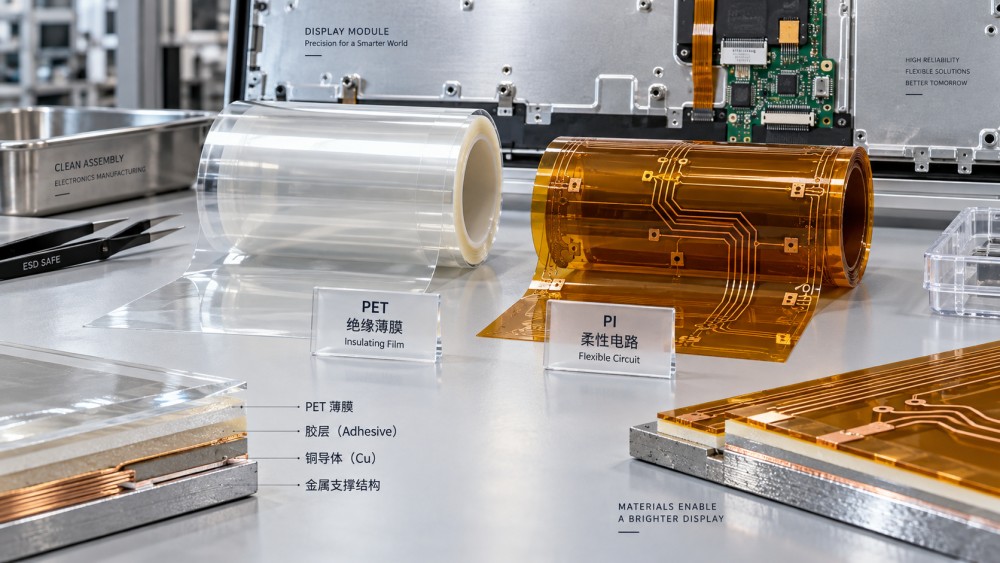
A cross-section of the film, adhesive, conductor, and support surface is particularly useful during this review. It makes clear whether the vulnerable location is the bulk insulation, an exposed edge, a sharp chassis feature, or an unsupported bend.
Humidity and bonding can reverse the initial preference
Conventional PI films often absorb more moisture than PET, although the comparison depends on formulation and conditioning. Moisture uptake can affect dimensions and electrical properties. During rapid heating, retained moisture may also contribute to blistering in a bonded structure. Any drying requirement should be supported by supplier guidance and validated against the actual storage and assembly sequence.
PET is not immune to moisture-related aging. Prolonged hot, humid exposure can promote hydrolytic degradation, making grade selection relevant for displays intended for demanding service environments. Neither “low moisture absorption” nor “high heat resistance” is enough to establish long-term reliability by itself.
For adhesive-backed insulation, assess the finished laminate. Surface treatments, primers, adhesive chemistry, and coating uniformity can change peel strength, leakage behavior, and dimensional stability. Treatment effectiveness may also change during storage. A film that bonds well immediately after conversion may behave differently after extended warehousing.
Check compatibility with cleaning agents and assembly chemicals, too. The relevant question is not merely whether the polymer resists a solvent, but whether exposure damages the coating, weakens an interface, or leaves residues that compromise insulation.
Thin and flexible are not the same as durable
Reducing thickness helps fit insulation into compact displays, but it also reduces tolerance to puncture, handling damage, and local compression. Specify minimum thickness and thickness uniformity rather than relying only on a nominal value. Inspect die-cut edges and determine whether particles or tooling marks create weak points near conductors.
For moving interconnects, bend radius, layer placement, copper construction, and adhesive stiffness influence fatigue. PI’s established use in flexible circuits does not guarantee survival in an arbitrary folding geometry. Test the representative stack through the expected motion, including temperature effects, and inspect electrical continuity as well as insulation integrity. A substrate can remain intact while its conductor cracks.
Build qualification around the failure you need to prevent
Supplier qualification should connect incoming material properties to finished-assembly risks. A useful test plan includes the following checks, with acceptance limits established before samples are evaluated:
- Comparable electrical evidence: obtain test methods, specimen thickness, conditioning, and results for breakdown strength and insulation resistance.
- Process simulation: reproduce bonding pressure, thermal dwell, cooling, and any permitted rework cycles on converted parts.
- Environmental aging: evaluate leakage, adhesion, dimensions, and visible damage after project-relevant heat, humidity, and cycling exposure.
- Mechanical challenge: assess puncture or abrasion at chassis contacts and flex endurance where movement occurs.
- Production consistency: verify thickness variation, surface treatment, cleanliness, traceability, and notification procedures for material changes.
Where flame behavior or safety recognition is required, confirm the exact grade, thickness, and construction covered by the documentation. A polymer family name or a rating for another thickness is insufficient. Similarly, recycled-content PET should be evaluated for contamination, consistency, and electrical performance rather than accepted solely on its sustainability claim.
Make the decision at stack level
PET is a sensible starting point for cost-sensitive, static insulation with moderate and well-controlled thermal exposure. PI becomes more compelling when processing heat or flexible-circuit requirements leave too little margin for qualified PET grades. If moisture, optical performance, or adhesive durability is the limiting factor, changing the base polymer alone may not resolve the problem.
The Global Advanced Polymers & Industrial Materials Intelligence Network (APIM) connects polymer performance with film processing, adhesives, and procurement considerations. That application-level perspective is useful here: compare the cost and reliability of the finished insulation construction, including conversion yield, handling, qualification, and supply consistency—not just film price.
Before approving either material, document the exact grade, minimum thickness, adhesive system, thermal history, environmental exposure, and electrical acceptance criteria. If a supplier comparison lacks any of those details, the next step is to close the evidence gap rather than declare PET or PI the winner.
Have questions about this sector analysis, or seeking best practices specific to your niche? Drop us a line below and let the senior consultants at APIM assist you.
We respect your privacy. Your information is strictly confidential.
Related News
- 00
0000-00
NAPCOR Report: US PET Bottle Recycling Rate Fell to 29% in 2025 - 00
0000-00
How does washing affect contamination in post-consumer recycled PP resins? - 00
0000-00
How does feedstock affect depolymerization equipment selection? - 00
0000-00
US Sets 213.44% Preliminary Antidumping Deposit on Chinese PTMEG - 00
0000-00
When should epoxy be used as a thermal interface material for semiconductors?