




How film converting technology prevents edge lift in protective films
Edge lift is one of the most visible—and often most misunderstood—failure modes in protective films. A film may look acceptable immediately after lamination, then begin to curl, whiten at the perimeter, collect dust, or detach around corners after a few hours, thermal exposure, transport, or normal handling. In electronics, that can compromise both appearance and screen protection. On automotive trim, painted panels, appliance surfaces, and industrial equipment, lifted edges can become a pathway for moisture, cleaning chemicals, and abrasion.
The usual reaction is to question adhesive quality. Adhesive matters, but it is rarely the whole story. Edge lift is often created earlier, during coating, drying, laminating, slitting, die-cutting, rewinding, and liner handling. This is why film converting technology for protective films deserves to be evaluated as a connected process rather than a collection of separate machine steps.
For a technical evaluator, the practical question is not simply whether a protective film has “high adhesion.” It is whether the finished construction retains balanced internal stress, clean edges, controlled adhesive geometry, and stable release behavior when it reaches the application line.
Why edge lift starts before the film is applied
Protective films are usually thin multilayer systems. A typical construction may include a polymer backing, a pressure-sensitive adhesive, and a release liner. Each layer responds differently to heat, tension, humidity, winding pressure, and time. PET, TPU, PE, PP, PVC, and multilayer specialty substrates do not behave in the same way; neither do acrylic, rubber-based, silicone, or polyurethane adhesive systems.
A film can leave the converting line with stored stress even when its surface looks flat. Excessive web tension during coating or rewinding may stretch the backing slightly. Uneven drying can create a differential through the adhesive layer. A poorly matched liner can introduce curl when it is removed. Narrow slit rolls can telescope, dish, or develop edge compression that later shows up as lifting after application.
This is particularly relevant on small display covers, curved automotive surfaces, camera modules, textured housings, and parts with sharp radii. The edge is where the film must resist peel forces while accommodating surface geometry. If the converted roll already has curl memory or an adhesive edge defect, the application process is being asked to correct a problem it did not create.
Tension control is a quality variable, not just a machine setting
Web tension affects nearly every stage of protective film conversion. The substrate must travel stably enough for accurate coating and slitting, but it should not be pulled beyond what the film construction can recover from. This balance becomes more sensitive as films become thinner, softer, more elastic, or more optically demanding.
A converter may see no obvious defect while running a wide master roll. The problem can emerge only after that roll is slit into narrow widths. The reason is simple: tension is not always distributed evenly across the web. Variations in unwind profile, roller alignment, nip pressure, splice thickness, or winding hardness can place more stress on one side of the web than another. After slitting, each narrow roll carries its own version of that stress history.
Good tension management therefore includes more than a nominal setpoint. It involves controlled unwind and rewind behavior, appropriate taper tension where needed, stable roller traction, and attention to roll hardness. A roll wound too tightly may retain stress or squeeze adhesive near the edge. A roll wound too loosely may shift, wrinkle, or allow air entrapment. Neither condition is harmless simply because the roll appears acceptable in storage.
For technical reviews, it is useful to ask how the converter manages tension across different film thicknesses, widths, and substrate types. A process designed around a relatively stiff PET film may not transfer directly to a highly conformable TPU protective film. The equipment may be capable, but the process window still has to be developed for the actual construction.
Adhesive coating must remain uniform at the edge
Edge lift can be caused by insufficient adhesive coverage, but excessive adhesive near the edge is also a risk. Pressure-sensitive adhesives can flow under pressure and temperature. If coating weight, drying, or lamination conditions create an unstable adhesive profile, the film may show edge ooze, contamination pickup, or an irregular peel boundary. Once dust or handling residue reaches that boundary, the edge can lose its seal and begin to lift.
The adhesive must also be compatible with the backing and the intended surface. An adhesive with strong initial tack may still perform poorly on a low-surface-energy plastic, a textured coating, a powder-coated metal, or a surface that experiences heat cycling. In such cases, changing the converting process alone will not solve the issue. However, poor converting can make a marginal adhesive construction fail much sooner than expected.
Drying and curing deserve special attention. Solvent, water, or other volatile components must be removed in a controlled manner without overheating the backing or creating uneven adhesive properties across the roll. The exact requirements depend on adhesive chemistry and coating method, so there is no universal temperature profile worth copying. What matters is proof that the line maintains repeatable conditions and that the finished film is allowed an appropriate stabilization period before critical converting or application testing.
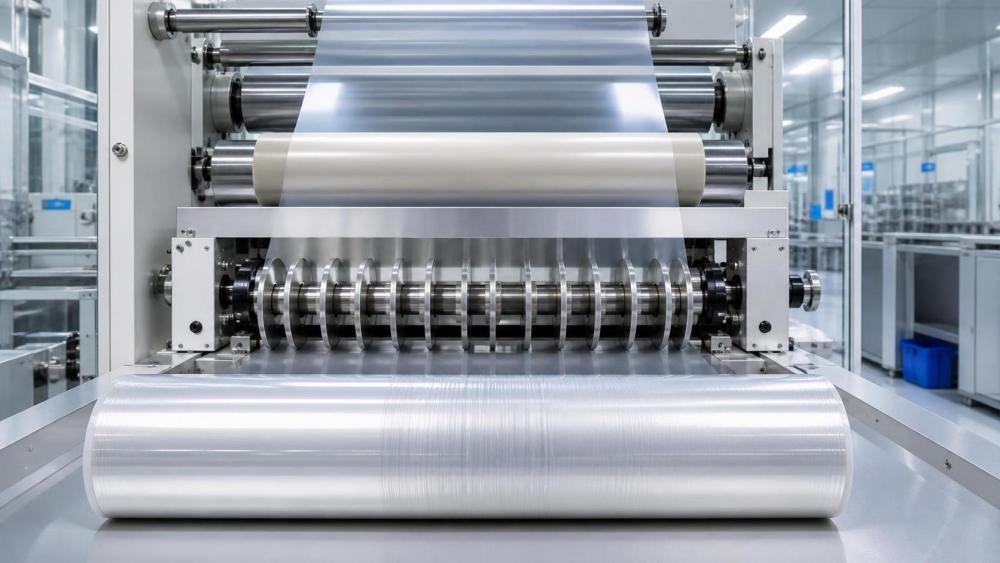
Slitting quality often determines whether an edge stays sealed
Slitting is where a broad, apparently stable laminate becomes a product with exposed functional edges. A clean slit is not merely cosmetic. Rough cutting, adhesive transfer to the blade, liner distortion, backing burrs, or locally compressed edges can all interfere with adhesion after the film is applied.
The selected slitting method must match the material stack. Razor slitting, shear slitting, and score slitting impose different mechanical forces on the film. A method that works for a general packaging film may create unacceptable deformation in a thin optical protective film or a soft elastomeric construction. Blade condition is equally important. A worn blade can create micro-tears or drag adhesive, yet the defect may only become apparent under angled light or after peeling the liner.
Converting teams sometimes focus on visible edge fuzz while overlooking the larger problem: edge compression. If the backing and adhesive are squeezed or displaced during cutting, the final edge may not lie flat after application. On a flat test plaque this may be hard to detect. On a curved or thermally loaded component, it becomes an initiation point for peel.
A useful evaluation practice is to inspect slit edges before and after liner removal, then compare behavior on representative substrates rather than only on glass or polished metal. The protective film should be assessed where it will actually work: on coated plastics, painted panels, display glass, textured surfaces, or molded parts with real corner geometries.
Release liners can either protect the adhesive or destabilize the construction
Release liner selection is sometimes treated as a packaging detail. It is not. The liner influences adhesive surface quality, unwind force, moisture response, static generation, die-cutting behavior, and the way stress is released when the film is applied.
If release force is too high, an installer may stretch the film while removing the liner, especially on narrow strips or flexible films. That stretch can pull the edges inward and encourage later lifting. If release is too low or inconsistent, liner handling becomes difficult and the adhesive can be exposed to contamination or accidental pre-lift during converting and application.
Liner flatness and dimensional stability also matter. A mismatch between liner and backing can produce curl after delamination. This is not always an adhesive failure; it may be a laminate balance issue. Films intended for manual application, automated laminating, or precision die-cut parts should be reviewed under the actual liner-removal method. A construction that behaves well in a laboratory peel test may behave differently at production speed or in a dry, static-prone environment.
Do not separate converting quality from end-use conditions
Protective films are frequently selected for surfaces that see changing temperatures, vibration, handling, cleaning agents, ultraviolet exposure, or extended storage. The converting process must preserve the design intent of the material through those conditions. A film applied to a consumer-electronics display is judged heavily on clarity, bubble control, and edge appearance. A temporary automotive surface-protection film may need clean removal after transport or assembly. Industrial protection may prioritize abrasion resistance and residue-free removal from painted or coated equipment.
Those are different requirements, and they can create different edge-lift mechanisms. High conformability may be more important than stiffness on a curved housing. Clean removal may limit how aggressively an adhesive can be formulated. Heat resistance may change the preferred backing and liner combination. The right answer is normally a materials-and-process decision, not a single “stronger adhesive” decision.
This broader view is central to the way APIM examines specialty films, adhesive systems, extrusion technologies, and advanced polymer applications. Film performance is shaped by substrate selection, formulation, processing control, application geometry, and the operating environment. Looking at only one of these variables tends to produce short-term fixes.
Questions worth asking a converter before approving a protective film
A technical approval should go beyond a data sheet and a small hand-applied sample. The following questions usually reveal whether edge-lift risk has been considered in a practical way:
- How are web tension and winding hardness controlled for this specific film construction and final slit width?
- Which slitting method is used, and how is blade wear or adhesive buildup monitored?
- How is adhesive coating uniformity checked across the web and near the slit edge?
- Has the liner-film combination been evaluated for curl, release consistency, and static behavior?
- What application surfaces, radii, storage conditions, and thermal exposures were considered during qualification?
- Are retained samples and batch traceability available if a field issue appears after conversion?
The answers do not need to be overly elaborate. What matters is whether the supplier understands the relationship between process history and application performance. A converter that only discusses adhesive peel values, while having no view on tension, slit edge condition, or liner behavior, may be overlooking the real source of the problem.
A practical route to fewer edge-lift failures
When edge lift occurs, begin with the failed geometry rather than a generic lab panel. Examine whether lifting begins at a cut edge, a corner, a formed radius, a contamination point, or a region exposed to heat. Then trace the construction backward: substrate stability, adhesive behavior, liner release, lamination, slitting, winding, storage, and application technique. This sequence is often more productive than immediately changing adhesive grade.
Film converting technology for protective films prevents edge lift by reducing the hidden stresses and edge defects that turn into peel later. Controlled tension keeps the laminate balanced. Consistent coating and drying protect adhesive performance. Clean slitting preserves the perimeter. Well-matched liners avoid curl and application-induced distortion. None of these controls can compensate for an unsuitable material system, but together they give a suitable system a realistic chance to perform as designed.
For critical projects, the most reliable approval path is to test the converted film on representative parts, after realistic storage and exposure conditions, while documenting the exact converting and application variables. Edge lift is usually easier to prevent in the converting plan than to explain after the product is already in the field.
Have questions about this sector analysis, or seeking best practices specific to your niche? Drop us a line below and let the senior consultants at APIM assist you.
We respect your privacy. Your information is strictly confidential.
Related News
- 00
0000-00
How does washing affect contamination in post-consumer recycled PP resins? - 00
0000-00
How does feedstock affect depolymerization equipment selection? - 00
0000-00
US Sets 213.44% Preliminary Antidumping Deposit on Chinese PTMEG - 00
0000-00
When should epoxy be used as a thermal interface material for semiconductors? - 00
0000-00
US Midterm Results Unlikely to Quickly Shift Recycled Plastics Market or Legislation