




High Temperature Polymer Films: When Display Processing Requires PI Over PET
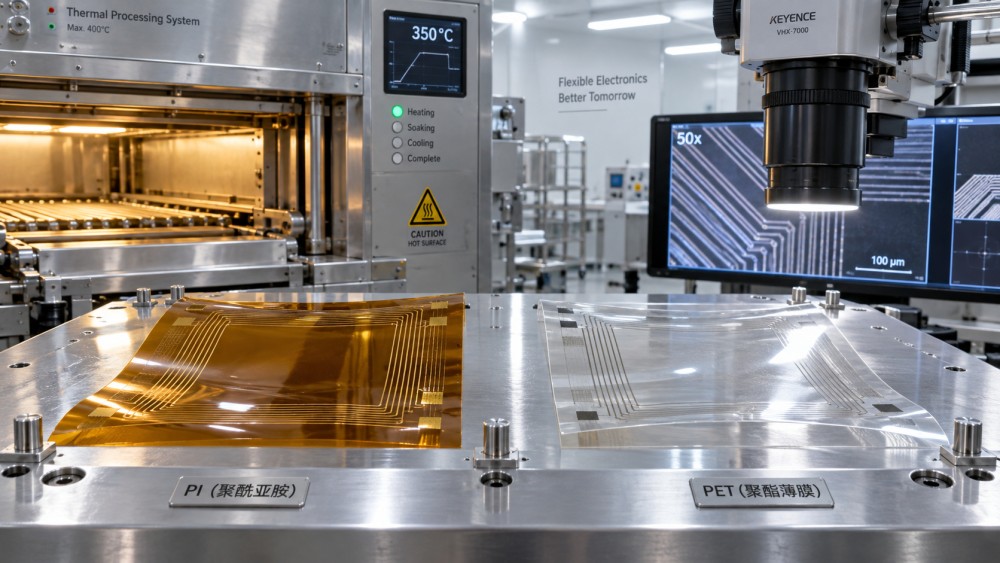
Choose polyimide (PI) over polyethylene terephthalate (PET) when the complete display-processing cycle exceeds the PET grade’s validated limits for dimensional stability, mechanical support, or surface integrity. Repeated baking, heated deposition, and tight layer-registration requirements can make a film unsuitable well before it melts. Shrinkage or distortion can misalign patterned layers, damage conductive coatings, or create uneven bonding.
PI is not automatically the better substrate. A high temperature polymer must also meet optical, thermal-expansion, outgassing, and coating-compatibility requirements. PET remains a credible choice for lower-temperature display layers and processes with qualified dimensional control. The decision should therefore start with the film’s actual manufacturing role and measured thermal history, rather than a generic maximum-temperature rating.
First establish where the film sits in the display process
A flexible backplane substrate, an optical cover film, and a temporary protective film face different demands. A substrate that supports patterned electronics must preserve registration throughout fabrication. An optical film laminated after the hottest operations may never experience those conditions. Specifying PI for both roles simply because they belong to the same display assembly can add cost without resolving a real failure mechanism.
For a permanent substrate, map every exposure from incoming-film conditioning through deposition, patterning, curing, lamination, and release from a carrier. Include rework where it is permitted. Record dwell time, heating and cooling rates, atmosphere, vacuum conditions, mechanical restraint, and web tension—not just the highest chamber setpoint.
The substrate temperature may differ from the equipment reading. Plasma exposure and deposition can heat a film locally, while a carrier can change heat transfer. Establish how temperature is measured or inferred at the film. A selection based on the oven setpoint alone can miss the exposure that actually causes distortion.
The central question is whether the film maintains the required geometry and interface quality throughout that route. Its suitability at the final operating temperature is a separate qualification requirement.
PET can lose dimensional accuracy without melting
PET film is semicrystalline, and its behavior depends on orientation, crystallinity, heat setting, thickness, and previous thermal exposure. As molecular mobility increases during heating, residual stresses can relax. The result may be permanent shrinkage, uneven contraction, or loss of flatness, even though the film remains visibly intact.
This distinction matters in display fabrication. A substrate can survive a bake yet fail the alignment budget for a subsequent patterning step. Machine-direction and transverse-direction changes may differ, so one reported shrinkage value does not fully describe the risk.
Heat-stabilized PET can improve performance within a qualified process window. It should not, however, be treated as equivalent to every other PET grade or assumed to retain precision under repeated cycles. Film orientation and heat-setting conditions influence how much additional relaxation remains possible.
PI generally offers greater thermal-processing capability, but the family includes substantially different formulations. Conventional aromatic PI, colorless PI, and low-expansion PI do not necessarily share the same optical properties, moisture response, or dimensional behavior. “PI” identifies a material family, not a complete display-substrate specification.
Separate permanent shrinkage from thermal expansion
Two films can show similar dimensions after cooling but behave differently while hot. Reversible thermal expansion affects the substrate during deposition and alignment; irreversible shrinkage changes the reference geometry after the cycle. Both need measurement when successive layers must register accurately.
The coefficient of thermal expansion (CTE) describes dimensional response to temperature, but a single room-temperature value may not represent the relevant processing range. Request directional data and the measurement interval. For oriented films, machine-direction and transverse-direction behavior should be evaluated separately.
Also examine mismatch with deposited materials. A polymer substrate expands differently from a conductive oxide, metal trace, or inorganic barrier. Restraint between layers can create stress during heating and cooling, contributing to curvature, cracking, or delamination. Replacing PET with PI does not eliminate this mechanism; some PI grades still have substantial expansion relative to inorganic coatings.
A carrier can hold a film flat during fabrication while concealing residual stress. After release, the structure may curl or change dimensions. Evaluate the released stack as well as the supported film, especially where downstream lamination requires flatness.
Optical requirements may narrow the PI choice
Conventional aromatic PI commonly has an amber appearance, which can be unacceptable in a light-transmitting display layer. Colorless PI formulations address this limitation, but optical clarity should be verified for the actual grade, thickness, and thermal history. Transparency before processing is not enough.
Assess transmission over the wavelengths relevant to the display, together with haze, yellowness, surface defects, and optical uniformity. Thermal exposure or interaction with coatings can change these properties. A material that passes an incoming inspection may therefore fail after fabrication.
Polarization-sensitive optical stacks also require attention to birefringence and retardation. Oriented PET may introduce optical effects that are acceptable in one stack and troublesome in another. PI is not inherently exempt from optical anisotropy; formulation and film processing still matter.
Where the film lies outside the primary optical path, color may be less restrictive. This can make conventional PI a practical candidate without requiring a colorless formulation. Define the optical function before comparing prices, otherwise the evaluation may focus on an unnecessarily demanding grade.
A heat-resistant film can still fail at its interfaces
Thermal capability does not establish cleanliness or coating compatibility. Under vacuum or heating, absorbed moisture, residual solvents, additives, and processing residues can evolve from a film. Depending on the process, this may disturb chamber conditions, contaminate deposited layers, or contribute to interfacial defects.
Some PI grades absorb appreciable moisture, making storage and pre-drying important. Supplier conditioning guidance should be checked against the production route: a laboratory drying procedure is not useful if the film reabsorbs moisture during normal handling. PET also requires suitable moisture and cleanliness control.
Surface preparation can change the comparison. Plasma, corona treatment, primers, and cleaning chemicals influence wetting, adhesion, roughness, and sometimes optical performance. Confirm compatibility with the actual photoresists, developers, stripping agents, deposition conditions, and bonding materials used in the stack.
- Blistering after heating: investigate evolved moisture or volatiles, trapped material, and adhesive behavior before attributing the defect solely to the substrate.
- Cracked conductive coatings: examine thermal mismatch, film deformation, coating stress, and bending strain together.
- Delamination after cooling: distinguish insufficient adhesion from stresses generated by contraction or carrier release.
- Haze or discoloration: compare uncoated controls with processed samples to separate substrate changes from coating or surface-treatment effects.
Switching to PI may solve substrate distortion while leaving an adhesive as the temperature-limiting component. The process window belongs to the complete stack, including primers, barriers, conductors, and release layers.
Qualify candidates against the real process, not isolated datasheet values
Before requesting samples, define acceptance limits from the display design and manufacturing tolerances. These may include registration error, residual shrinkage, bow, optical change, coating continuity, and adhesion after processing. Without those limits, a comparison can show that PI performs differently without establishing whether PET actually fails.
- Characterize incoming films. Record grade, thickness, thickness variation, surface condition, orientation, conditioning, and lot identity. Measure baseline dimensions and the optical properties relevant to the application.
- Reproduce the thermal sequence. Include repeated exposures, cooling periods, atmosphere, and any allowed rework. Use the intended carrier or tension arrangement rather than testing only unsupported coupons.
- Measure dimensional behavior. Track fiducials in both film directions and at multiple positions. Separate recoverable expansion from permanent change, and assess local distortion as well as average shrinkage.
- Build representative interfaces. Apply the planned treatments and critical coatings. Bare-film stability cannot establish the performance of a patterned, multilayer structure.
- Inspect after cooling and release. Check flatness, registration, cracks, adhesion, and optical changes. Repeat relevant checks after moisture conditioning or reliability exposure required by the application.
Use enough sampling to distinguish a material trend from coupon variation. Edge and center locations can behave differently, especially in wider films or tensioned processing. Once a candidate passes screening, evaluate lot consistency before releasing a production specification.
Datasheet decomposition temperatures, glass-transition measurements, and short-term heat-resistance claims are useful screening information. None alone defines a safe display-processing temperature. A decomposition result, in particular, does not show that a film will preserve micrometer-scale registration at a lower temperature.
Make the material decision together with the process decision
Before committing to PI, determine whether the demanding exposure is unavoidable. A lower-temperature cure, different deposition sequence, or introduction of PET after the hottest steps may preserve a workable PET route. Such changes need validation for device performance and throughput; reducing temperature is not a solution if it compromises coating quality.
Commercial comparisons should include usable yield, carrier handling, conditioning, coating compatibility, inspection, and scrap—not only film price. Conversely, PI’s higher thermal capability has little value where optical requirements become harder to satisfy or the existing PET route already meets its tolerances.
Request grade-specific evidence for thermal-cycle shrinkage, directional CTE, moisture conditioning, optical properties after heating, surface treatment, and thickness consistency. Ask suppliers to state the test conditions behind each value. Results obtained on a different thickness or under mechanical restraint may not transfer to the intended process.
Specify PI when PET fails a defined process-critical requirement and the selected PI grade passes the complete stack qualification. Retain PET when its validated window covers the manufacturing route with adequate margin. Where neither candidate meets both thermal and optical limits, revise the process or substrate architecture rather than approving a film on heat resistance alone.
Have questions about this sector analysis, or seeking best practices specific to your niche? Drop us a line below and let the senior consultants at APIM assist you.
We respect your privacy. Your information is strictly confidential.
Related News
- 00
0000-00
NAPCOR Report: US PET Bottle Recycling Rate Fell to 29% in 2025 - 00
0000-00
How does washing affect contamination in post-consumer recycled PP resins? - 00
0000-00
How does feedstock affect depolymerization equipment selection? - 00
0000-00
US Sets 213.44% Preliminary Antidumping Deposit on Chinese PTMEG - 00
0000-00
When should epoxy be used as a thermal interface material for semiconductors?
Tag