




High Temperature Plastics for Electronics: Key Trade-Offs by Application
High Temperature Plastics for Electronics: Key Trade-Offs by Application
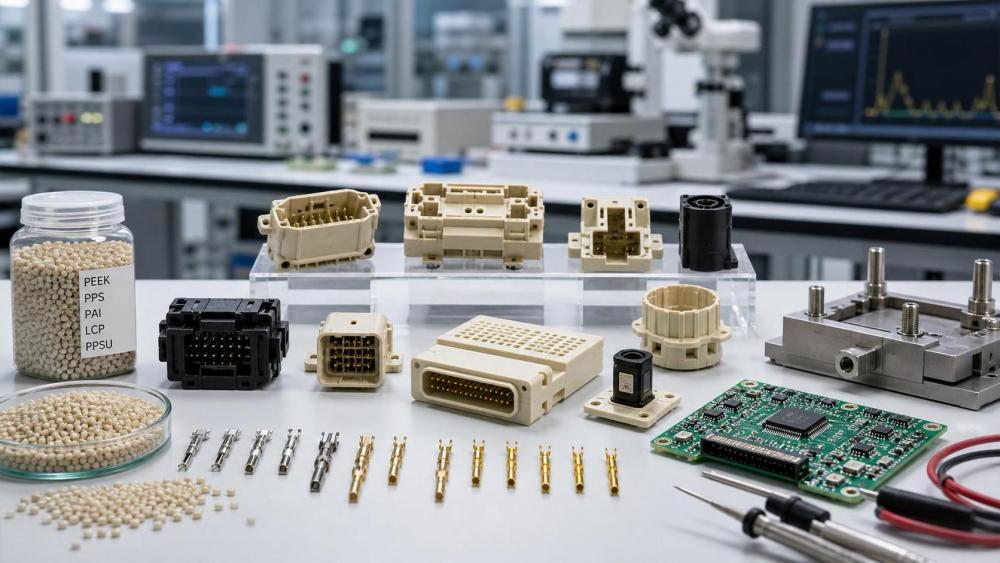
Selecting high temperature plastics for electronics is rarely a simple material upgrade.
In most programs, the real question is which compromise is acceptable for the target application.
High temperature plastics for electronics must survive soldering heat, long service cycles, and strict electrical requirements.
At the same time, they must still mold consistently, meet compliance targets, and fit the project budget.
That is why material selection often becomes a cross-functional decision, not just an engineering choice.
For electronics, common candidates include PPS, PEEK, LCP, PEI, high-temperature nylon, PPA, and specialty PBT compounds.
Each one solves a different problem, and each one creates a different processing or cost burden.
The practical task is to match the polymer to the real failure mode, not the broadest specification sheet.
What “High Temperature” Really Means in Electronics
The phrase sounds straightforward, but in electronics it covers several different thermal events.
One part may face a short solder reflow peak above 260 degrees Celsius.
Another may sit near a heat source for years at 150 degrees Celsius.
A third may see repeated thermal cycling, where dimensional drift matters more than peak heat.
This distinction matters because high temperature plastics for electronics are not selected by one number alone.
Heat deflection temperature, glass transition, continuous use temperature, and reflow resistance all tell different stories.
More importantly, fillers, wall thickness, moisture content, and part geometry can shift actual performance.
In real sourcing discussions, a stable molded part usually beats a nominally superior resin with poor process control.
Core Selection Criteria
- Short-term heat exposure versus long-term thermal aging
- Dielectric behavior under temperature and humidity
- Dimensional stability after molding and during use
- Flame retardancy and regulatory compliance
- Flow behavior in thin-wall or micro-feature designs
- Material availability, qualification effort, and cost risk
Connectors: Heat Resistance Versus Precision
Connectors are one of the clearest examples of trade-offs in high temperature plastics for electronics.
These parts often require reflow resistance, tight tolerances, low warpage, and reliable pin retention.
LCP is popular because it flows extremely well in thin sections and supports fine-pitch designs.
That said, LCP can bring anisotropy, weld line sensitivity, and design constraints in complex geometries.
PPS offers strong thermal stability and chemical resistance, with a more balanced performance profile.
However, PPS may be less forgiving in very thin-wall designs where flow length becomes critical.
PPA and high-temperature nylon can work well when cost pressure is stronger and reflow conditions are controlled.
Their weakness is moisture sensitivity, which can affect dimensions, mechanical properties, and process consistency.
For connector programs, the best question is not which resin handles the highest temperature.
It is which resin keeps contact alignment, coplanarity, and throughput stable at production scale.
Typical Decision Pattern
- Choose LCP for very small connectors and ultra-thin walls
- Choose PPS for balanced heat, chemical, and dimensional performance
- Choose PPA when cost and mechanical toughness need a middle ground
Housings and Structural Parts: Flame Retardancy Versus Processability
Electronic housings face a different material logic.
Here, the part may need flame retardancy, dimensional stability, good appearance, and impact resistance.
PEI, flame-retardant PC blends, PPS, and reinforced PBT can all enter the shortlist.
The challenge is that better heat performance often comes with tougher molding conditions or higher resin cost.
PEI offers strong thermal and electrical performance, especially where long-term heat matters.
Still, it usually requires higher processing temperatures and tighter control over mold design.
Flame-retardant PC may process more easily and support good aesthetics, but its heat ceiling is lower.
PPS handles heat very well, yet brittleness and surface appearance can limit use in visible housings.
This is where project teams need to rank actual priorities.
If the part sits near power electronics, thermal aging may dominate.
If the housing is customer-facing, surface quality and color stability may drive the final selection.
Insulation Parts: Electrical Performance Under Real Conditions
Insulation parts reveal another layer of complexity in high temperature plastics for electronics.
A material can look strong on thermal data yet underperform when humidity, voltage, and contamination combine.
Comparative tracking index, dielectric strength, arc resistance, and insulation retention all deserve close attention.
PPS is often valued here because it holds dimensions and electrical properties well under harsh conditions.
PEEK brings premium thermal and chemical resistance, but the cost burden can be difficult to justify.
PBT and PA compounds may still fit moderate environments when exposure levels are lower.
This also means testing should reflect service conditions, not just laboratory baselines.
A passing result at room temperature does not guarantee insulation stability after thermal aging and moisture uptake.
Questions Worth Asking Early
- Will the part face continuous voltage in humid or contaminated air?
- Does the design require flame retardants that may affect dielectric performance?
- Are creepage distances tight enough to raise tracking concerns?
- Will aging tests match the actual duty cycle?
Precision Components: Dimensional Stability Versus Toughness
Small gears, sensor carriers, switch parts, and coil formers depend heavily on dimensional repeatability.
In these cases, high temperature plastics for electronics must hold tolerances after molding and during service.
PPS performs well where low shrink variation and chemical resistance are important.
LCP may also deliver excellent precision, especially in miniaturized parts.
But very rigid materials can become less attractive when impact loads or assembly stress are meaningful.
That is where reinforced PPA or specialty nylon compounds may offer a better balance.
The trade-off is that moisture and thermal expansion must be managed more carefully.
From a project standpoint, tolerance stack-up should be reviewed together with material behavior, tool design, and post-mold conditioning.
Cost, Compliance, and Supply Chain Reality
Material selection often fails when technical ranking ignores commercial and qualification reality.
High temperature plastics for electronics can vary sharply in price, lead time, regional supply depth, and approved grade options.
PEEK may be technically excellent, but over-specified for many connector, insulation, or housing applications.
LCP may improve miniaturization, yet not every molder is equally prepared to run it consistently.
Flame-retardant systems also need scrutiny because halogen-free, UL, RoHS, and REACH expectations affect both design and sourcing.
A resin that passes lab testing but lacks long-term supplier support can still become a project risk.
This is why approved alternates and second-source strategy should be discussed early.
A Practical Evaluation Table
How to Make Better Material Decisions Earlier
The most effective teams narrow material options by failure mode, not by brand familiarity.
Start with the application event that matters most.
That could be solder reflow, thermal aging, dielectric loss, creep, warpage, or assembly damage.
Then compare high temperature plastics for electronics against that exact stress pattern.
It also helps to review molding capability before locking the resin.
A material with perfect data can still fail if drying, temperature control, or tool venting are weak.
Shortlisting should therefore include resin performance, processing window, compliance status, and supplier support.
In practical terms, three qualified materials are often better than one theoretically ideal option.
That approach improves negotiation, reduces sourcing exposure, and shortens redesign cycles when conditions change.
For electronics programs, the best specification is usually the one that remains stable from prototype to volume production.
Have questions about this sector analysis, or seeking best practices specific to your niche? Drop us a line below and let the senior consultants at APIM assist you.
We respect your privacy. Your information is strictly confidential.
Related News
- 00
0000-00
How does washing affect contamination in post-consumer recycled PP resins? - 00
0000-00
How does feedstock affect depolymerization equipment selection? - 00
0000-00
US Sets 213.44% Preliminary Antidumping Deposit on Chinese PTMEG - 00
0000-00
When should epoxy be used as a thermal interface material for semiconductors? - 00
0000-00
US Midterm Results Unlikely to Quickly Shift Recycled Plastics Market or Legislation