




FDA Tightens Migration Limits for Display Films
On July 11, 2026, the U.S. FDA put into effect a revised guidance for migration testing of optical PET and PI films used in display applications. The update matters not only because it lowers the DEHP migration threshold for PI substrates, but also because it makes full migration kinetics model reporting mandatory for optical films used in OLED and MicroLED module encapsulation. For exporters, film manufacturers, procurement teams, testing providers, and downstream display supply chains serving the U.S. market, this is a concrete compliance change that can affect qualification, documentation, and delivery arrangements.
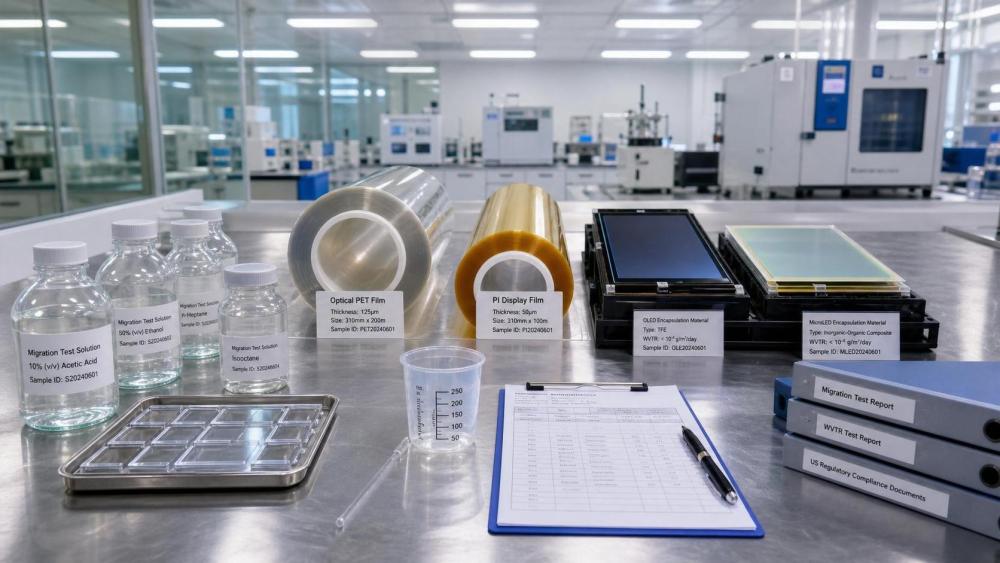
What the revised FDA guidance changes
The confirmed change is that the FDA guidance titled Guidance for Industry: Migration Testing of Optical PET and PI Films Used in Display Applications (2026 Revision) became effective on July 11, 2026.
According to the provided summary, the revision tightens the migration limit for DEHP in PI substrates to 0.05 mg/kg, down from 0.3 mg/kg.
The same revision also requires all optical films used for OLED and MicroLED module encapsulation to submit a complete migration kinetics model report.
The scope described in the input covers all display film suppliers exporting to the United States, including major Chinese optical film manufacturers.
Where pressure is likely to appear across the supply chain
Export-facing film suppliers may face a higher documentation threshold
From an industry perspective, suppliers shipping display films to the U.S. may be affected first because the rule change is tied directly to market access and compliance review. The impact is likely to appear in product qualification files, customer documentation packages, and pre-shipment compliance preparation. What deserves closer attention is whether existing test reports and technical files are sufficient under the revised threshold and the new modeling requirement.
OLED and MicroLED packaging-related manufacturing steps may need closer alignment
Manufacturers involved in OLED and MicroLED module encapsulation may be affected because the mandatory reporting requirement is linked to films used in those applications. The practical issue is not only the material itself, but also whether supporting technical documentation can move in step with customer audits, internal approval gates, and shipment release processes. Analysis shows that coordination between material specifications and compliance paperwork may become more important in these product lines.
Procurement and sourcing teams may need to re-check supplier readiness
Procurement functions may need to confirm whether suppliers can provide evidence aligned with the revised migration limit and the required migration kinetics model report. The likely pressure points are supplier onboarding, approved vendor lists, contractual technical attachments, and replacement-source planning. Observably, this is less about a broad commercial adjustment and more about whether sourcing decisions can still support uninterrupted delivery into U.S.-bound programs.
Testing and compliance service providers may see greater review depth
Testing service providers and compliance support teams may be affected because the revision points to a more demanding documentation standard for covered films. The issue to watch is the completeness and consistency of test records, model reporting materials, and submission-ready technical files. It is more appropriate to understand this as a signal that documentary sufficiency may receive closer scrutiny in relevant transactions and approvals.
What companies should review now
Check whether existing compliance files still match the revised limit
Analysis shows that companies exporting covered films to the U.S. should first review whether current DEHP migration test results for PI-based materials remain aligned with the new 0.05 mg/kg threshold. Where internal files were built around the previous limit, the gap may appear in qualification status, customer disclosure materials, or shipment support documents.
Prepare for fuller technical reporting on covered film applications
For optical films used in OLED and MicroLED module encapsulation, the new requirement for a complete migration kinetics model report deserves immediate attention. Companies should focus on whether their current technical dossier, test package, and supporting material declarations are organized in a way that can support customer review or compliance submission under the revised guidance.
Track contract, tender, and customer-document changes
Observably, the rule itself is only one part of execution. What deserves closer attention is whether procurement specifications, customer approval documents, tender requirements, or supplier qualification forms begin to reflect the revised migration threshold and reporting obligation. Where those downstream documents change, the operational impact may appear quickly in order confirmation and delivery timing.
Watch for execution language and review practice
The input does not provide detailed enforcement procedures or review criteria, so companies should avoid treating the market response as fully settled. A practical near-term focus is to monitor official wording, customer compliance requests, and documentation expectations as they develop, especially for U.S.-bound supply relationships involving regulated material disclosures.
How this development is best understood at this stage
Analysis shows that this update is more than a routine wording change because it combines a stricter numerical migration limit with a mandatory reporting requirement for specific display applications. At the same time, it would be premature to describe all downstream consequences as fixed, since the input does not provide detailed execution practice, review timelines, or market-level outcomes.
It is more appropriate to understand this as an already effective compliance signal with direct relevance for exporters and supply-chain participants serving the U.S. market. The part that still requires observation is how consistently the revised limit and reporting requirement are reflected in customer audits, procurement documents, and practical submission expectations.
Why the market will keep watching this revision
From an industry perspective, the immediate significance lies in the fact that the rule has already taken effect and applies to suppliers exporting covered display films to the United States. The clearest current takeaway is that compliance work for PI-based materials and encapsulation-related optical films may need to become more document-intensive and more threshold-sensitive.
Observably, this should be read neither as a broad market forecast nor as a completed enforcement outcome. It is better understood as a live rule change with direct operational relevance, while the pace and depth of implementation across procurement, qualification, and delivery workflows still need continued observation.
Basis of this article and items still requiring verification
This article is based on the user-provided news title, event date, and event summary. For developments of this type, commonly relevant source categories may include official regulatory releases, notices from competent authorities, customs or trade-administration information, industry association updates, standard-setting documents, and reporting by established professional media.
A specific official source link was not provided in the input, so the exact official publication path still requires follow-up verification. Ongoing attention should remain on any detailed implementation language, compliance review practice, tender-document changes, market feedback, and how affected companies adjust their documentation and delivery processes.
Have questions about this sector analysis, or seeking best practices specific to your niche? Drop us a line below and let the senior consultants at APIM assist you.
We respect your privacy. Your information is strictly confidential.
Related News
- 00
0000-00
How does washing affect contamination in post-consumer recycled PP resins? - 00
0000-00
How does feedstock affect depolymerization equipment selection? - 00
0000-00
US Sets 213.44% Preliminary Antidumping Deposit on Chinese PTMEG - 00
0000-00
When should epoxy be used as a thermal interface material for semiconductors? - 00
0000-00
US Midterm Results Unlikely to Quickly Shift Recycled Plastics Market or Legislation