




Do protective films reduce the optical clarity of OLED displays?
Yes. A protective film can reduce the optical clarity of an OLED display, but the effect ranges from barely perceptible to clearly visible. The outcome depends on how the film and its adhesive transmit, scatter, and reflect light—and on how well the film is applied. A smooth, optically clear construction can protect the surface with little apparent change, while a textured finish, trapped air, or an incompatible adhesive can make the image look hazy, less sharp, or different in color.
The important distinction is between a change in the light emitted by the display and a change in how that light reaches the viewer. A protective film does not necessarily alter the OLED pixels themselves. It adds an optical layer above the existing display stack, however, and that layer can affect perceived brightness, contrast, sharpness, and color under particular viewing conditions.
Where optical losses occur
Light from an OLED panel passes through several existing layers before it reaches the viewer. Depending on the display design, these can include encapsulation, touch components, a polarizer, optical adhesives, and cover glass or another protective surface. An added film introduces its own substrate, adhesive, surface treatment, and interfaces into that path.
Even a transparent material is not optically invisible. Some light can be absorbed within it; some can be reflected at boundaries between materials with different refractive indices; and some can be scattered by surface texture, particles, or irregularities. The magnitude and visibility of these effects depend on the complete assembly, not just the film substrate.
Bonding matters because an air gap creates additional interfaces. An optically clear adhesive fills much of the space between the film and display surface, reducing the refractive-index discontinuity compared with an unfilled air interface. It does not eliminate all reflection or guarantee a defect-free image. Bubbles, incomplete wetting, and adhesive variations can still introduce localized optical defects.
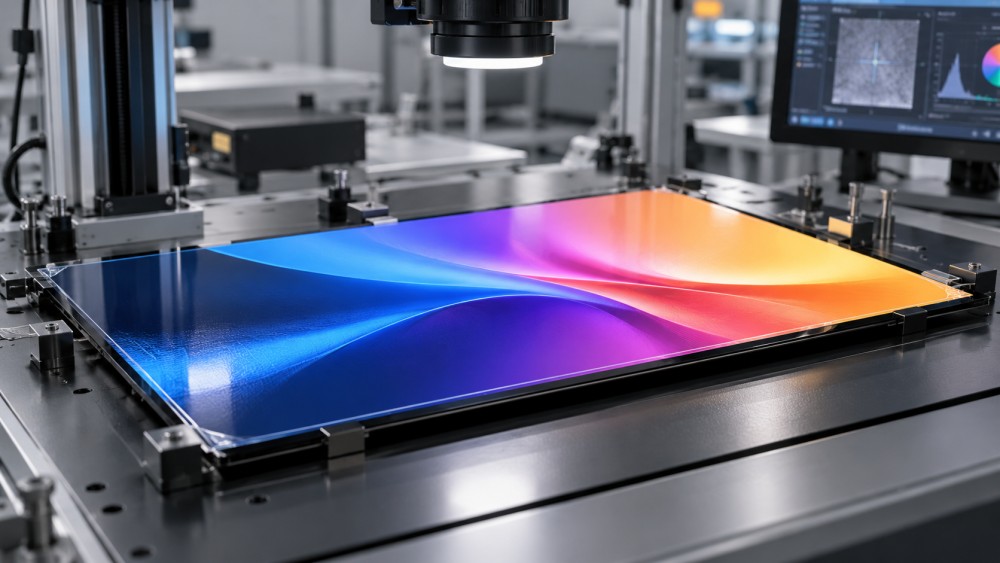
It is also important to distinguish a removable shipping or processing film from a film intended to remain on the display in use. A temporary film may be designed primarily for handling protection and clean removal; its appearance should not automatically be taken as representative of the finished display. Conversely, a film specified for permanent use needs optical performance that remains acceptable after installation and environmental exposure.
Transmission and haze describe different effects
Light transmission indicates how much incident light passes through a material under specified measurement conditions. Lower transmission can reduce the luminance reaching the viewer and may require a higher display brightness setting to produce a similar appearance. A transmission value alone, however, does not show whether the transmitted light preserves image detail.
Haze describes the proportion of transmitted light scattered beyond a defined angular range. A hazy film can pass substantial light while spreading some of it away from its original path. On a display, that scattering can soften fine text, reduce the apparent separation between bright and dark features, or create a milky appearance over the image.
The distinction matters when comparing datasheets. Two films with similar total transmission can produce different images if one scatters more light. Equally, two materials with similar haze figures can differ in absorption, reflection, color, or surface appearance. Measurement geometry, wavelength range, specimen construction, and whether a release liner was present can all affect the reported result.
Haze is not the only measure of image definition. Clarity, in the optical measurement sense, concerns light scattered through small angles and can be relevant to how sharply details are seen through a film. An aggregate haze value may not fully predict the appearance of fine OLED pixel patterns or small text. The most useful comparison combines material measurements with evaluation on the intended display.
Surface finish changes the trade-off
A glossy, smooth protective film generally preserves image sharpness better than a strongly textured film because it introduces less deliberate surface scattering. Its limitation is that reflections of lamps, windows, and other bright objects can remain distinct. A display may look clear in a dark room yet be difficult to read when reflected surroundings compete with the image.
An anti-glare film addresses that problem by scattering reflected light across a wider area. This can make a reflected light source less distracting, but the same surface texture can scatter light leaving the display. The result may be reduced apparent sharpness or contrast. Some textures can also produce a grainy or sparkling appearance as they interact with the display’s pixel structure.
An anti-reflection coating works differently: it is designed to reduce reflected light through optical interference rather than primarily diffusing it. Its performance depends on wavelength, viewing angle, coating design, and the underlying stack. “Anti-glare” and “anti-reflection” should therefore not be treated as interchangeable descriptions.
For an OLED display used in bright ambient light, reduced external reflection can improve perceived contrast even if a film introduces some transmission loss. In a dim environment, where reflected light is less troublesome, the same surface treatment may offer less benefit while its effect on image sharpness remains visible. The appropriate finish depends on the lighting and image content the display must support.
Why OLED image quality is sensitive to the surrounding stack
OLED pixels emit their own light, allowing dark image areas to be very dark under suitable conditions. That makes unwanted reflections and scattered light significant: they can raise the apparent brightness of dark regions or spread light from bright features into adjacent areas. A protective film cannot improve the panel’s intrinsic black emission, but it can change the apparent black level and contrast seen in a particular environment.
Color is another stack-level issue. A film that absorbs or reflects wavelengths unevenly can shift the display’s white point or alter the balance between colors. A faint tint in the film or adhesive may be difficult to notice by looking through a loose sample but visible over a uniform white or gray screen. The effect can also change with viewing angle.
Mechanical stress introduces a separate concern. Some polymer films are birefringent: their optical behavior varies with direction, particularly when they are stretched or stressed. In combination with polarized light and polarizing layers already present in a display, this can produce colored patterns or changes in brightness as the viewing angle or orientation changes. The effect depends on the particular film and display stack; it cannot be inferred from the polymer name alone.
Pixel-related artifacts deserve attention on high-resolution panels. Surface texture, adhesive nonuniformity, or patterns in a film can interact visually with the pixel structure, producing sparkle or moiré-like effects. These are spatial effects rather than simple reductions in average transmission, so a single optical percentage may not capture them.
The adhesive and installation can be the limiting factors
Optical film performance is determined by more than the base material. An adhesive can be clear in isolation but still introduce visible defects if it does not wet the display surface evenly. Contamination, surface coatings, film stiffness, lamination pressure, and application method all influence the final bond.
Common defects include bubbles, dust inclusions, wrinkles, edge lifting, and small regions of incomplete contact. These do not necessarily affect the whole screen, but localized defects are conspicuous over uniform images and can be unacceptable even when average transmission and haze measurements are good.
Adhesive compatibility should be assessed against the actual surface being protected. A cover glass may have an anti-fingerprint or other functional coating that changes wetting and adhesion. A removable protective film also has to release without leaving residue or damaging that surface. Stronger adhesion is not inherently better if removal damages a coating or makes the film difficult to replace.
Environmental exposure can change appearance after an initially successful application. Heat, humidity, light exposure, and repeated temperature changes can affect adhesive stability, edge adhesion, or discoloration, depending on the materials used. Flexible displays add mechanical demands: bending can strain the film and bond, so optical inspection should include the relevant curved or folded condition rather than only a flat sample.
How to evaluate clarity on the finished display
A useful evaluation starts with a baseline measurement and visual record of the display without the candidate film. The same display, settings, viewing geometry, and ambient lighting should then be used after application. Comparing different panels without accounting for panel variation can make a film effect difficult to isolate.
Review supplier optical data, but confirm what was actually measured: the substrate alone, the film with adhesive, or the complete applied construction. Note the test conditions and whether values are typical results or specification limits. A clear substrate does not establish the optical quality of the adhesive bond, and a measurement through a release liner does not necessarily represent the installed film.
On the assembled display, the following observations address different failure mechanisms:
- White and gray fields: reveal tint, unevenness, contamination, bubbles, and adhesive defects.
- Dark fields in controlled ambient light: help distinguish changes in apparent black appearance and reflected surroundings.
- Fine text, lines, and pixel-level patterns: expose softness, sparkle, or pattern interaction that broad transmission measurements may miss.
- Multiple viewing angles: reveal angular color changes, reflection differences, and stress-related patterns.
- Representative lighting: shows whether a reduction in glare compensates for any loss of sharpness in the intended environment.
Instrumented measurements can supplement visual inspection. Depending on the requirement, these may include luminance, chromaticity, contrast under defined illumination, reflectance, haze, and transmission. If color accuracy is important, measurements should be made across relevant colors and viewing angles rather than relying only on white-point appearance. The acceptance limits should reflect the display’s intended use; a reading interface in a bright factory and a color-critical display do not necessarily need the same balance of properties.
Finally, repeat the relevant optical and adhesion checks after the environmental or mechanical exposure specified for the application. A film that looks clear immediately after lamination is not fully evaluated until its appearance, bond, and removability—where required—have been checked under the conditions it is expected to encounter.
The decisive question is therefore not whether a protective film changes light at all; every added layer can do so. It is whether the change remains acceptable in the complete OLED assembly, under the lighting, viewing angles, handling, and service conditions for which the display is intended.
Have questions about this sector analysis, or seeking best practices specific to your niche? Drop us a line below and let the senior consultants at APIM assist you.
We respect your privacy. Your information is strictly confidential.
Related News
- 00
0000-00
How does washing affect contamination in post-consumer recycled PP resins? - 00
0000-00
How does feedstock affect depolymerization equipment selection? - 00
0000-00
US Sets 213.44% Preliminary Antidumping Deposit on Chinese PTMEG - 00
0000-00
When should epoxy be used as a thermal interface material for semiconductors? - 00
0000-00
US Midterm Results Unlikely to Quickly Shift Recycled Plastics Market or Legislation
Tag