




Do Protective Films Reduce Optical Clarity on OLED Panels?
Yes. A protective film can reduce the apparent optical clarity of an OLED panel, but the result is not determined by the presence of a film alone. A well-matched optical protection layer can remain nearly invisible in normal viewing, while a poorly selected or poorly applied film can introduce haze, glare, color shifts, reduced contrast, edge distortion, or a textured appearance. The relevant question is whether the complete stack of film, adhesive, cover surface, and installation process preserves the display characteristics required for its intended viewing conditions.
OLED panels are especially sensitive to surface changes because their perceived image quality depends heavily on deep black levels, high contrast, saturated color, and wide viewing angles. A thin surface layer that looks clear when held in the air can still alter the image after lamination. Reflections from multiple interfaces, adhesive nonuniformity, surface microtexture, and local air gaps become visible against dark OLED content more readily than they would on a conventional bright display.
Clarity is not a single property
“Clear” is often used as a broad commercial description, but several different optical effects determine whether a protective film looks acceptable on an OLED display. Light transmission matters, yet high transmission alone does not guarantee a clean image. A film may pass most incident light while scattering enough of it to soften text edges, wash out dark scenes, or create a faint milky veil under bright ambient light.
Haze and transmission are frequently misread as interchangeable. They are not. A surface can show high transmission and still create objectionable haze. Likewise, a matte film can deliberately increase scatter to reduce mirror reflection; that may improve outdoor readability in some situations while reducing the crisp, high-contrast appearance expected from a glossy OLED surface. The correct choice follows the viewing environment and display finish, rather than a single clarity value on a data sheet.
Where optical losses enter the film stack
A protective construction usually contains more than a base film. It may include a hard coat, primer, pressure-sensitive adhesive, release liner, anti-fingerprint coating, anti-glare texture, or a removable temporary protection layer. Each layer adds an optical interface or a processing variable.
The base film is commonly a transparent polymer such as PET, TPU, COP, COC, or another optical-grade material selected for flexibility, dimensional stability, impact behavior, and coating compatibility. Material choice affects more than transparency. Internal orientation from film production can create birefringence, meaning that polarized light travels differently along different directions. Because OLED modules often include polarizing elements or optical compensation films, residual birefringence may become visible as color variation, rainbow effects, or contrast changes at certain viewing angles.
Thickness also has a practical optical role. A thicker film can offer better puncture resistance and handling stiffness, but it increases the distance between the viewer and the emissive display. That separation can make edge reflections more noticeable and may alter the perceived alignment of pixels or touch graphics when viewed off-axis. Thickness alone is not automatically harmful; uniform thickness and controlled optical bonding are more important than simply choosing the thinnest possible film.
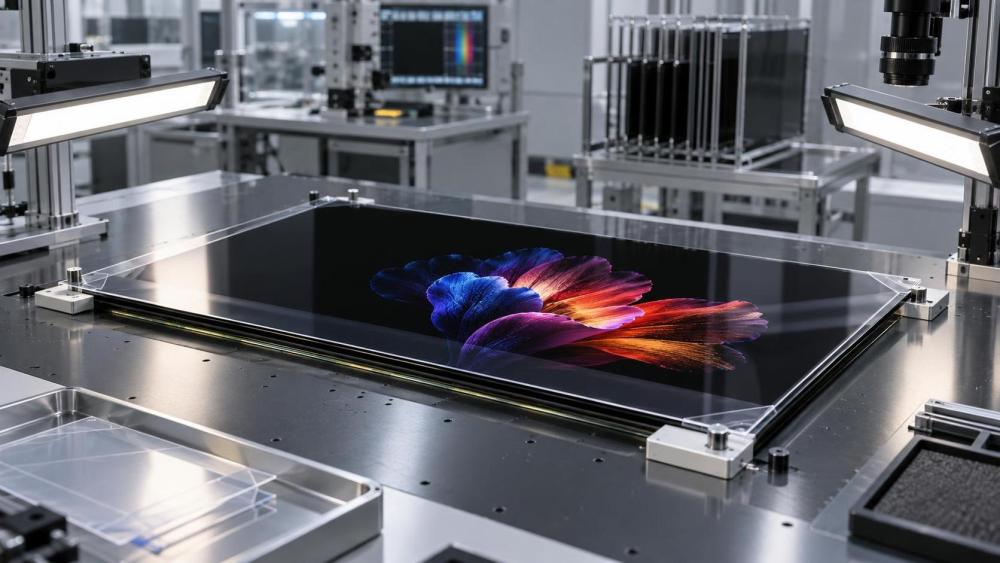
Adhesive behavior is often the dividing line between a film that appears invisible and one that makes a premium display look compromised. A clear pressure-sensitive adhesive must wet the display surface consistently without trapping air, forming flow marks, or leaving local thickness variation. Uneven adhesive thickness can produce Newton-ring-like interference patterns, particularly over smooth glossy surfaces. These colored or dark circular patterns are sometimes blamed on the film substrate even though the actual cause is a microscopic gap or nonuniform contact zone.
Optically clear adhesive is a functional description, not a guarantee that every adhesive will suit every stack. Its refractive index, flow behavior, curing state, moisture response, and long-term resistance to yellowing must be considered alongside the surface energy of the layer it contacts. A film can be optically sound before lamination but develop visible defects after temperature cycling, pressure exposure, or extended humidity because the adhesive relaxes, absorbs moisture, or loses edge adhesion.
Glossy, matte, and anti-reflective surfaces behave differently
A glossy protective film preserves the sharp, high-contrast character of a polished OLED surface when its finish is smooth and the adhesive bond is uniform. Its drawback is reflected ambient light. Strong specular reflection can obscure dark content even when the display itself has excellent contrast. Fingerprints and fine scratches are also more obvious on a high-gloss surface unless an effective top coat is present.
Matte and anti-glare films reduce mirror reflection by using controlled surface texture or light-scattering structures. The tradeoff is intrinsic: scatter that suppresses reflected glare can also scatter emitted display light. Fine text may appear less defined, dark areas may look lighter under room illumination, and high-resolution pixel detail can lose some visual precision. The amount of texture matters. A coarse anti-glare surface can create visible sparkle, where individual bright pixels appear to shimmer as the viewing angle changes. This is particularly noticeable on white backgrounds, small fonts, and high-pixel-density OLED panels.
Anti-reflective coatings follow a different approach. Rather than relying mainly on surface roughness, they use thin optical layers to reduce reflection at interfaces. A good anti-reflective system can retain a smoother image than a strongly matte surface, but coating thickness control, coating adhesion, abrasion resistance, and color neutrality become more demanding. Minor variation in thin-film coating behavior can produce a residual tint or angle-dependent reflection color. A film described as anti-reflective should therefore be evaluated in the actual display stack, not judged only by a sample viewed on a white backing sheet.
Installation defects often look like material defects
Even an appropriate film can visibly degrade an OLED panel when the application environment and lamination method are poorly controlled. Dust particles create point defects and local lifting. Fibers from wipes or release liners can look like trapped contamination. A small air channel at an edge may expand after thermal exposure and become a broad bubble. Excessive application pressure can stress a flexible panel or cause adhesive displacement, while insufficient pressure leaves incomplete wet-out.
Surface preparation requires restraint. Residual oils, silicone-containing cleaners, cleaning-agent surfactants, and moisture can interfere with adhesion or produce patchy optical contact. Aggressive solvents present a separate risk: they may damage coatings, soften adhesive residues, or alter printed border inks around the display. The cleaning chemistry must be compatible with the outermost panel surface and fully removed before lamination.
Temperature matters during both application and use. Adhesives become less able to flow at low temperature, so immediate bond appearance may include small unbonded regions that later change as the adhesive equilibrates. At elevated temperature, a film with mismatched thermal expansion can place stress on the stack, especially near cutouts, curved edges, and narrow border regions. This is why a visually clean room-temperature installation does not by itself establish long-term optical performance.
A practical evaluation sequence
Start by defining the display surface and the reason for protection. A temporary shipping film, a removable scratch guard, and a permanently laminated cover layer should not be evaluated by the same criteria. Temporary films may prioritize clean removal and process protection. A permanent layer must retain optical quality, adhesion, and surface durability throughout the expected operating environment.
- Inspect the bare OLED module first under the intended lighting conditions. Record baseline brightness, black appearance, white balance, reflected-image quality, and viewing-angle behavior before the film is introduced.
- Review the complete construction rather than only the base-film specification: substrate, coatings, adhesive, liner, total thickness, surface finish, and any curing or dwell requirements all influence the final image.
- Laminate representative samples using the intended cleaning, alignment, pressure, and temperature conditions. Hand-applied samples can be useful for early screening, but they may not represent a controlled production process.
- Examine dark, gray, white, saturated-color, and fine-text test images under low ambient light and under strong directional illumination. Different defects become visible in different image fields.
- Repeat the inspection after realistic handling and environmental exposure. Look for bubbles, edge lift, haze increase, yellowing, interference patterns, coating damage, and changes in touch response where applicable.
Viewing angle should be part of the evaluation, especially for larger panels, automotive displays, foldable assemblies, and devices held close to the face. A film that appears neutral at normal incidence may show a color cast or reflection shift when tilted. This can arise from birefringence, anti-reflective coating behavior, or the interaction of the film with an existing polarizer.
Do not judge clarity from a single sample metric
Data-sheet values are useful for narrowing options, but they cannot fully predict the installed appearance. Haze measured on an isolated film does not include adhesive wet-out, the optical behavior of the OLED cover surface, local pressure variation, or the ambient reflections encountered in use. Similarly, total transmission does not show whether the loss is spectrally neutral. A small reduction in blue, green, or red transmission can shift the perceived white point even where the overall transmission value still appears high.
Surface hardness should also be interpreted carefully. A hard-coated film can resist visible scratches, yet the coating may add reflectivity, crack under bending, or develop micro-scratches that scatter light after repeated cleaning. Flexible OLED assemblies need a film and coating system that retain adhesion and surface integrity through their expected bend radius or handling deformation. A rigid optical film can look excellent on a flat sample and fail visually after flexing.
Removal behavior deserves attention when the layer is intended to be temporary. Adhesive residue, coating transfer, or localized changes in surface gloss after peeling can affect the final display appearance even after the film is gone. The release force must be stable enough to avoid accidental lift during transport while remaining compatible with the panel surface and removal temperature.
Reading visible symptoms correctly
A cloudy appearance across the full panel usually points toward film haze, a matte surface, or dispersed adhesive scatter. Cloudiness concentrated around edges is more likely related to incomplete bonding, contamination, edge stress, or adhesive migration. Circular rainbow marks indicate interface spacing or adhesive nonuniformity rather than ordinary haze. Sparkle on bright fields suggests excessive anti-glare texture. A yellow or blue cast across the panel requires investigation of spectral transmission, coating behavior, adhesive aging, and interaction with polarized layers.
These distinctions matter because replacing the film with a thinner version will not solve every defect. A thinner glossy film may reduce separation from the panel but will not correct dust, poor wet-out, or a mismatched adhesive. Switching to an anti-glare surface may suppress reflections while worsening sparkle. The useful response is to identify the mechanism visible in the assembled display, then adjust the relevant layer or process condition.
Protective films do affect optical clarity on OLED display panels whenever they change transmission, scatter, reflection, color balance, or interface uniformity. The effect can be negligible when an optical-grade construction is matched to the panel and applied under controlled conditions. It becomes obvious when material properties are evaluated in isolation, surface treatments are selected without regard to viewing conditions, or lamination defects are treated as minor cosmetic issues.
Have questions about this sector analysis, or seeking best practices specific to your niche? Drop us a line below and let the senior consultants at APIM assist you.
We respect your privacy. Your information is strictly confidential.
Related News
- 00
0000-00
Do polyolefin hot melt adhesives bond well to polyethylene? - 00
0000-00
Korean Study Finds PLA Barely Degrades in Landfill After 320 Days - 00
0000-00
How to assess batch consistency from a thermal potting compounds supplier - 00
0000-00
How much weight can carbon fiber reinforced plastics save in cars? - 00
0000-00
Switching from PS to ABS Sheet Extrusion: Equipment Checks
Tag