




Do PET Protective Films Leave Residue When Removed from Glass?
PET protective films can leave residue when removed from glass, although a properly matched film should release cleanly within its specified application conditions. Residue becomes more likely when the adhesive ages, experiences unsuitable heat or sunlight exposure, or bonds too strongly to the particular glass surface. The PET backing does not determine clean removal by itself: the adhesive formulation, its attachment to the backing, and the conditions during contact all matter.
A film that peels cleanly immediately after application can behave differently after storage, transport, or processing. Clean removal therefore needs to be evaluated at the intended removal point, including the longest expected contact time and any temperature exposure along the way.
What actually remains on the glass?
Most self-adhesive PET protection consists of a polyester backing carrying a pressure-sensitive adhesive. During successful removal, separation occurs between the adhesive and the glass, while the adhesive stays attached to the backing. Visible residue indicates that this separation has changed: the adhesive has split internally, detached from the backing, or left transferable components on the surface.
These failure modes produce different appearances. Cohesive splitting can leave sticky patches on both the film and glass. Poor anchorage to the backing can leave a more continuous adhesive layer on the glass. Small amounts of transferred material can appear as streaks, haze, or an oily-looking film without obvious tackiness.
However, a visible mark is not automatically adhesive residue. Trapped moisture, cleaning-agent deposits, dust, and changes to a surface coating can all become apparent after protection is removed. Identifying the mark before attempting cleanup avoids treating a damaged coating as removable contamination.
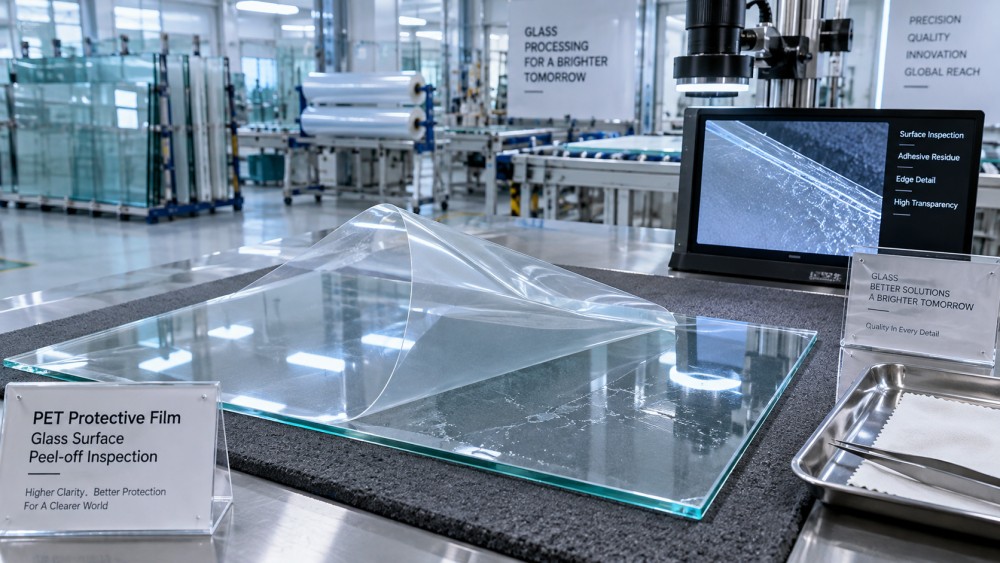
Why does a film remove cleanly at first but leave residue later?
Pressure-sensitive adhesives develop contact with glass as they conform to its surface. Application pressure starts this process, and contact can continue to develop during dwell. An immediate peel test therefore measures a different condition from removal after extended storage. Increasing adhesion does not necessarily cause residue, but it changes the balance between adhesion to glass, internal adhesive strength, and attachment to the PET backing.
Heat can accelerate contact development and alter adhesive behavior. If an adhesive softens excessively, its internal strength may become insufficient during peeling. Prolonged exposure can also age the formulation. The relevant temperature is the film-and-glass interface temperature, which can differ substantially from room air temperature when glass is exposed to direct sunlight or a heated process.
Sunlight adds another variable. UV exposure can change susceptible adhesives and other film components, affecting tack, brittleness, or removal behavior. A transparent PET backing is not evidence that the complete film is suitable for outdoor exposure.
The exposure sequence also matters. Warm storage followed by cooling before removal differs from peeling while the adhesive is hot. A film qualified for indoor handling should not be assumed suitable for a heating stage merely because its PET backing remains intact.
Does the adhesive type predict clean removal?
Adhesive chemistry helps narrow the choice, but broad labels such as acrylic, silicone, or rubber-based do not establish residue performance. Formulation, crosslinking, coating weight, and anchorage to the backing all influence the result. Two films carrying the same adhesive-family description can behave differently on the same glass.
Acrylic adhesives are widely used where aging stability and transparency are important. Rubber-based systems can provide strong initial tack, while their resistance to heat and oxidation varies with formulation. Silicone adhesives are used in applications requiring particular temperature or surface compatibility, but even a visually clean peel may require assessment for trace transfer before sensitive bonding or coating operations.
“Low tack” is also an incomplete specification. Peel force describes removal resistance under stated test conditions; it does not directly measure adhesive transfer. A film can have modest peel force and still leave contamination if its adhesive splits. Conversely, a film with higher peel force can release without transfer if the adhesive remains cohesive and firmly anchored.
Any quoted adhesion value needs context: the test substrate, dwell time, peel angle, peel speed, and temperature. A value measured on another substrate cannot establish performance on coated glass.
Is coated glass different from ordinary glass?
Yes. Uncoated glass, anti-reflective glass, conductive-coated glass, and glass with an oleophobic treatment present different surfaces to an adhesive. Surface energy and coating strength affect both the bond that forms and what happens when the film is peeled away.
A film that releases cleanly from untreated glass may adhere poorly to a low-surface-energy treatment. Increasing tack to prevent lifting can create a different problem if the surface coating is weakly attached. Removal then risks lifting the coating even when no adhesive residue remains.
Low-emissivity glass requires particular attention to which surface receives the film. The coated face and the opposite glass face are not interchangeable test substrates. Cleaning methods that are acceptable for bare glass may also be unsuitable for exposed functional coatings.
Printed borders, textured areas, and transitions between coatings can produce uneven contact. A flat central coupon may pass while adhesive accumulates or stretches near a printed edge. Qualification should include the actual surface features beneath the protection, especially where removal begins.
How long can PET protection stay on glass?
There is no universal safe contact time for all PET protective films. The appropriate limit belongs to the complete adhesive-and-backing construction under defined conditions. Shelf life before application and permitted dwell time after application are separate specifications.
A stated removal window is useful only alongside its exposure limits. Controlled indoor storage and direct outdoor sunlight are different service conditions. Similarly, a film permitted to remain on glass during transport is not automatically suitable for every subsequent processing step.
Record the application date and any significant heat or outdoor exposure. This makes an unexpected residue event easier to diagnose and prevents early samples from being compared with glass that has remained protected much longer. If project timing exceeds the qualified dwell period, test that extension before adopting it.
What removal technique reduces adhesive transfer?
Start with the film supplier’s removal instructions and the glass coating’s handling limits. Support the pane securely and begin at an accessible edge without pressing a sharp tool against the surface. Maintain a controlled pull so the adhesive separates steadily rather than stretching and snapping through repeated jerks.
Peel geometry affects the force and deformation at the separation front. Folding the film back toward itself is a useful starting approach for many constructions, but the best angle should be established on the actual film-and-glass combination. A universal angle or speed would overlook differences in adhesive response and fragile coatings.
If residue begins to appear, pause and inspect both surfaces. Pulling harder can increase adhesive stretching without resolving the cause. Changing the peel rate or allowing excessively warm glass to return to the approved removal range may improve separation, provided the film instructions support those conditions.
Heating is not a universal remedy. Gentle warming helps release some adhesives, while excessive warming promotes softening and transfer in others. Localized heating also creates temperature gradients in glass. Use only a validated method rather than improvising with concentrated heat.
How should residue be removed without damaging the surface?
First establish whether the exposed surface is bare glass or a coating, and identify any nearby seals, printed features, or bonded parts. Cleaner compatibility applies to the entire assembly. A solvent tolerated by glass itself can damage edge materials or dissolve an adjacent print.
Begin with the least aggressive cleaning method approved for that surface. Loose dirt and water-soluble deposits may respond to a suitable detergent and clean water, while adhesive residue may require a compatible cleaner recommended for the adhesive. Isopropyl alcohol is useful for some contamination, but it does not dissolve every pressure-sensitive adhesive and should not be assumed suitable for every coating.
Test a small, inconspicuous area before wider treatment. Use a clean, nonabrasive wipe and replace it as contamination transfers. Repeatedly wiping with the same loaded cloth spreads dissolved adhesive and can leave a thin haze over a larger area. Keep cleaning liquid away from vulnerable edges and openings.
Avoid dry rubbing, abrasive pads, and unapproved scraping on coated or optical surfaces. If a mark survives compatible cleaning without changing, reassess the diagnosis instead of escalating solvent strength or abrasion. Persistent reflection changes can indicate surface alteration rather than removable adhesive.
What evidence supports a “residue-free” claim?
A useful clean-removal evaluation reproduces the actual application and removal conditions. Apply the candidate film to representative glass using the intended cleaning method and application pressure. Include relevant coatings, printed features, and edge conditions, then expose samples to the expected dwell period and processing environment.
The assessment should cover both normal conditions and credible process extremes. If glass sometimes waits longer before removal or experiences a warm transport stage, include those conditions. An accelerated aging test can support evaluation, but an arbitrary high-temperature exposure does not establish a reliable equivalent to real service time without a validated relationship.
After peeling, inspect under consistent lighting, including reflected light that reveals streaks. Compare the protected area with an untreated reference and examine the removed film for adhesive disruption. Record removal behavior, visible contamination, and any coating change separately; a low peel force alone is insufficient evidence.
Acceptance criteria should reflect what happens next. Glass used only for visual presentation may be assessed differently from a surface that will receive an optical coating or adhesive bond. Trace contamination invisible during routine inspection can affect wetting or adhesion, so sensitive applications need a relevant surface assessment or downstream process trial.
A meaningful specification ties clean removal to a named glass surface, defined exposure conditions, a removal method, and an inspection criterion. That makes “residue-free” a verifiable requirement rather than an undefined label.
Have questions about this sector analysis, or seeking best practices specific to your niche? Drop us a line below and let the senior consultants at APIM assist you.
We respect your privacy. Your information is strictly confidential.
Related News
- 00
0000-00
Do polyolefin hot melt adhesives bond well to polyethylene? - 00
0000-00
Korean Study Finds PLA Barely Degrades in Landfill After 320 Days - 00
0000-00
How to assess batch consistency from a thermal potting compounds supplier - 00
0000-00
How much weight can carbon fiber reinforced plastics save in cars? - 00
0000-00
Switching from PS to ABS Sheet Extrusion: Equipment Checks