




Do Acrylic Sheets Need Surface Treatment for Print Adhesion?
Do Acrylic Sheets Need Surface Treatment for Print Adhesion?
Do acrylic sheets need surface treatment for printing adhesion? The practical answer is: not always, but assuming that untreated acrylic will print reliably is a common and expensive mistake. PMMA, commonly called acrylic, has an attractive combination of optical clarity, gloss, weather resistance, rigidity, and machinability. Those qualities make it a familiar substrate for retail displays, signage, point-of-sale units, machine guards, nameplates, lighting panels, interior components, and decorative industrial parts.
Its appearance, however, should not be confused with a guaranteed printing surface. Ink adhesion depends on whether the ink can wet the sheet, form a stable interface, cure correctly, and remain attached through handling and service. Surface condition, acrylic grade, printing technology, ink chemistry, protective-film residue, storage conditions, and the finished product’s exposure environment all affect that result.
For a short-lived indoor graphic, careful cleaning and a compatible ink may be sufficient. For a printed panel exposed to abrasion, cleaning chemicals, heat, humidity, outdoor weathering, repeated flexing, or automotive-interior conditions, a more deliberate surface-preparation plan is often justified. The question is therefore not simply whether acrylic “needs treatment,” but what level of preparation is appropriate for the intended print performance.
Why a Visually Clean Sheet Can Still Produce Weak Adhesion
Printing is an interfacial process. Before an ink can bond, it must spread evenly over the substrate rather than bead, retract, or leave pinholes. This behavior is strongly influenced by surface energy and contamination. Acrylic generally offers a more printable surface than low-surface-energy polyolefins such as polyethylene or polypropylene, but that does not mean every acrylic sheet behaves identically on press.
Acrylic sheets may carry dust, static charge, fingerprints, processing lubricants, polishing residues, plasticizer-free protective-film adhesive traces, or airborne oils from fabrication areas. Even a thin, nearly invisible layer can interfere with wetting. A sheet that prints well immediately after delivery may produce inconsistent results after cutting, thermoforming, laser processing, stacking, or extended warehouse storage.
The sheet itself also matters. Cast and extruded acrylic can differ in surface characteristics, residual stress, thickness control, and response to solvents or heat. Specialty grades containing impact modifiers, UV-stabilizing packages, recycled content, colorants, matte textures, or co-extruded layers should be evaluated as distinct substrates. A print setting developed for clear cast PMMA should not automatically be transferred to a textured, colored, or modified acrylic grade.
One additional complication is that good initial adhesion is not the same as durable adhesion. Ink may look perfect after curing yet fail later during tape testing, scratch exposure, chemical cleaning, temperature cycling, or outdoor use. The relevant test is the one that reflects the actual application, not merely the appearance of the first printed sample.
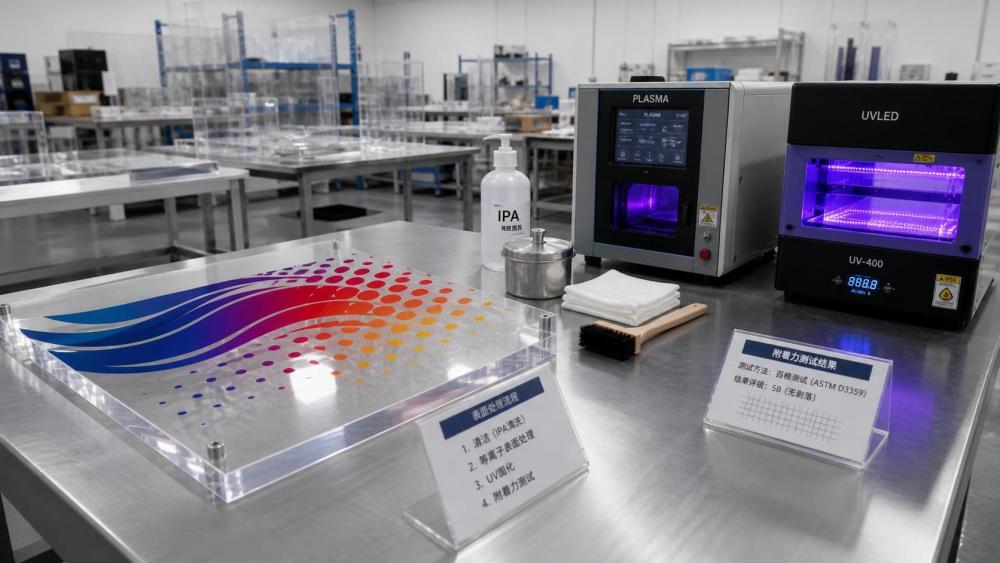
When Treatment Is Usually Unnecessary—and When It Is Not
Many digital UV printers, screen-printing systems, and other industrial processes can print directly onto properly cleaned acrylic when the ink supplier has confirmed compatibility with PMMA. This is especially plausible for indoor display graphics, protected back-printed panels, or components with limited physical and chemical exposure. Direct printing may be the most efficient route when production volumes are moderate and quality checks show consistent wetting and adhesion.
Treatment becomes more relevant when the application creates a narrow margin for failure. Examples include high-touch control panels, appliance fascias, reusable signage, protective labels, transport interiors, face-mounted graphics, chemically cleaned equipment covers, and prints that will be laminated, bonded, or overcoated after decoration. In these situations, surface preparation is a risk-control measure rather than an optional processing step.
Choosing Between Cleaning, Flame, Corona, Plasma, and Primer
Cleaning is the baseline, not a substitute for every other treatment. The goal is to remove contamination without introducing stress cracking, haze, or residue. Some solvents can attack acrylic or contribute to crazing, especially if the sheet contains residual stress from extrusion, machining, or thermoforming. The appropriate cleaning method should therefore be confirmed with both the sheet supplier and the ink or coating supplier. Clean cloths, controlled handling, and sufficient drying time are often as important as the cleaning fluid itself.
Flame treatment can modify the outermost surface and improve wettability when carefully controlled. It is fast and can suit continuous production, but its process window should be managed closely. Excess heat can affect appearance, generate local stress, or create uneven results around complex geometries. Flame treatment may be less convenient for delicate optical parts or thick, highly finished sheets where visual quality is critical.
Corona treatment is widely associated with films and web-based materials, though it may also be considered for suitable sheet-processing setups. It can raise surface energy and improve ink anchorage, but treatment uniformity, equipment configuration, and the time between treatment and printing all matter. Surface activation is not necessarily permanent. If treated sheets sit too long, collect contamination, or are handled excessively, the benefit can decline.
Atmospheric plasma offers another route for demanding applications, particularly where precise treatment, lower thermal load, or selective activation is useful. It may provide a controlled process, but the economic case depends on throughput, part geometry, automation level, and the cost of print failure. It should not be selected simply because it is technologically advanced.
Primers are often the most direct answer when a specific ink system needs a more compatible interface. They can improve bonding and sometimes broaden the process window, yet they introduce their own variables: coating weight, drying or curing conditions, shelf life, worker exposure controls, visual impact, and an additional quality checkpoint. A primer should be evaluated as part of the full ink-substrate system, not treated as a universal repair for poor process discipline.
The Print Method Changes the Decision
Screen printing remains relevant where opacity, specialty effects, durable color, or controlled ink build are important. Because screen inks can be formulated for PMMA, direct adhesion may be strong on a clean sheet. Still, mesh selection, ink deposit, solvent balance, drying conditions, and multi-color sequencing can influence the final bond. A print that is under-dried between colors or incompletely cured may fail even if the substrate preparation was correct.
UV digital printing is popular for short runs, variable graphics, and direct-to-substrate workflows. It offers speed, but high cure speed does not remove the need for compatibility. UV inks differ in flexibility, shrinkage behavior, pigment load, and adhesion profile. A rigid ink film on an acrylic part that later flexes, bends, or experiences thermal movement can crack or detach at the interface. Lamp output, print speed, ink layer thickness, and post-cure behavior deserve review.
Solvent-based, latex, and other ink technologies each bring different interactions with PMMA. Some systems may rely more on chemical affinity, while others depend largely on mechanical anchoring and cure. For reverse printing—where the graphic is viewed through clear acrylic—the demands can be stricter because defects, haze, trapped contamination, and inconsistent opacity become highly visible. Adhesion must also remain stable if a backing adhesive, coating, or secondary panel is added later.
A Better Qualification Process Than “Print and Pull Tape”
A simple tape check can be useful as an initial screen, but it should not be the only decision tool. It may reveal gross adhesion failure while missing issues caused by aging, abrasion, moisture, thermal exposure, or chemicals. Procurement teams should avoid accepting a vague statement that an acrylic sheet is “printable” without knowing the ink type, decoration method, intended exposure, and validation method behind that claim.
A practical qualification sequence begins with the exact commercial sheet grade, thickness, finish, protective-film condition, and production route. Print samples using the intended ink, printer settings, curing conditions, and artwork coverage. Then assess the risks that matter in service: rubbing during assembly, repeated cleaning, exposure to moisture or temperature change, contact with packaging materials, and the effect of any overprint varnish, adhesive, or laminate.
The most useful output is a documented process window: acceptable cleaning method, whether treatment is required, maximum delay between treatment and print, approved inks, cure conditions, handling requirements, and inspection criteria. This is particularly important when sheet supply comes from more than one source. Similar-looking PMMA products should not be assumed interchangeable for critical printed parts.
Frequent Causes of Adhesion Problems
When ink fails on acrylic, the root cause is often not the resin alone. Protective films are frequently overlooked. Their adhesive systems can leave low-level residues, especially when sheets have been stored under heat, pressure, or extended time. Operators may also remove the film, clean only selected areas, and then transfer contamination back to the surface through gloves, cutting tables, or stacked parts.
Another recurring issue is treating a surface and then waiting too long to print. Activation can diminish, and freshly treated sheets can attract dust. Poor treatment uniformity can create a puzzling pattern: the same artwork passes adhesion testing in one area but lifts at the edges or near the middle of the panel.
Cure errors are equally common. Low lamp output, aging lamps, unsuitable print speed, excessive ink laydown, incorrect drying, or incompatible overcoats can all be mistaken for a surface-energy problem. Before investing in treatment equipment, production teams should confirm the ink manufacturer’s recommended cure conditions and test the full system under controlled conditions.
Making the Material Decision Earlier
For converters, product developers, and buyers, print adhesion should be defined during material selection rather than after artwork has been approved. The key questions are straightforward: Is the sheet cast or extruded PMMA? Is it clear, colored, matte, impact-modified, UV-stabilized, or made with recycled content? Will the print be front-facing or reverse-printed? What will touch it during assembly and use? Which ink, coating, adhesive, and cleaning chemicals are involved?
This is the kind of cross-functional decision that benefits from connecting polymer behavior with converting and end-use requirements. Global Advanced Polymers & Industrial Materials Intelligence Network (APIM) approaches material questions through that broader chain: sheet formulation and extrusion conditions, surface characteristics, ink and adhesive compatibility, process control, and the performance demanded by the finished product. For printed PMMA, no single treatment method is universally correct. The defensible choice is the one validated for the exact sheet, print system, and service environment before production volume makes failure costly.
Have questions about this sector analysis, or seeking best practices specific to your niche? Drop us a line below and let the senior consultants at APIM assist you.
We respect your privacy. Your information is strictly confidential.
Related News
- 00
0000-00
Do polyolefin hot melt adhesives bond well to polyethylene? - 00
0000-00
Korean Study Finds PLA Barely Degrades in Landfill After 320 Days - 00
0000-00
How to assess batch consistency from a thermal potting compounds supplier - 00
0000-00
How much weight can carbon fiber reinforced plastics save in cars? - 00
0000-00
Switching from PS to ABS Sheet Extrusion: Equipment Checks