




How to select engineering thermoplastic compounds for battery systems
A battery enclosure that passes an initial fit check can still create serious problems later: a connector body may crack after coolant exposure, a busbar support may lose insulation resistance after heat aging, or a large molded cover may warp enough to compromise a seal. In battery systems, these failures rarely come from one weak datasheet value. They usually result from selecting a compound without matching its real operating environment, part geometry, joining method, and failure consequences.
The practical approach to selecting engineering thermoplastic compounds for battery systems is to begin with the component’s function and credible failure modes, then screen materials against the most demanding combination of thermal, electrical, chemical, mechanical, flame, and processing requirements. A compound should not be chosen simply because it has a high heat rating, a flame-retardant classification, or glass-fiber reinforcement. The right grade is the one that retains the required properties after molding, assembly, service exposure, and aging.
Start with the part’s job inside the battery system
“Battery component” is too broad to support a meaningful material decision. A high-voltage connector, a cell spacer, a module frame, a pack cover, a vent feature, and a cooling-plate manifold may all sit within the same assembly, but their material priorities differ sharply.
Before comparing resin families, define what the component must do and what happens if it does not do it. A housing may need to contain debris, support a gasket, protect electronics, and maintain a controlled clearance between live parts. A busbar carrier may primarily need electrical isolation, creep resistance, and dimensional stability. A cooling component may need hydrolysis resistance and long-term compatibility with a specific coolant mixture. This functional definition prevents teams from selecting an expensive high-performance polymer for a problem that is actually caused by poor geometry, or from choosing a low-cost grade that cannot survive its service conditions.
Build the requirement set around exposure, not room-temperature data
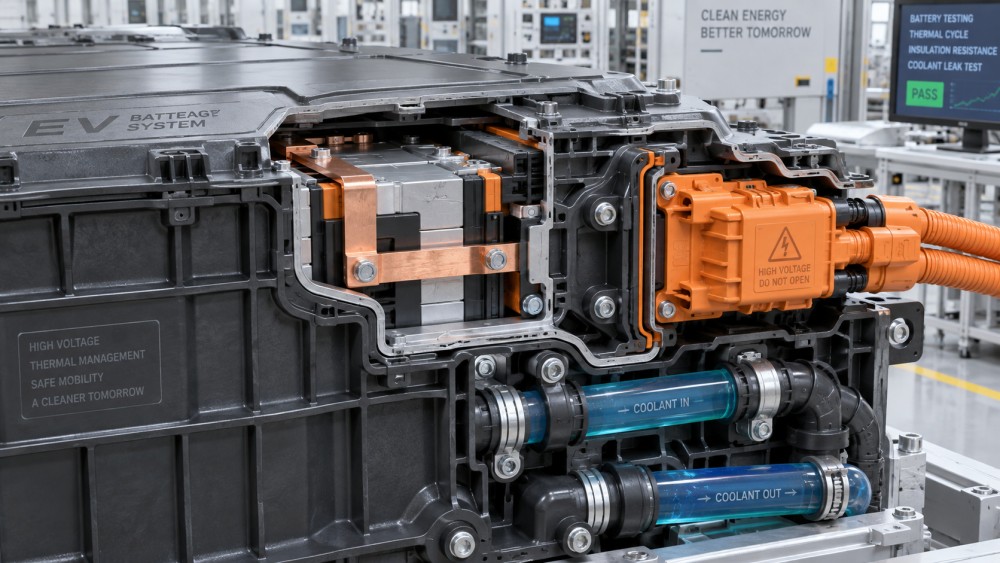
Battery systems create overlapping exposures. A part can be warm for long periods, see short higher-temperature events, contact moisture or glycol-based coolant, endure road vibration, and sit close to energized conductors. A material that performs well in a dry laboratory condition may behave differently after moisture uptake, thermal cycling, or chemical contact.
Thermal requirements should distinguish between continuous operating temperature, local hot spots, assembly temperature, and abnormal-event exposure. Continuous heat aging is often more relevant than a short-term temperature peak because it can reduce impact resistance, change stiffness, accelerate stress relaxation, or affect electrical behavior. Where a part is positioned near cells, current-carrying elements, chargers, power electronics, or thermal interfaces, map the temperature gradient across the actual part rather than assigning one generic system temperature.
Chemical exposure deserves the same discipline. Coolants, condensation, electrolyte residues, cleaning agents, adhesives, potting materials, lubricants, and sealants can each affect a polymer differently. Polyamides may offer excellent toughness and strength but can absorb moisture, affecting dimensions and electrical behavior. Polyester-based materials such as PBT may provide strong dimensional stability and electrical properties, but hydrolysis resistance must be assessed in wet and hot environments. Polypropylene may offer broad chemical resistance, though it may not meet the stiffness, heat, or flame-performance demands of every structural location. The question is not whether a resin is “chemical resistant”; it is resistant to the substances, concentrations, temperatures, contact durations, and stress state relevant to the component.
Flame performance must be interpreted in the assembled design
Flame-retardant compounds are frequently shortlisted first for battery applications, but a stated flame classification is only a starting point. The relevant thickness, color, reinforcement content, moisture condition, and molding process can all influence performance. A rating demonstrated on a standard specimen may not fully describe behavior in a thin rib, a weld line, a highly filled region, or a part with complex airflow around it.
Material selection should also consider the secondary effects of flame-retardant packages. Some formulations can influence flow behavior, surface appearance, plate-out, corrosion risk around sensitive metal components, mechanical retention after aging, or electrical tracking performance. These effects are not universal; they depend on the compound formulation and the application. A technically sound evaluation asks the supplier for grade-specific information at the proposed thickness and checks whether the same compound is appropriate for the intended electrical and mechanical environment.
Do not treat flame performance as a substitute for system-level safety design. Vent paths, isolation barriers, spacing, thermal propagation measures, fastener locations, and enclosure architecture determine how a material functions during an abnormal thermal event. A compound can support the design objective, but it cannot correct an inadequate venting concept or a component layout that creates direct heat exposure beyond the polymer’s service capability.
Electrical insulation involves more than dielectric strength
For high-voltage areas, electrical selection should account for dielectric strength, comparative tracking behavior, volume and surface resistivity, arc resistance where relevant, and retention of these characteristics after conditioning. Tracking resistance becomes especially important where conductive contamination, moisture, condensation, or residues may bridge surfaces over time. The molded part’s geometry matters as much as the number on a material data sheet: creepage distance, clearance, rib arrangement, sharp corners, insert placement, and surface condition can influence real electrical reliability.
Glass-fiber reinforcement often improves stiffness, thermal stability, and creep resistance, but it may introduce local surface variability and directional behavior. In high-voltage connectors and insulators, assess whether fiber orientation near the surface, knit lines, or gate areas could affect the intended electrical path. Mineral-filled formulations may provide lower warpage or more isotropic shrinkage in some designs, yet their electrical and mechanical balance should be checked rather than assumed.
Pay attention to moisture-conditioned properties
This is particularly important with hygroscopic materials. A dry-as-molded test may show one set of electrical and mechanical properties, while conditioned material can show another. That does not automatically disqualify a polyamide or similar resin; it means the validation condition should represent how the finished assembly will be stored and used. If the component requires tight electrical tolerances after humid exposure, dimensional movement and insulation behavior need to be included in the selection gate.
Choose reinforcement based on load path and dimensional risk
Reinforcement is often specified to increase stiffness or reduce creep, especially for module structures, brackets, and components that support cells or electrical hardware. The benefit is real, but reinforcement changes molding behavior. Glass-fiber-filled compounds can exhibit directional shrinkage, warpage, abrasive wear on tooling, and different strength across and along the flow direction. On a small, compact part, these effects may be manageable. On a broad cover with long flow paths, multiple gates, sealing flanges, or precision interfaces, they can become the central design issue.
Evaluate the actual load path. A component carrying sustained clamp load needs creep data at temperature, not merely tensile strength at room temperature. A snap-fit needs strain capability and fatigue resistance around the hinge or retention feature. A threaded boss needs suitable boss geometry, fiber distribution, and resistance to splitting. A metal insert may create concentrated stress during thermal cycling because the polymer and metal expand differently.
- Use unfilled or lightly filled compounds where impact retention, flexibility, or more uniform shrinkage is more important than maximum stiffness.
- Consider glass-fiber reinforcement where structural rigidity, heat-aged strength, and creep resistance govern the design, then verify orientation effects on the molded part.
- Assess mineral-filled grades when reduced warpage, surface stability, or isotropic behavior may be valuable, while confirming that impact and weld-line performance remain adequate.
- For conductive or thermally conductive compounds, confirm that the intended conductivity does not conflict with electrical isolation requirements elsewhere in the same part.
Material family selection should narrow options, not make the final decision
Several engineering thermoplastic families commonly appear in battery-system evaluations. Polyamide compounds can provide a useful balance of strength, toughness, heat performance, and processability, particularly in reinforced grades, but moisture management and dimensional change need attention. PBT compounds are often considered for electrical components because of their dimensional stability, electrical characteristics, and moldability; moisture and hydrolysis conditions remain important. PPS can be attractive where higher heat resistance, chemical resistance, and low moisture absorption are needed, although its inherent behavior, brittleness risk in some formulations, and processing requirements must match the design. Polycarbonate blends may be relevant for impact-resistant housings or covers, but chemical compatibility and long-term stress exposure should be checked carefully. High-temperature materials such as PPA, PPS, or specialty high-performance polymers may be justified near demanding heat sources, but a higher-temperature resin is not automatically the best choice for a large, impact-exposed, cost-sensitive enclosure.
The selection process becomes more efficient when each candidate is assigned a specific reason for being on the list. One material may be the baseline for manufacturability, another may address heat aging, and another may be retained because it offers better coolant resistance. A broad list of seemingly comparable grades often hides fundamentally different risks.
Do not separate material selection from molding and assembly
A compound is selected in pellet form but used as a molded, assembled part. Drying conditions, melt temperature, residence time, gate location, mold temperature, regrind policy, and cooling rate can all influence the final result. Hygroscopic materials that are not properly dried may show surface defects, reduced molecular integrity, or inconsistent properties. Flame-retardant and reinforced grades may require tighter process control to maintain appearance, flow, and mechanical consistency.
Request processing guidance early, especially for thin-wall connectors, large covers, parts with long flow lengths, and components containing inserts. Molding simulation can help identify likely weld lines, pressure requirements, fiber orientation, and distortion before tooling decisions become difficult to reverse. It should be treated as a design input, then confirmed through molded-part measurement and testing.
Assembly methods also affect the decision. Ultrasonic welding, vibration welding, hot-plate welding, adhesive bonding, overmolding, press-fit insertion, and mechanical fastening each impose different demands. A resin that is easy to mold may be unsuitable for a planned joining method. Conversely, changing joint design or weld geometry can allow the use of a more robust and readily processed compound.
Use a staged validation plan before locking the grade
Datasheet screening is appropriate for the first reduction of options, but it should not be the final approval gate. A useful validation sequence moves from material-level evidence to part-level evidence and then to assembly-level exposure. The exact tests depend on the component, yet the logic remains consistent.
- Define the service envelope. Document temperature range, contact media, voltage exposure, load type, vibration, impact risk, expected service duration, thickness range, and joining method.
- Screen candidate grades. Compare grade-specific thermal, electrical, flame, chemical, mechanical, and processing information at relevant thicknesses and conditioning states.
- Mold representative parts or test plaques. Include critical geometry where possible: weld lines, ribs, bosses, sealing faces, insert regions, and thin sections.
- Condition and age specimens realistically. Evaluate properties after the exposures most likely to alter performance, rather than relying only on as-molded results.
- Test the assembled interface. Check the material with gaskets, coolant, metal inserts, adhesives, electrical contacts, and neighboring polymers that may create stress or compatibility issues.
- Review production consistency. Confirm color, filler content, moisture handling, lot documentation, processing window, and availability of technical support for the intended manufacturing route.
When results conflict, prioritize the failure mode with the highest safety, reliability, or service consequence. A minor surface issue may be manageable; loss of insulation, cracking around a coolant path, or distortion that compromises a high-voltage barrier is not. This hierarchy helps prevent a material choice from being driven by a single attractive property while a more critical requirement remains unproven.
The most reliable decision is usually not the compound with the strongest headline specification. It is the grade whose performance has been verified in the actual thickness, molded geometry, environmental condition, and assembly context of the battery component.
Have questions about this sector analysis, or seeking best practices specific to your niche? Drop us a line below and let the senior consultants at APIM assist you.
We respect your privacy. Your information is strictly confidential.
Related News
- 00
0000-00
How does washing affect contamination in post-consumer recycled PP resins? - 00
0000-00
How does feedstock affect depolymerization equipment selection? - 00
0000-00
US Sets 213.44% Preliminary Antidumping Deposit on Chinese PTMEG - 00
0000-00
When should epoxy be used as a thermal interface material for semiconductors? - 00
0000-00
US Midterm Results Unlikely to Quickly Shift Recycled Plastics Market or Legislation