




How to assess a high heat polymers manufacturer for EV battery films
Choosing a high heat polymers manufacturer for EV battery films is not a routine sourcing exercise. A film that appears acceptable on a data sheet may behave very differently after lamination, winding, stamping, electrolyte exposure, thermal cycling, or months inside a tightly packed battery enclosure. For technical evaluators, the real question is not simply whether a polymer has a high melting point. It is whether the supplier can repeatedly convert that polymer into a controlled film structure that protects electrical safety, supports manufacturing yield, and remains stable throughout the battery system’s intended life.
EV battery films may serve as electrical insulation, cell wrapping, module barriers, busbar protection, dielectric layers, thermal shields, protective laminates, adhesive carrier films, or surface-protection materials during assembly. Each role creates a different failure pathway. A dielectric film may lose insulation resistance after humidity and heat exposure. A multilayer barrier may delaminate after thermal cycling. A stiff high-temperature substrate may crack during forming. The manufacturer assessment therefore needs to begin with the application, not with a generic resin family comparison.
Start by defining the film’s real duty inside the battery system
Before approaching suppliers, translate the component’s operating environment into a concise technical requirement profile. This avoids a common mistake: requesting a “high-temperature film” without specifying what heat, stress, voltage, chemicals, and converting operations the film must actually survive.
For example, a film used as an internal electrical insulation layer may need strong dielectric performance, low defect density, controlled thickness, and resistance to mechanical abrasion at edges. A film positioned near cells or module interfaces may also require flame-retardant behavior, dimensional stability under heat, and compatibility with adjacent adhesives, foams, coatings, or potting compounds. Films used in battery pack housings can face humidity, road-salt contamination, vibration, and prolonged temperature excursions that differ sharply from conditions inside a cell.
Technical teams should clarify whether the requirement concerns continuous service temperature, short-term thermal exposure, or an abnormal-event scenario. These are not interchangeable. A material can withstand a brief high-temperature event yet creep, shrink, embrittle, or lose dielectric margin during long-term operation at a lower temperature.
- What is the intended film function: insulation, barrier, protection, release, lamination, or structural support?
- What are the maximum continuous and peak temperatures at the actual installation point?
- Will the film contact electrolyte, coolant, condensate, cleaning agents, adhesives, or flame-retardant additives?
- Does the part face high voltage, partial discharge risk, sharp metal edges, compression, vibration, or repeated flexing?
- How will the film be converted: slitting, die cutting, thermoforming, heat sealing, coating, laminating, or ultrasonic welding?
A capable supplier should respond to this profile with focused questions rather than immediately offering its most heat-resistant grade. That early discussion often reveals whether the manufacturer understands battery film applications or is mainly selling general-purpose industrial film.
Look beyond polymer names and resin-level specifications
Polyimide, PPS, PEEK, high-temperature polyester systems, fluoropolymers, and engineered multilayer constructions can all be relevant in EV battery environments. Yet the polymer name alone says little about the finished film. Molecular orientation, filler selection, residual solvent control, surface treatment, coating chemistry, cure conditions, and lamination design can change performance substantially.
A manufacturer may list an attractive thermal index or melting temperature, but technical evaluators should ask how the film retains its critical properties after exposure. For electrical insulation applications, the important evidence may include dielectric strength, insulation resistance, dissipation factor, and breakdown behavior before and after aging. For dimensionally sensitive parts, thermal shrinkage in both machine and transverse directions can be more decision-relevant than a headline heat-resistance value.
Mechanical properties also need context. Tensile strength is useful, but it does not fully describe puncture resistance, tear propagation, edge-fracture behavior, flex fatigue, or resistance to abrasion against metal components. A very rigid film may show impressive tensile data while creating problems during high-speed die cutting or assembly.
When reviewing a high heat polymers manufacturer, ask for property data tied to test conditions, film thickness, orientation, conditioning state, and measurement direction. A single average value without tolerance bands or test-method references should not be treated as proof of production capability.
Manufacturing control is often the hidden differentiator
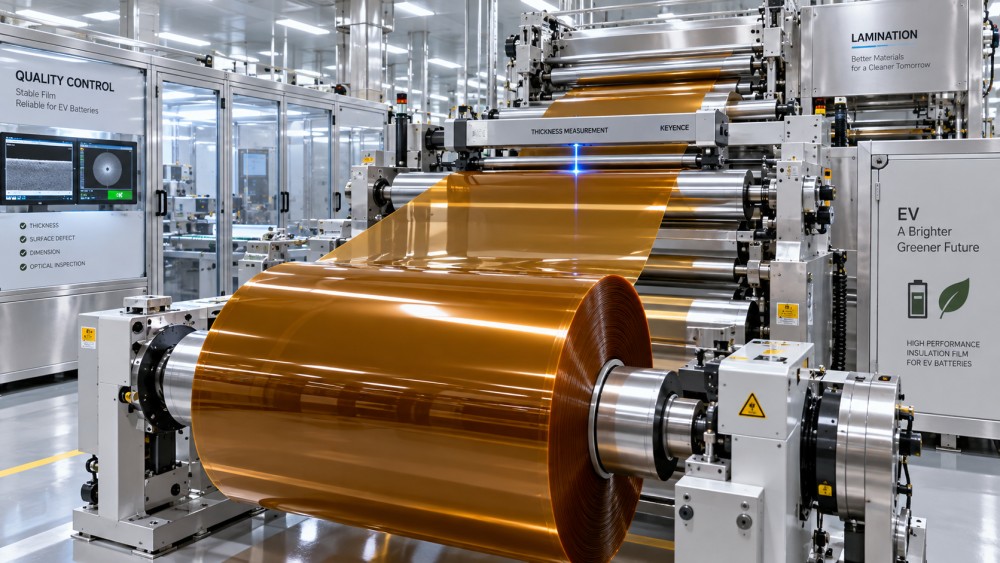
In battery applications, film consistency can matter as much as nominal material performance. A minor thickness variation may affect dielectric margin, coating weight, laminate balance, or fit within a compact module design. Gel particles, pinholes, surface scratches, embedded contamination, and uneven treatment can become production defects long before they become visible field failures.
During supplier evaluation, examine how the manufacturer controls the full process chain: raw-material qualification, drying, extrusion or casting, orientation, heat setting, coating, lamination, slitting, packaging, and final inspection. The best questions are practical ones. How are moisture-sensitive resins handled? What controls prevent foreign-material contamination? How is edge trim managed? Are roll-to-roll defects mapped and traceable? What happens when an online gauge detects thickness drift?
For multilayer battery films, the assessment should include interface reliability. The supplier needs to demonstrate that layer adhesion remains stable after thermal cycling, humidity exposure, and any relevant chemical contact. A laminated construction can fail not because the base film is unsuitable, but because the tie layer, primer, or coating cure window was poorly controlled.
Slitting quality deserves particular attention. Battery-film converters may experience edge dust, telescoping rolls, uneven winding tension, poor roll flatness, or inconsistent splice quality. These issues are easy to dismiss as packaging details, yet they can reduce automated converting yield and introduce particles into clean assembly environments.
Evidence should match the battery risk, not just the sales brochure
A supplier’s technical data sheet is a starting point, not a qualification package. Technical evaluators should request evidence that resembles the application’s failure mechanisms. The appropriate test plan will vary by component, but it commonly includes thermal aging, thermal cycling, humidity exposure, dielectric testing, puncture or abrasion testing, dimensional-stability measurement, and chemical compatibility assessment.
For films used near high-voltage components, evaluate electrical performance after aging rather than only in an as-received condition. Where relevant, investigate dielectric breakdown behavior across multiple locations and samples, not merely one reported value. If the construction contains coatings or adhesives, test the complete structure. A high-performing base film does not guarantee that the finished laminate will retain its electrical properties.
Chemical compatibility should be treated with care. Battery environments are complex, and exposure can come from electrolyte leakage, coolant fluids, cleaning residues, adhesive ingredients, plasticizer migration, or metal-ion contamination. The supplier does not need to claim universal chemical resistance, but it should be able to discuss known limitations and support a jointly agreed immersion or exposure protocol.
Flame performance requires equally careful interpretation. A flame-retardant result may depend on thickness, specimen orientation, color, additives, or a particular test method. It should not automatically be extended to thinner gauges or a different multilayer configuration. Ask which exact construction was tested and whether post-aging flame behavior has been considered.
Useful documents to request during technical screening
- Current technical data sheets with test methods, specimen thicknesses, and conditioning details.
- Certificates of analysis or lot-level inspection records showing actual production variation.
- Thermal-aging, shrinkage, dielectric, and mechanical test reports relevant to the intended use.
- Information on restricted substances, material declarations, and change-notification procedures.
- Process-flow documentation covering traceability, inspection points, nonconformance handling, and roll identification.
- Guidance for storage, drying, converting, bonding, and disposal or recycling considerations.
Assess thickness, surface, and converting behavior as a connected system
It is tempting to specify a narrow thickness tolerance and consider the issue resolved. In practice, thickness control is linked to surface quality, winding behavior, stiffness, coating uniformity, and the film’s response in downstream processing. A supplier may be able to make a nominal 50-micron film, for instance, but not necessarily maintain the required cross-web profile, roll-to-roll consistency, and surface condition at the width and volume needed for production.
Surface treatment is another area where generic claims can hide risk. Corona, plasma, primers, and functional coatings can improve adhesion, but treatment level may decay during storage or vary across the web. If the film will be laminated or coated by another converter, ask for surface-energy targets, shelf-life conditions, treatment-side identification, and test methods for verifying bond readiness.
Request sample rolls rather than only hand sheets when possible. A realistic trial can expose issues that laboratory coupons do not show: curl after die cutting, liner release inconsistency, static buildup, poor registration, edge cracking, or unexpected interaction with the customer’s adhesive and equipment settings. Pilot trials should include both normal processing conditions and reasonable process-window challenges.
Evaluate quality systems through change control and traceability
Battery programs are sensitive to unannounced changes. A resin source change, additive adjustment, coating reformulation, production-line transfer, or revised curing profile may alter a film’s performance even when the product name remains the same. This makes formal change control one of the strongest indicators of a supplier’s maturity.
Ask the manufacturer how it distinguishes a routine batch adjustment from a material change that requires customer notification and requalification. Review whether lot numbers can be traced back to resin batches, production dates, line conditions, inspection records, and retained samples. In the event of a field concern, vague assurances are not enough; the supplier should be able to isolate affected material efficiently.
Quality capability also includes how the supplier handles deviations. A useful conversation is not “Do you have defects?” Every manufacturing operation encounters variation. The more revealing question is how defects are detected, contained, investigated, and prevented from recurring. Suppliers that can describe this process clearly are generally easier to work with during qualification and scale-up.
Do not separate technical qualification from supply-chain reality
A technically suitable battery film can still become a program risk if lead times are uncertain, capacity is concentrated in one location, or the supplier has limited ability to support width changes and ramp-up volumes. For this reason, the high heat polymers manufacturer assessment should include operational questions alongside laboratory evidence.
Consider resin-source resilience, manufacturing footprint, minimum order quantities, standard versus custom widths, packaging protection, storage conditions, and the availability of local technical support. If the film is custom-engineered, establish who owns the specification, how revisions are controlled, and what happens if the original production line is unavailable. For long-running EV platforms, continuity may be just as valuable as initial performance.
Sustainability should also be reviewed in practical terms. Some high-performance films are difficult to recycle in mixed constructions, while others may support thinner gauges, longer service life, or simplified material architectures. Ask for realistic information on material composition, recycled-content feasibility where applicable, scrap handling, and end-of-life constraints. Avoid assuming that a recyclable resin automatically creates a recyclable battery-film assembly.
A practical qualification path for technical evaluators
A staged approach reduces both risk and wasted effort. Begin with an application requirement matrix and use it to screen candidate materials. Next, compare data packages and manufacturing controls. Shortlist suppliers that can explain the relationship between their process and the intended battery duty. Then move to sample-roll trials, followed by application-relevant aging and converting tests. Only after those stages should commercial negotiations finalize the specification.
During the final review, document acceptance criteria that are measurable and linked to the application: thickness range, defect limits, shrinkage limits, dielectric performance, surface-treatment requirements, roll format, packaging, traceability, and change-notification expectations. The finished specification should not merely repeat catalog values. It should capture the conditions that make the film reliable in the actual EV battery assembly.
The strongest supplier is rarely the one with the longest list of polymer grades. It is the manufacturer that can connect material science, film conversion, quality discipline, and battery application knowledge in a transparent way. For technical teams evaluating EV battery films, that connection turns a promising high-temperature polymer into a component they can confidently qualify, manufacture with, and support over time.
Have questions about this sector analysis, or seeking best practices specific to your niche? Drop us a line below and let the senior consultants at APIM assist you.
We respect your privacy. Your information is strictly confidential.
Related News
- 00
0000-00
How does washing affect contamination in post-consumer recycled PP resins? - 00
0000-00
How does feedstock affect depolymerization equipment selection? - 00
0000-00
US Sets 213.44% Preliminary Antidumping Deposit on Chinese PTMEG - 00
0000-00
When should epoxy be used as a thermal interface material for semiconductors? - 00
0000-00
US Midterm Results Unlikely to Quickly Shift Recycled Plastics Market or Legislation