




How to Evaluate a Battery Separator Films Manufacturer for EV Cell Performance
Choosing a battery separator films manufacturer is not a routine sourcing task in EV cell development. Separator film quality affects ion transport, shutdown behavior, dimensional stability, and defect risk inside the cell.
That is why evaluation cannot stop at a datasheet. A film may look competitive on thickness and porosity, yet still create problems in coating, winding, puncture resistance, or thermal abuse conditions.
In practice, the better question is whether a manufacturer can deliver stable separator performance across scale, batches, and operating demands. For EV programs, that difference shows up in safety margins, cycle life, charging speed, and qualification time.
Why separator film supply matters more in EV batteries
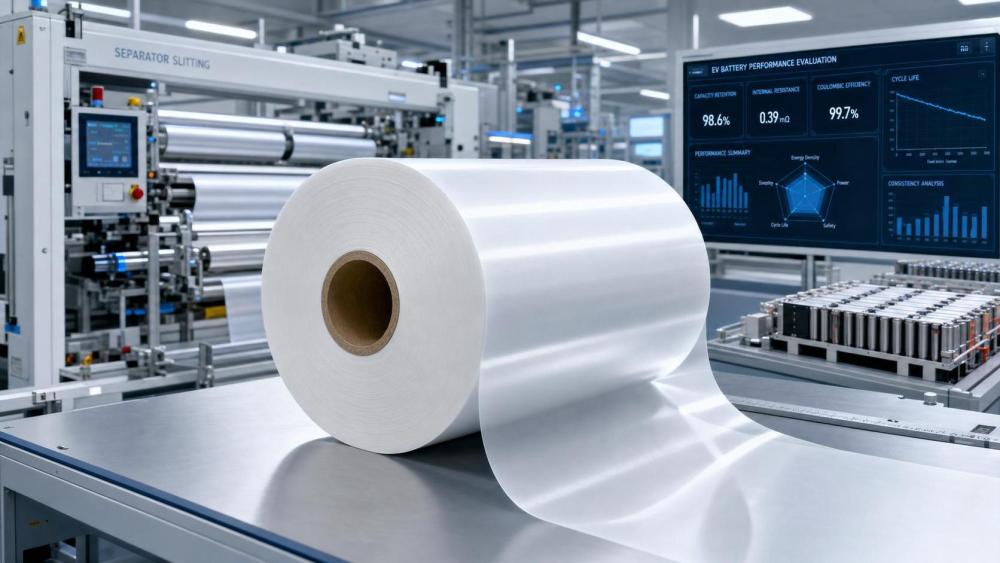
A separator is a thin porous membrane placed between anode and cathode. It must prevent internal short circuits while allowing lithium ions to move through electrolyte-filled pores.
That sounds simple, but EV cells place separator films under difficult conditions. High energy density increases thermal stress. Fast charging increases local current density. Large-format cells amplify consistency issues.
For this reason, a battery separator films manufacturer becomes part of the cell performance equation. Film chemistry, stretching process, coating uniformity, and cleanliness all influence downstream battery behavior.
From a materials intelligence perspective, separator films sit at the intersection of polymer selection, specialty film processing, and industrial quality control. That is exactly the kind of decision area where APIM-style evaluation logic becomes useful.
What should be assessed beyond the headline specification
Many comparisons start with thickness, porosity, air permeability, and tensile strength. Those matter, but they are only the surface layer of the decision.
A reliable battery separator films manufacturer should also be assessed on process capability, raw material control, defect management, and compatibility with the intended cell format.
Material system and film architecture
Start with the polymer base. Most separators rely on polyethylene, polypropylene, or multilayer PP/PE/PP structures. Each option changes shutdown function, heat resistance, and mechanical balance.
Ceramic-coated separators add another layer of evaluation. Coating composition, adhesion strength, surface roughness, and coating weight uniformity can influence thermal shrinkage and electrolyte wetting.
A capable battery separator films manufacturer should explain why a given structure fits prismatic, pouch, or cylindrical cells, rather than presenting every film as universally suitable.
Pore structure and electrochemical behavior
Porosity alone is not enough. Pore size distribution, tortuosity, Gurley value, ionic resistance, and electrolyte uptake must be examined together.
A separator with aggressive permeability may improve rate performance, but it can also reduce mechanical margin. A balanced design usually performs better in actual EV duty cycles.
Suppliers should be able to link film structure to cell-level outcomes, including impedance growth, cycle retention, and fast-charge behavior at low temperature.
Manufacturing discipline is often the real differentiator
Two separator samples can test similarly in a lab, yet perform very differently in volume production. The gap usually comes from manufacturing control rather than brochure claims.
This is especially relevant in specialty films, where thickness tolerance, orientation control, edge quality, and contamination discipline define usable yield.
Process consistency
Ask how the film is produced and stabilized. Dry and wet processes create different microstructures. Stretching ratios, solvent handling, annealing conditions, and heat setting all affect separator reliability.
A strong battery separator films manufacturer should provide meaningful tolerance data, not only target values. Look for evidence of tight control across width, length, and lot history.
Defect prevention and cleanliness
Separator defects can become cell defects. Gels, black specks, pinholes, coating streaks, broken edges, and embedded particles can trigger scrap or hidden reliability problems.
That makes inline inspection, cleanroom practice, slit quality, and roll packaging standards essential review points. A supplier that cannot describe defect escape control is carrying real risk.
The most useful questions are tied to cell application
A separator should not be evaluated in isolation from the cell design. The right battery separator films manufacturer for one platform may be the wrong choice for another.
For high-nickel cathodes, thermal stability and coating durability may carry more weight. For fast-charging cells, ionic resistance and wetting behavior may dominate. For large-format pouch cells, dimensional stability can become a gating issue.
Application review should also include electrolyte chemistry, electrode loading, calender density, operating temperature range, and formation strategy. Those factors change what “good separator performance” actually means.
Useful supplier evidence during technical review
- Lot-based data, not only typical values
- Cell validation results under relevant charge rates
- Shrinkage and shutdown curves with test conditions
- Defect classification and outgoing inspection criteria
- Change control rules for resin, coating, and process settings
- Failure analysis support when qualification issues appear
Quality systems, scale readiness, and supply risk
Even a technically strong film can become a weak supply choice if quality systems are immature. EV programs need reproducibility, documentation, and controlled expansion capacity
Have questions about this sector analysis, or seeking best practices specific to your niche? Drop us a line below and let the senior consultants at APIM assist you.
We respect your privacy. Your information is strictly confidential.
Related News
- 00
0000-00
Do polyolefin hot melt adhesives bond well to polyethylene? - 00
0000-00
Korean Study Finds PLA Barely Degrades in Landfill After 320 Days - 00
0000-00
How to assess batch consistency from a thermal potting compounds supplier - 00
0000-00
How much weight can carbon fiber reinforced plastics save in cars? - 00
0000-00
Switching from PS to ABS Sheet Extrusion: Equipment Checks