




Which barrier film materials withstand retort packaging temperatures?
Retort packaging is unforgiving. A film that performs well in an ordinary chilled or ambient pouch may fail after exposure to steam, pressure, and prolonged heat. Oxygen transmission can rise, seals can wrinkle or channel, adhesives can weaken, and the package may look intact while its shelf-life protection has already been compromised.
For technical evaluators, selecting barrier film materials for retort packaging is therefore not simply a search for the lowest oxygen transmission rate. The full multilayer structure must survive sterilization, retain barrier performance after processing, maintain seal integrity, resist food or product chemicals, and remain practical to convert on the available equipment.
Most commercial retort systems operate around 115–135°C, with process duration determined by product type, package geometry, fill weight, and required lethality. Some applications use lower-temperature pasteurization; others demand aggressive high-temperature sterilization. The right material choice begins with that actual process window—not with a generic claim that a film is “retortable.”
Why retort conditions challenge barrier structures
During retort, a package experiences more than heat. Internal pressure changes as the product expands, while external overpressure may be applied to prevent packs from bursting. Moisture and steam can reach film edges, seals, and any vulnerable interface in a laminate. If the pack contains oil, acid, salt, spices, or protein-rich food, the internal environment may add another layer of chemical stress.
This is why single-material data sheets are useful but incomplete. A polymer may have an adequate melting point, yet lose stiffness at retort temperature. A high-barrier layer may remain chemically stable but become ineffective if adjacent tie layers delaminate. A sealant may not melt catastrophically, but its hot-tack behavior and creep resistance may be insufficient under pressure.
Technical selection should assess the package as a system: outside abuse layer, print or adhesive layer, barrier layer, tie layers, sealant layer, sealing geometry, and the intended retort profile.
The materials most commonly used in retort barrier films
Several polymer families are established in retort pouches, trays, lidding structures, and specialty laminates. Their suitability depends on temperature, product formulation, target shelf life, package format, and recycling strategy.
Polypropylene: the usual heat-resistant sealing foundation
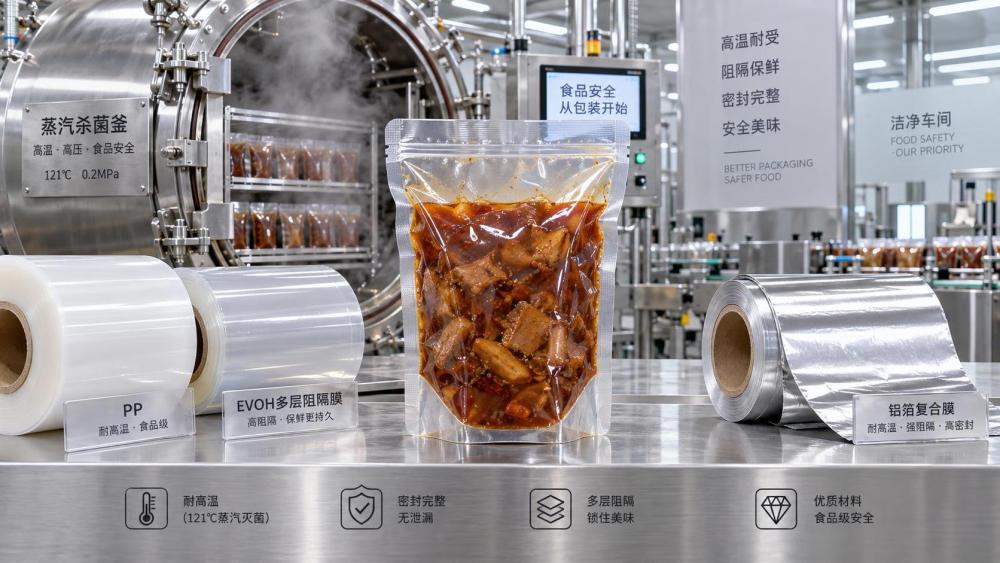
Polypropylene (PP), especially cast PP and retort-grade copolymer formulations, is one of the most important materials in retort packaging. It is frequently used as the food-contact sealant layer because it offers useful heat resistance, moisture resistance, flexibility, and sealing behavior. In many high-temperature pouches, PP forms the inner layer that must remain intact while in direct contact with food.
PP is a strong candidate for moist foods, soups, sauces, ready meals, and other applications where water-vapor resistance matters. However, its oxygen barrier is limited. PP generally needs to be paired with a dedicated oxygen-barrier material when long ambient shelf life is required. Evaluators should also distinguish between homopolymer PP, random copolymer PP, and impact copolymer designs, as their stiffness, clarity, heat resistance, and seal performance differ.
EVOH: high oxygen barrier with important moisture limitations
Ethylene vinyl alcohol copolymer (EVOH) is widely used as a high-oxygen-barrier layer in coextruded retort structures. It can provide excellent protection against oxygen-driven flavor loss, oxidation, discoloration, and microbial spoilage risks when incorporated correctly into a multilayer film.
Its limitation is well known: EVOH is sensitive to humidity. Water absorption can reduce its barrier performance, especially during steam retort exposure and in high-moisture storage conditions. That does not disqualify EVOH from retort use. Rather, it means the layer must be protected by surrounding hydrophobic materials—commonly PP or polyamide-based layers—and the finished structure must be evaluated after retort, not only before it.
The ethylene content of EVOH also matters. Higher ethylene grades generally offer better moisture tolerance but lower oxygen barrier, while lower ethylene grades may provide stronger dry-state barrier but require more careful protection. A technical review should examine both the resin grade and the layer placement.
Polyamide: toughness, puncture resistance, and process resilience
Polyamide (PA), often nylon, is used in retort laminates for mechanical strength, puncture resistance, flex-crack resistance, and resistance to handling damage. It is particularly valuable where packs may encounter sharp food particulates, bone fragments, rough processing, or demanding distribution conditions.
PA also contributes some oxygen barrier, although it is not normally selected as the sole barrier layer for a long-shelf-life retort package. Like EVOH, polyamide can absorb moisture, which influences mechanical and barrier properties. Its role is often structural: helping the laminate remain durable through forming, filling, retort pressure, cooling, and consumer handling.
Polyester and aluminum oxide-coated polyester
PET is commonly used as an outer web in retort pouch laminates because it offers dimensional stability, printability, stiffness, and good resistance to elevated temperature. Standard PET alone is not usually enough where a demanding oxygen barrier is required, but it provides a dependable exterior layer and can support high-quality graphics.
For transparent packages, AlOx-coated PET may be considered where an enhanced barrier is needed without using metal foil. The coating must be evaluated carefully for retort stability, flex durability, and barrier retention after thermal processing. A coated film can be effective, but it is less forgiving of severe flexing or damage than a properly protected bulk barrier layer.
Aluminum foil: the benchmark for maximum barrier
For the highest protection against oxygen, moisture, light, aroma loss, and external contamination, aluminum foil remains a proven component in retort pouch structures. A typical foil-based laminate may combine PET for exterior strength and printing, aluminum foil for barrier, and CPP or retort-grade PP for sealing.
Foil is robust from a barrier perspective, but it changes the package’s trade-offs. It eliminates product visibility, can develop pinholes if mishandled, may complicate microwave use, and does not fit every material-reduction or recyclability objective. Still, for sensitive foods, military rations, pet food, sauces, and long-shelf-life products, foil laminates remain difficult to match.
What a reliable retort structure looks like in practice
There is no universal construction, but common design logic is clear. The outer layer must tolerate handling, printing, and retort exposure. The middle of the structure provides oxygen, light, or aroma protection. The inner layer must seal reliably, resist product contact, and remain stable during sterilization.
A foil laminate may be selected when the barrier target is severe and opacity is acceptable. A transparent coextruded PP/EVOH/PP-based structure may be more suitable when visibility, lower weight, or a move toward polyolefin-rich packaging matters. Between those ends are numerous hybrid constructions that combine PET, PA, EVOH, PP, coatings, and specialized adhesive systems.
The adhesive and tie-layer question is often underestimated
Retort failures are frequently interface failures. In adhesive-laminated films, the adhesive must fully cure before retort, maintain bond strength in hot wet conditions, and resist attack from the packaged product. Standard laminating adhesives may not be adequate for a high-temperature sterilization cycle, even if the film substrates themselves are suitable.
For coextruded structures, tie layers must bond dissimilar polymers while tolerating thermal history and moisture exposure. Their thickness, formulation, and placement can affect not only adhesion but also processing stability and overall downgauging potential.
Technical teams should ask suppliers for retort-specific bond retention data rather than relying only on initial peel-strength values. Testing after retort, after storage, and after exposure to the actual product is far more informative than a room-temperature laboratory result.
How to match material selection to the retort process
The phrase “retort temperature” can conceal major differences. A 121°C water-spray cycle and a 130°C steam process do not impose the same risk. Come-up time, dwell time, cooling rate, overpressure control, and package headspace all influence material behavior.
- For 115–121°C applications: retort-grade PP sealants combined with PA and EVOH layers are often viable, provided moisture protection and seal design are validated.
- For 121–130°C applications: material margins become more important. High-performance CPP or PP seal layers, robust PA reinforcement, retort-capable adhesives, and carefully protected EVOH are commonly considered.
- For the most severe requirements: foil-based laminates or purpose-designed high-temperature coextrusions may offer a safer route, especially where shelf life and barrier consistency outweigh transparency.
Temperature alone should never determine the decision. A short high-temperature cycle may be less damaging than a long lower-temperature cycle in some constructions. The actual temperature-pressure-time profile should be part of the packaging specification supplied to film producers and converters.
Performance checks before approving barrier film materials for retort packaging
A well-run qualification program does not treat the first successful retort cycle as final approval. The package should be examined before processing, immediately after retort, and after an appropriate storage period. Visual inspection matters, but it is only the beginning.
Key checks commonly include oxygen transmission rate and water-vapor transmission rate after retort; seal-strength testing; burst or creep testing; laminate bond strength; flex-crack inspection; pouch curl and distortion; pinhole detection for foil structures; and migration or food-contact compliance verification for the intended market.
Where the product contains oil, acid, salt, or aggressive seasonings, evaluate the film with the real formulation whenever possible. Food simulants are useful screening tools, but they may not reproduce the combined effects of fat, thermal processing, and long-term storage. For medical, pet food, and industrial chemical packaging, the same principle applies: test the real-use environment.
Common selection mistakes
One frequent mistake is choosing a high-barrier film based on dry-condition data. EVOH, coated films, and some adhesive systems can show impressive values before retort but require protective design to retain performance in a humid thermal cycle.
Another is focusing only on the barrier core layer while treating seals as a converting detail. In real distribution, a minor seal channel can defeat an otherwise excellent oxygen barrier. Seal contamination tolerance, sealing temperature window, and resistance to retort-induced stress should be considered early, especially for viscous or particulate-filled products.
It is also risky to assume that a structure proven for one pouch size will transfer directly to another. Larger packs, altered gussets, sharper folds, different fill weights, and different cooling conditions can change stress concentration and failure behavior.
A practical decision path for technical evaluators
Start by defining the sterilization profile, required ambient shelf life, product chemistry, pack format, and barrier target. Then decide whether product visibility is essential. If it is not, foil-based options may simplify barrier risk management. If transparency is necessary, compare EVOH-containing coextrusions and coated-film structures based on post-retort—not pre-retort—performance.
Next, review the complete material stack with the converter: resin grades, layer sequence, thickness distribution, adhesive chemistry, sealing conditions, and any surface treatments. Ask where moisture can enter, where flexing will occur, and which layer is expected to absorb the greatest mechanical load. These questions often reveal risks before expensive line trials begin.
The most dependable retort package is rarely the one with the most advanced individual film. It is the structure in which barrier, sealability, mechanical durability, process compatibility, and compliance requirements remain balanced through the entire life of the pack. For teams comparing suppliers or developing a new format, that systems view is what turns a promising material specification into a reliable commercial package.
Have questions about this sector analysis, or seeking best practices specific to your niche? Drop us a line below and let the senior consultants at APIM assist you.
We respect your privacy. Your information is strictly confidential.
Related News
- 00
0000-00
Do polyolefin hot melt adhesives bond well to polyethylene? - 00
0000-00
Korean Study Finds PLA Barely Degrades in Landfill After 320 Days - 00
0000-00
How to assess batch consistency from a thermal potting compounds supplier - 00
0000-00
How much weight can carbon fiber reinforced plastics save in cars? - 00
0000-00
Switching from PS to ABS Sheet Extrusion: Equipment Checks