




When do EVOH multilayer films provide enough oxygen barrier for food packaging?
EVOH multilayer films can deliver the oxygen barrier food packaging needs when their layer structure, EVOH thickness, humidity exposure, product sensitivity, and target shelf life are properly evaluated.
For technical assessors, the important question is not whether EVOH is a strong barrier resin in laboratory conditions.
The practical question is whether the complete construction preserves barrier performance during converting, filling, storage, transport, retail display, and consumer use.
Start With the Product's Actual Oxygen Barrier Requirement
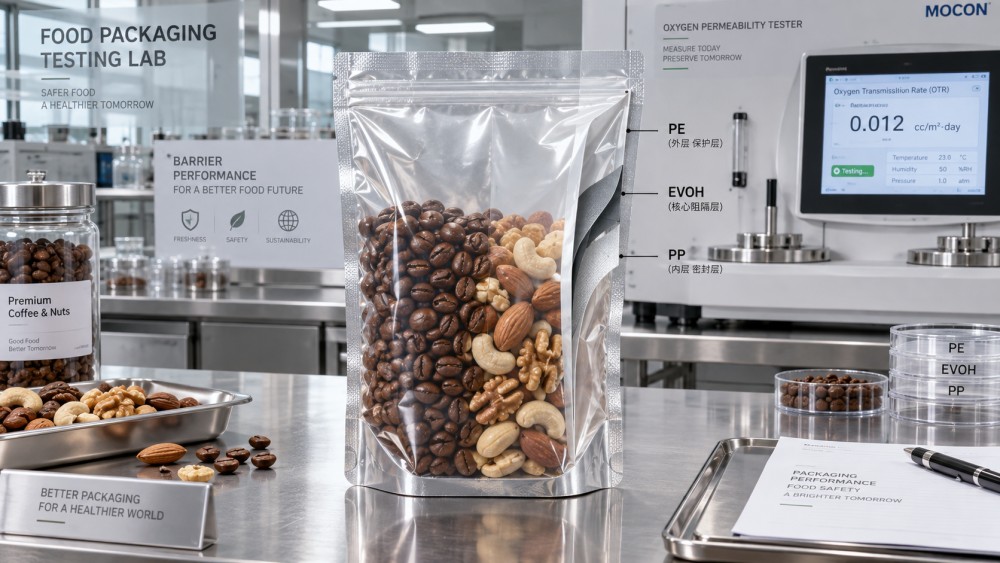
EVOH multilayer films provide enough oxygen barrier when their measured oxygen transmission rate supports the required shelf life with realistic safety margins.
That requirement should be established from the packaged food, not selected only from a generic film specification or supplier comparison chart.
Oxygen-sensitive foods include processed meats, cheese, coffee, snacks, nuts, pet food, ready meals, sauces, and products containing oils or pigments.
These products can deteriorate through oxidation, flavor loss, discoloration, microbial growth, vitamin degradation, or rancidity at different oxygen exposure levels.
Technical assessors should therefore define the acceptable quality loss before deciding whether a specific EVOH multilayer film is sufficient.
A high-barrier package is unnecessary when oxygen does not materially limit product quality or when the intended shelf life is short.
Conversely, a film with excellent published barrier data may still be inadequate for a highly sensitive product requiring long ambient distribution.
The first evaluation step is translating product behavior into a packaging target, usually expressed through oxygen transmission rate, residual oxygen, and shelf-life performance.
Oxygen transmission rate, commonly called OTR, indicates the amount of oxygen passing through a defined film area during a specified time.
However, OTR results are meaningful only when test temperature, relative humidity, film thickness, and test method match anticipated service conditions.
Assessors should ask whether the target is based on package-level oxygen ingress rather than simply a flat-film measurement supplied by the resin producer.
Package geometry, seal area, folds, puncture risk, and headspace all influence whether a nominal film OTR produces acceptable food protection.
Why EVOH Is Effective, and Why Humidity Changes the Answer
EVOH is widely used because its polymer structure provides very low oxygen permeability under dry or moderately humid conditions.
In a coextruded structure, EVOH commonly forms a thin functional barrier layer protected between moisture-resistant polyolefin layers.
This design allows converters to combine oxygen barrier performance with sealing, stiffness, toughness, printability, or compatibility with existing packaging equipment.
The central limitation is that EVOH absorbs moisture, and absorbed moisture increases molecular mobility within the barrier layer.
As humidity rises, oxygen permeability can increase significantly, particularly for grades designed with lower ethylene content and stronger dry-state barrier performance.
That does not make EVOH unsuitable for moist foods, but it means humidity must be treated as a design input.
Dry snacks, coffee, powdered foods, and oxygen-sensitive dry ingredients may allow EVOH to operate near its strongest barrier range.
High-moisture foods, retort products, chilled meat, sauces, and liquid-containing packs demand a more conservative evaluation of humidity-conditioned barrier values.
Moisture can come from the food itself, external storage conditions, steam processing, refrigerated condensation, or water vapor migration through adjacent layers.
For this reason, a dry-test OTR should never be used alone to qualify EVOH multilayer films for demanding food packaging applications.
Ask suppliers for data at relevant relative humidity levels, especially 50%, 75%, 85%, or conditions aligned with the product's expected internal environment.
When those data are unavailable, package testing under conditioned storage is more useful than assuming a standard published value remains stable.
Evaluate the Complete Multilayer Structure, Not EVOH Alone
An EVOH layer does not determine barrier performance by itself because the surrounding layers control protection, thickness consistency, and package functionality.
Typical food packaging constructions combine PE, PP, PET, PA, tie layers, EVOH, sealant layers, and occasionally paper or aluminum-based components.
Each layer should have a defined job, including moisture protection, mechanical support, sealing, abuse resistance, print support, or barrier reinforcement.
Polyolefin outer layers are particularly important because they slow water vapor reaching the EVOH core during storage and use.
For example, PE or PP skins can protect EVOH while also providing heat-seal performance suited to pouches, lidding films, thermoforming webs, or trays.
Polyamide may improve puncture resistance and thermoformability, but its moisture behavior and interaction with the overall barrier design require review.
Tie layers are essential where EVOH must adhere to incompatible polyolefin layers, yet they also add thickness, cost, and processing complexity.
A technically sound design balances the EVOH layer against the adjacent layers rather than maximizing EVOH content without considering total package performance.
Very thin EVOH layers may appear economical, but normal extrusion variation can create local weak points and reduce consistency across production runs.
Thicker EVOH can improve oxygen barrier, although returns may diminish once other factors, such as seals or humidity exposure, become dominant.
Assessors should request the nominal EVOH thickness, minimum thickness tolerance, total film gauge, layer sequence, and measurement method from the converter.
Those details matter more than a general claim that a structure contains EVOH or is described as a high-barrier multilayer film.
Match EVOH Thickness to Shelf Life and Distribution Conditions
There is no universal EVOH thickness that guarantees enough oxygen barrier because food sensitivity and package conditions vary substantially between applications.
Instead, thickness should be selected from a package-level oxygen budget calculated against shelf life, pack surface area, storage temperature, and acceptable oxygen exposure.
A small sachet and a large stand-up pouch can use the same film OTR but receive very different total oxygen ingress.
Larger surface areas permit more oxygen transfer, while thicker films may reduce transmission only if the barrier layer remains uniform throughout conversion.
Longer distribution cycles increase the cumulative effect of oxygen ingress, especially for products crossing climate zones or stored before retail placement.
Temperature also matters because oxygen permeability normally rises as temperature increases, and heat can accelerate oxidation within the food.
For ambient products, assess the warmest credible logistics condition rather than relying only on laboratory testing at a comfortable room temperature.
For chilled products, account for refrigerated storage, intermittent temperature abuse, condensation, and oxygen exposure after the package is opened.
Technical teams should distinguish between a film that meets initial qualification requirements and one that remains sufficient across manufacturing and distribution variability.
Safety margins are particularly justified when product shelf life is long, sensory quality is commercially critical, or product claims depend on stability.
A well-designed margin can reduce later reformulation, waste, complaints, and emergency packaging changes caused by borderline barrier performance.
However, excessive barrier can increase material cost and complicate recycling objectives without delivering meaningful additional product protection.
Consider Filling Method, Headspace, and Seal Integrity
Even strong EVOH multilayer films cannot compensate for poor sealing, excessive residual oxygen, or package damage introduced during filling and handling.
Modified atmosphere packaging requires particular attention because residual oxygen after gas flushing may dominate the initial oxidation risk.
For vacuum-packed foods, the vacuum level, package recovery behavior, seal contamination, and leak rate can affect shelf life more than film OTR.
Technical assessors should separate oxygen entering through intact film from oxygen entering through imperfect seals, pinholes, channel leaks, and mechanical damage.
Sealant selection must match the food contact surface, contamination level, sealing temperature window, line speed, and expected opening behavior.
A film structure can be overengineered in barrier terms while failing commercially because its seal performance is inconsistent on the packaging line.
Thermoformed packages need additional scrutiny because stretching can thin barrier layers, especially in corners, sidewalls, and deep-draw regions.
Stretch distribution should be measured on representative formed packs rather than inferred from the thickness of the unformed bottom web.
Retort and hot-fill applications also require validation after thermal processing because heat, pressure, moisture, and mechanical stress can alter package performance.
Testing should include real seal geometries and finished packages wherever possible, because flat-film results cannot capture all failure mechanisms.
Use the Right Tests to Confirm That the Barrier Is Sufficient
A reliable qualification program combines laboratory barrier testing with finished-package testing and food shelf-life validation under representative conditions.
Start by confirming oxygen transmission rate using a recognized method, such as ASTM D3985 or ISO 15105, with documented test conditions.
The test report should identify temperature, relative humidity, sample conditioning, exposed area, film orientation, thickness, and instrument sensitivity.
For EVOH multilayer films, include testing after humidity conditioning rather than treating dry-state measurements as the sole decision criterion.
Next, conduct package integrity testing using methods appropriate to the format, including leak detection, burst testing, dye penetration, or pressure decay.
Seal-strength testing should address both average strength and variability across line conditions, operators, materials, and expected contamination scenarios.
Where oxygen-sensitive foods are involved, measure residual oxygen after packing and monitor changes during accelerated and real-time storage.
Food quality evaluation may include sensory review, color measurement, peroxide value, microbial analysis, aroma retention, texture, and nutrient stability.
Accelerated studies can help compare structures quickly, but they should not be treated as direct substitutes for real-time shelf-life evidence.
Acceleration factors are product-specific, and food deterioration may not respond linearly to higher temperature, humidity, or oxygen concentration.
A practical decision is strongest when material data, package testing, and actual food performance point to the same conclusion.
If those results conflict, the team should investigate seal failures, humidity effects, thickness variation, and product chemistry before changing resin grade.
When EVOH Multilayer Films Are Usually a Strong Choice
EVOH multilayer films are often a strong choice when high oxygen barrier is needed alongside flexible packaging performance and manageable material cost.
They are particularly effective for vacuum pouches, modified-atmosphere packs, thermoformed trays, lidding films, sachets, and coextruded bottles.
Dry or moderately moist foods with meaningful oxidation sensitivity frequently benefit from EVOH because the barrier layer can be thin and efficient.
They can also support downgauging when a carefully designed multilayer structure replaces a thicker conventional film with weaker oxygen protection.
For converters, coextrusion can integrate EVOH into established film production processes while retaining PE or PP surfaces needed for sealing.
For food brands, the potential benefits include longer shelf life, reduced preservative dependence, improved appearance, lower food waste, and more stable flavor.
These benefits must be validated against the actual product because a barrier improvement has limited value if another failure mode determines shelf life.
EVOH is less straightforward when packaging is continuously exposed to very high humidity, subjected to severe retort conditions, or required to meet mono-material targets.
In those cases, teams may compare higher-protection structures, alternate barriers, protective layer designs, or recycling-compatible construction approaches.
The correct answer is not always to replace EVOH, but to identify whether humidity protection and layer architecture can solve the limitation.
Questions Technical Assessors Should Ask Suppliers
Supplier discussions should move beyond general high-barrier claims and focus on documented performance under the intended packaging and storage conditions.
Ask for oxygen transmission rate data at relevant humidity levels, temperatures, film gauges, and test standards for the proposed construction.
Request the EVOH grade, ethylene content range, nominal layer thickness, minimum thickness capability, and expected extrusion thickness variation.
Confirm whether reported values apply to flat film, formed packages, or a comparable commercial structure with the same surrounding layers.
Review processing guidance for melt temperature, residence time, drying, regrind use, layer adhesion, and sensitivity to thermal degradation.
For food packaging, obtain food-contact compliance documentation for all layers, tie resins, additives, inks, coatings, and adhesives.
Ask how the supplier controls lot-to-lot consistency and what support is available during trials, scale-up, line troubleshooting, and qualification.
Where sustainability targets matter, clarify the effect of EVOH content on recycling pathways, sortability, compatibility, and local recycling guidance.
These questions help procurement and engineering teams compare offers based on usable technical evidence rather than headline material claims.
Conclusion: Enough Barrier Means Proven Performance in the Finished Pack
EVOH multilayer films provide enough oxygen barrier when the complete package keeps oxygen exposure below the food's practical deterioration threshold throughout its intended life.
That decision depends on product sensitivity, humidity, EVOH thickness, adjacent layers, package geometry, sealing performance, filling conditions, and distribution temperature.
For technical assessors, the most defensible approach is to set a package-level oxygen target and verify it with conditioned barrier, integrity, and shelf-life testing.
When EVOH is protected by an appropriate multilayer structure and validated under realistic conditions, it can be an efficient and reliable barrier solution.
When humidity, thermal processing, or sealing risk is underestimated, even an apparently high-barrier EVOH film may fail to deliver the required food protection.