




When EVOH packaging barrier materials are needed for longer shelf life
When EVOH Packaging Barrier Materials Are Needed for Longer Shelf Life
When product freshness, oxygen sensitivity, and distribution timelines become critical, EVOH packaging barrier materials can provide a practical route to longer shelf life without turning a package into an unnecessarily complex structure. For technical evaluators, however, EVOH is not simply a “high-barrier film” to specify whenever shelf life needs to improve. Its value depends on the product, the package format, the humidity environment, the converting process, the filling method, and the end-of-life expectations for the finished pack.
The central question is not whether EVOH has strong oxygen-barrier properties. It does. The more useful question is whether oxygen ingress is actually the dominant reason a product loses quality before its intended expiry date. If oxidation drives flavor loss, discoloration, nutrient degradation, rancidity, aroma change, or reduced product stability, an EVOH-containing multilayer structure may be justified. If moisture transmission, seal failure, light exposure, or microbial control is the real limiting factor, adding EVOH alone may not solve the commercial problem.
The situations where oxygen barrier becomes a material decision
EVOH, or ethylene vinyl alcohol copolymer, is widely used as a functional barrier layer in coextruded films, sheets, bottles, trays, pouches, tubes, and lidding structures. It is usually protected within a multilayer construction rather than used as the main structural or sealing material. That arrangement matters because a package rarely has only one job. It must also run on available equipment, survive transport, seal reliably, present the product appropriately, and meet the operational requirements of a filling line.
A move toward EVOH packaging barrier materials is often worth evaluating when one or more of the following conditions apply:
- The product contains fats, oils, pigments, flavors, or active ingredients that are vulnerable to oxidation.
- The target shelf life is longer than the current mono-layer or standard polyolefin package can support.
- The supply chain includes extended warehousing, long-distance shipment, seasonal demand fluctuations, or uncertain retail turnover.
- The package must preserve aroma, taste, color, or functional quality with limited use of preservatives.
- A company is replacing glass, metal, or more complex barrier laminates with a lighter plastic-based structure.
- The application involves sensitive food, pharmaceutical, personal-care, agricultural, or industrial chemical products where oxygen exposure affects stability.
These conditions do not automatically define the required barrier level. A dry powdered product, a refrigerated prepared food, a hot-filled sauce, and an oxygen-sensitive industrial formulation may all require oxygen control, but their humidity conditions, package geometry, filling temperatures, and sealing needs differ substantially. Selection begins with the actual failure mechanism, not with a generic material preference.
Why EVOH is usually part of a multilayer design
EVOH performs particularly well as an oxygen barrier under relatively dry conditions, but it is sensitive to humidity. As moisture uptake increases, its oxygen-barrier performance can decline. This does not make EVOH unsuitable for humid, chilled, retorted, or liquid-packed products; it means the surrounding layers must be designed to manage exposure and protect the barrier layer during the package’s real service life.
A typical structure may combine polyethylene or polypropylene for moisture resistance and heat sealing, EVOH for oxygen barrier, and adhesive tie layers to create stable bonding between otherwise incompatible polymers. PET, PA, or other substrates may also be used where stiffness, puncture resistance, printability, heat resistance, or forming behavior is needed. The final package is therefore a system of interdependent layers, not an EVOH grade with a few supporting materials attached.
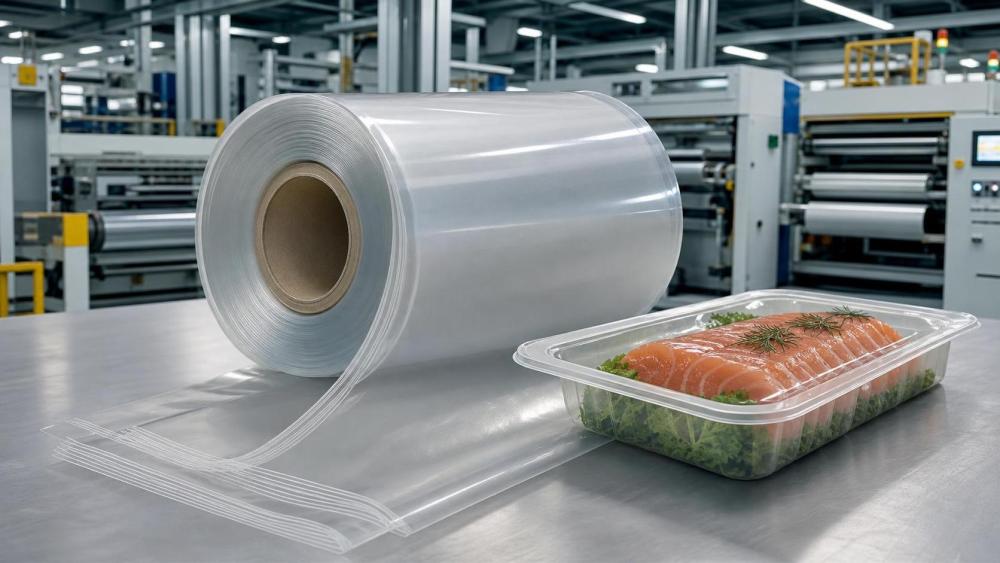
This system view prevents a recurring mistake in packaging development: comparing barrier resins by datasheet values without considering the finished package. A resin’s nominal oxygen transmission performance is not the same as the oxygen transmission rate of a formed tray, thermoformed lid, blown film, bottle shoulder, pouch seal area, or finished pack after distribution handling. Thickness variation, orientation, layer continuity, defects, seal integrity, and storage humidity can all change the result.
Start with the shelf-life failure mode, not the material
Technical teams can avoid over-specification by mapping the product’s degradation pathway before defining a film structure. For a food product, that may include oxidation, moisture migration, aroma loss, microbial growth, texture change, or exposure to light. For a non-food product, it may involve solvent loss, oxygen-driven viscosity change, corrosion risk, discoloration, loss of active performance, or contamination sensitivity.
The package should then be assessed alongside the product formulation and pack atmosphere. Modified atmosphere packaging, vacuum packaging, oxygen scavengers, headspace volume, and filling conditions can all influence how much barrier is needed. A barrier layer can slow oxygen ingress, but it cannot correct a poorly controlled gas-flushing process or a seal design that leaks under routine handling.
A useful internal discussion is: “What must remain within specification at the end of the stated shelf life?” The answer might be flavor profile, peroxide value, color, dissolved oxygen, active ingredient content, viscosity, or another product-specific measure. Once the end-of-life criterion is clear, teams can determine the appropriate package test plan. This is more reliable than choosing a barrier material because a competing product happens to use it.
Key evaluation points for an EVOH multilayer structure
Barrier performance should be evaluated under relevant temperature and humidity conditions, rather than relying on a single laboratory result. The intended market may involve refrigerated storage, ambient warehousing, hot climates, or repeated temperature changes during transport. Each condition can affect the package differently. If a film is expected to see high humidity for much of its life, the design must account for EVOH’s moisture sensitivity and the protection offered by adjacent layers.
Sealability deserves equal attention. EVOH normally contributes barrier rather than acting as the sealing layer, so the sealant resin and seal interface need separate evaluation. A package can show excellent film barrier values yet fail shelf-life testing if seals are contaminated by product, distorted during thermal processing, weakened by flex-cracking, or incompatible with the lidding material. For rigid trays and thermoformed packages, corner thinning and forming distribution are also relevant because the barrier layer must remain continuous across the formed geometry.
Processing compatibility is often the real project constraint
EVOH projects frequently succeed or fail at the interface between material selection and plant capability. Coextrusion requires attention to melt temperature windows, residence time, drying practices where applicable, feed stability, layer-ratio control, and the behavior of tie layers. A resin may be technically appropriate but still create problems if the existing line cannot maintain a stable thin barrier layer, if the die configuration does not distribute layers evenly, or if regrind handling is not clearly defined.
For converters, trials should examine more than visual appearance. Check gauge variation, gel levels, layer integrity, adhesion, haze where appearance matters, thermoformability, puncture behavior, seal windows, and downstream print or lamination performance. For brand owners and procurement teams, it is reasonable to ask suppliers how a recommended grade fits the intended processing route and whether the proposed structure has been validated under comparable, not merely theoretical, conditions.
This is where material intelligence becomes more useful than a simple grade comparison. APIM tracks specialty films, EVOH multilayer structures, extrusion technologies, recycled polymers, and the practical relationship between formulation, processing control, and end-use performance. For a technical review, the relevant information is rarely limited to a resin data sheet. It includes the coextrusion architecture, equipment conditions, converting limitations, quality-control methods, and supply continuity for each functional layer.
EVOH versus other barrier approaches
EVOH is not the only option for managing oxygen transmission. Depending on the application, teams may consider polyamide-based structures, metallized films, aluminum foil laminates, coated substrates, or other functional barrier technologies. Each has trade-offs. Foil can provide very high barrier performance but may affect flex durability, visibility, microwave compatibility, cost, or material-reduction objectives. Metallized films can be effective in certain formats but may be vulnerable to cracking or may not suit transparent packaging. Polyamide contributes strength and barrier properties but does not behave identically to EVOH, particularly where high oxygen-barrier performance is needed.
The right comparison is not “which material is best?” It is “which structure achieves the required shelf life with acceptable process risk, cost, package weight, appearance, and recovery profile?” In some applications, EVOH allows a relatively thin functional barrier layer to be incorporated into a predominantly polyolefin structure. That can be attractive where packaging teams are working toward simpler material families. But recyclability claims and design guidance should always be reviewed against the rules, infrastructure, and technical criteria of the target market rather than assumed from the presence of a particular polymer.
Avoid two costly forms of overconfidence
The first is assuming that more barrier automatically means better packaging. Excessive barrier can add cost, complicate processing, and make a structure harder to align with recycling objectives without delivering a measurable product benefit. The second is assuming that a thin EVOH layer will compensate for every weakness elsewhere in the package. It will not replace robust seals, suitable product formulation, controlled filling, appropriate distribution conditions, or sound quality assurance.
A disciplined development plan should include finished-pack testing rather than film-only testing. Where relevant, that means evaluating barrier performance at expected environmental conditions, package integrity after distribution simulation, product quality through the proposed shelf-life period, and performance after the actual filling or thermal process. The details will vary by product category and market requirements, but the principle is consistent: assess the finished package as it will be used, not just its individual resin layers.
A practical threshold for deciding
EVOH packaging barrier materials are most compelling when longer shelf life depends materially on controlling oxygen ingress and when the package can be engineered to protect EVOH from the humidity conditions it will encounter. They are particularly relevant when product waste, long distribution routes, quality-sensitive formulations, or a shift away from heavier packaging formats makes oxygen barrier a commercial as well as technical issue.
Before finalizing a structure, confirm the product’s shelf-life failure mode, target storage environment, filling process, forming and sealing demands, barrier test conditions, and the local end-of-life pathway. That short list usually reveals whether EVOH is a necessary functional layer, an avoidable cost, or one component of a broader packaging redesign. The strongest decision is not the one with the highest barrier specification; it is the one that protects the product reliably through the real supply chain with a structure the converter can manufacture consistently.
Have questions about this sector analysis, or seeking best practices specific to your niche? Drop us a line below and let the senior consultants at APIM assist you.
We respect your privacy. Your information is strictly confidential.
Related News
- 00
0000-00
Do polyolefin hot melt adhesives bond well to polyethylene? - 00
0000-00
Korean Study Finds PLA Barely Degrades in Landfill After 320 Days - 00
0000-00
How to assess batch consistency from a thermal potting compounds supplier - 00
0000-00
How much weight can carbon fiber reinforced plastics save in cars? - 00
0000-00
Switching from PS to ABS Sheet Extrusion: Equipment Checks