




SEA Fast-Track Cuts EVOH Film Clearance to 3 Days
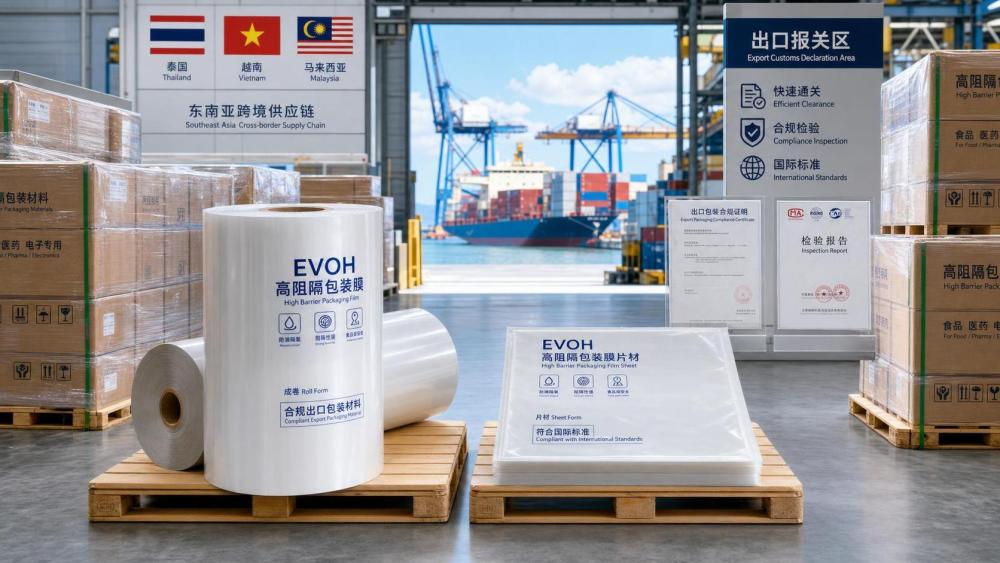
On June 26, 2026, customs authorities in Thailand, Vietnam, and Malaysia began applying a joint fast-track mechanism to qualifying EVOH-based high-barrier packaging films, reducing average clearance time for Chinese multilayer co-extruded EVOH film from 12 days to within three working days. For exporters, importers, packaging converters, and end-use sectors in food, pharmaceuticals, and electronics moisture-protection packaging, the development is worth close attention because it links customs efficiency directly to technical compliance and whitelist status.
What the new fast-track mechanism covers
According to the provided information, the three Southeast Asian markets launched a "Green Packaging Import Fast Track" from June 26, 2026. The mechanism applies to EVOH-based high-barrier packaging films that meet ASTM D3985 requirements, including an oxygen transmission rate of no more than 0.5 cm3/m2·24h·atm, and comply with ISO 15105-1.
The customs treatment described includes pre-declaration and exemption from carton-opening inspection. The covered application areas are food packaging, pharmaceutical packaging, and moisture-protection packaging for electronics. The same information states that major Chinese EVOH film exporters have already obtained the first batch of whitelist qualifications.
The confirmed operational result at this stage is a reduction in average customs clearance time from 12 days to within three working days for the relevant Chinese multilayer co-extruded EVOH films.
Where the impact is likely to be felt first
Exporters and direct trading companies
From an industry perspective, the most immediate effect is on exporters shipping qualifying EVOH film into Thailand, Vietnam, and Malaysia. The potential impact is concentrated in shipment scheduling, document preparation, and delivery commitments. What deserves closer attention is that the speed gain appears tied to both standard compliance and whitelist inclusion, which means faster customs handling may depend on maintaining documentation discipline rather than simply shipping the same products as before.
Converters and packaging manufacturers
For processors and manufacturers using EVOH-based barrier film in food, pharmaceutical, or electronics packaging, the change may affect inbound material planning and production coordination. Analysis shows that shorter customs cycles can alter lead-time assumptions in sourcing and replenishment. The practical point to monitor is whether the new customs path consistently supports production timing, especially for orders that depend on confirmed compliance with ASTM D3985 and ISO 15105-1.
Import-side procurement and supply chain teams
Procurement teams and cross-border supply chain operators in the three markets may see the biggest operational effect in inventory timing, customs coordination, and supplier communication. Observably, the announcement matters less as a general trade headline than as a workflow change: pre-declaration and exemption from unpacking inspection could reduce uncertainty in arrival handling, but only for shipments that fit the stated standards and mechanism conditions.
End-use sectors with barrier-sensitive packaging needs
Food, pharmaceutical, and electronics-related buyers are relevant because the mechanism explicitly covers their packaging use cases. Analysis shows that these sectors may watch the policy mainly through delivery reliability and material availability rather than through customs administration itself. The key business question is whether the faster import path translates into more predictable packaging supply for qualified film grades.
What companies should watch in day-to-day execution
Whether technical compliance is documented clearly enough
The fast-track mechanism is described with specific reference to ASTM D3985 and ISO 15105-1. Companies involved in sales, purchasing, and customs handling should therefore pay close attention to how compliance evidence is prepared and presented in shipment documentation and customer communication.
How whitelist status affects real shipment treatment
The provided information confirms that major Chinese EVOH film exporters have received first-batch whitelist qualification. What deserves closer attention is the operational distinction between the policy signal and actual shipment-level execution. Businesses should watch whether whitelist status remains central to receiving the shorter customs timeline in routine trade flows.
Which product lines and destination markets fit the mechanism
The current scope is specific: EVOH-based high-barrier films, three destination countries, and packaging applications in food, pharmaceuticals, and electronics moisture protection. Companies should focus on matching product portfolios and sales pipelines against that exact scope instead of assuming that all barrier-film shipments or all Southeast Asian routes now move under identical conditions.
How delivery promises and customer communication are updated
With average clearance reportedly reduced from 12 days to within three working days, sales and operations teams may need to revisit lead-time communication. Analysis shows that the prudent approach is to treat the shorter timeline as a meaningful operational change while continuing to communicate the qualifying conditions behind it, especially where delivery commitments rely on customs processing assumptions.
Why this looks like more than a one-off customs adjustment
Observably, this development can be read as a targeted facilitation measure rather than a broad trade liberalization signal. The announced benefit is narrow but concrete: qualifying EVOH high-barrier film can move faster through customs in three Southeast Asian markets when the required standards and process conditions are met.
It is more appropriate to understand this as an actionable near-term shift with possible longer-term significance, not yet as a fully settled regional trade pattern. Analysis shows that the industry should keep watching two things: whether implementation remains consistent over time, and whether the same logic is extended, tightened, or clarified in later official wording.
How the market may frame this development for now
At this stage, the clearest industry meaning is operational. The news points to faster customs handling for a defined category of EVOH-based packaging film and a direct advantage for compliant, whitelist-recognized exporters serving Thailand, Vietnam, and Malaysia. For the broader market, the message is less about headline expansion and more about the growing importance of standards-based trade execution.
In that sense, the update is best understood as a concrete short-term business change with longer-term relevance still requiring observation. It should not be overstated as a universal shift for all packaging materials or all cross-border routes, but it is significant enough for affected companies to reassess documentation, delivery planning, and market communication.
Basis of this report and points for continued verification
This article is based on the user-provided news title, event date, and event summary. The summary supplied states the launch date, the three participating countries, the name of the fast-track mechanism, the referenced standards, the covered packaging scenarios, the first-batch whitelist status of major Chinese EVOH film exporters, and the reported reduction in average clearance time.
For this type of industry update, commonly relevant source categories would include official customs notices, company announcements, industry association releases, authoritative media coverage, and standard-related documents. A specific official source link was not provided in the input, so continued verification is still necessary. Follow-up attention should focus on any later official clarification regarding implementation details, scope, qualification conditions, and the ongoing application of the fast-track process.
Have questions about this sector analysis, or seeking best practices specific to your niche? Drop us a line below and let the senior consultants at APIM assist you.
We respect your privacy. Your information is strictly confidential.
Related News
- 00
0000-00
Do polyolefin hot melt adhesives bond well to polyethylene? - 00
0000-00
Korean Study Finds PLA Barely Degrades in Landfill After 320 Days - 00
0000-00
How to assess batch consistency from a thermal potting compounds supplier - 00
0000-00
How much weight can carbon fiber reinforced plastics save in cars? - 00
0000-00
Switching from PS to ABS Sheet Extrusion: Equipment Checks