




PET vs Polycarbonate for Clear Packaging: How to Choose by Impact, Clarity, and Cost
Choosing between PET and polycarbonate for clear packaging is rarely a simple transparency decision. In industrial purchasing, material choice shapes impact performance, unit economics, converting efficiency, recycling options, and supply risk. For applications ranging from retail display packs to rigid protective containers, the comparison matters because visual quality alone does not determine packaging success.
That is why PET and polycarbonate continue to appear in the same sourcing discussions. Both can deliver clarity, both can be thermoformed or molded into demanding shapes, and both are used where appearance influences product value. Yet their cost structures, durability profiles, and downstream implications differ enough that a wrong choice can add avoidable expense or create performance gaps.
Why this comparison remains important in clear packaging
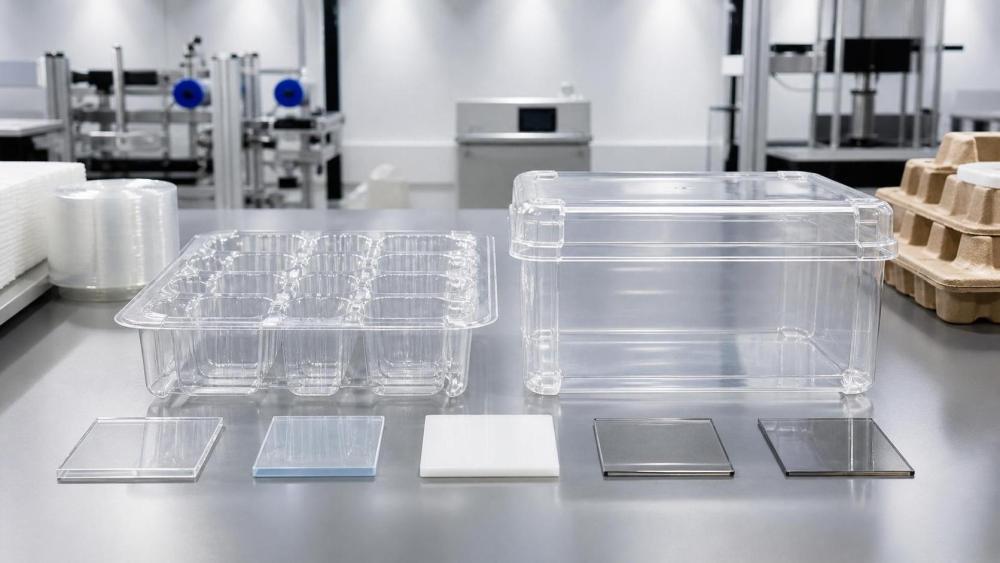
Clear packaging now serves more than shelf visibility. It often supports product protection, tamper awareness, brand presentation, transport efficiency, and regulatory expectations around food contact or recyclability. In that setting, PET and polycarbonate answer different business priorities.
PET is widely used because it balances optical clarity, processability, and cost. It fits many high-volume packaging programs where stable output and easier recycling pathways are important. Polycarbonate, by contrast, is typically considered when impact strength or toughness under abuse becomes a more critical design factor.
For a technical information platform such as APIM, this comparison reflects a broader materials trend. Packaging decisions are no longer based on resin names alone. Buyers increasingly connect material properties with conversion behavior, certification requirements, long-term availability, and circular material strategies.
A practical way to understand PET and polycarbonate
At a basic level, PET is a polyester known for high clarity, good stiffness, favorable forming behavior, and broad packaging familiarity. It is common in clamshells, trays, blister packs, lids, and transparent rigid sheets. Its packaging reputation is built on balanced performance rather than extreme toughness.
Polycarbonate is an engineering plastic with exceptional impact resistance and strong dimensional stability. It can remain clear while withstanding rough handling better than many packaging materials. That makes it attractive for reusable containers, high-value product protection, or cases where drop resistance outweighs raw material cost.
Simple comparisons can be misleading, though. A PET sheet grade optimized for thermoforming behaves differently from an injection molding grade. The same is true for polycarbonate compounds with UV packages, flame retardants, or recycled content. Material selection should therefore focus on the exact packaging format and process route.
Impact, clarity, and cost rarely point to the same answer
Impact resistance
If packaging faces repeated drops, compressive abuse, or handling in cold logistics, polycarbonate usually leads on toughness. It is harder to crack and better suited to demanding reuse cycles. PET offers useful impact resistance for many standard packaging uses, but it is not generally selected for extreme abuse conditions.
Optical appearance
Both materials can provide strong transparency, but the quality target matters. PET is often preferred for crisp retail presentation because it offers excellent clarity at competitive cost. Polycarbonate is also clear, yet in packaging decisions its optical value is usually considered together with toughness, not as a stand-alone advantage.
Cost position
On material price, PET typically has the advantage. It is more aligned with high-volume packaging economics and is often easier to justify when margins are tight. Polycarbonate generally commands a premium, which may only be reasonable when damage reduction, durability, or reuse offsets the higher resin cost.
Processing and supply chain factors often decide the final choice
Material selection becomes more realistic when processing is added to the conversation. PET is widely supported across sheet extrusion, thermoforming, and packaging conversion lines. That often means broader supplier options, more predictable lead times, and easier benchmarking across regions.
Polycarbonate can require a different economic logic. It may introduce higher resin cost, but also lower breakage rates or fewer packaging failures. In some programs, that tradeoff is justified. In others, it creates unnecessary specification without measurable return.
Processing conditions also matter for quality consistency. APIM regularly highlights how extrusion settings, moisture control, residence time, and melt stability affect downstream performance. For clear packaging, haze, yellowing, stress whitening, and dimensional variation can all change how a material performs commercially.
This is especially relevant when comparing virgin PET, recycled PET content, and specialty polycarbonate grades. The specification should not stop at the resin family. It should include the converting route, thickness range, sealing or printing needs, and any visual acceptance criteria.
Where PET usually fits better, and where polycarbonate earns its place
PET often fits better in applications where clarity, efficient forming, and cost control need to coexist. Typical examples include retail blister packaging, bakery lids, produce containers, cosmetics trays, and display-oriented rigid packs. In these uses, the packaging must look clean, run efficiently, and remain commercially competitive.
Polycarbonate becomes more relevant when packaging acts more like a protective component than a disposable shell. This may include reusable transit packs, technical device enclosures, transparent guards, or premium presentation cases for products exposed to rough handling.
- Choose PET when packaging volume is high and replacement cost must stay low.
- Choose PET when recycling alignment and mono-material strategy are under review.
- Consider polycarbonate when damage risk is costly or product protection is central.
- Consider polycarbonate when the package must survive repeated use cycles.
The better option depends on how the package is expected to fail. If scratching, cracking, deformation, or breakage creates customer complaints or product loss, impact performance becomes a direct purchasing issue rather than a technical side note.
Sustainability, compliance, and total cost deserve equal attention
In many packaging projects, PET benefits from stronger familiarity in recycling systems. That does not automatically make every PET structure circular, but it can simplify discussions around recoverability, recycled content, and brand sustainability targets. Those factors increasingly influence sourcing decisions alongside price.
Polycarbonate may still be the better answer in a durable system with repeated use. When a package is reused many times, total lifecycle logic can look different from one-way packaging economics. The key is to evaluate real circulation patterns, cleaning exposure, return rates, and damage frequency.
Compliance also matters. Food contact status, regional regulations, declaration packages, and batch consistency should be checked early. In practice, the material that looks cheaper on paper may become more expensive if qualification takes longer or supplier documentation is incomplete.
That broader view is consistent with how APIM approaches industrial materials: by linking resin performance with manufacturing realities, procurement risk, and long-term application fit rather than reducing decisions to headline properties.
A useful framework for the next comparison round
A practical evaluation should start with the packaging format, handling environment, and expected service life. From there, compare PET and polycarbonate against measurable criteria instead of general impressions.
- Define whether the package is single-use, limited reuse, or long-term reusable.
- Set minimum requirements for clarity, drop resistance, thickness, and appearance.
- Review extrusion, thermoforming, or molding compatibility before price comparison.
- Check documentation, regional compliance, and supply continuity from more than one source.
- Model total cost, including scrap, breakage, returns, and qualification time.
When those conditions are clear, PET often emerges as the stronger choice for efficient clear packaging at scale. Polycarbonate stands out when toughness changes the economics of failure. The next step is not to ask which resin is universally better, but which one matches the real packaging duty, processing route, and commercial target with the least compromise.
Have questions about this sector analysis, or seeking best practices specific to your niche? Drop us a line below and let the senior consultants at APIM assist you.
We respect your privacy. Your information is strictly confidential.
Related News
- 00
0000-00
How does washing affect contamination in post-consumer recycled PP resins? - 00
0000-00
How does feedstock affect depolymerization equipment selection? - 00
0000-00
US Sets 213.44% Preliminary Antidumping Deposit on Chinese PTMEG - 00
0000-00
When should epoxy be used as a thermal interface material for semiconductors? - 00
0000-00
US Midterm Results Unlikely to Quickly Shift Recycled Plastics Market or Legislation