




Mono Material Packaging: Cost, Recycling, and Trade-Offs
Mono Material Packaging: Cost, Recycling, and Trade-Offs
Mono material packaging is gaining attention as brands and manufacturers seek simpler recycling pathways, better regulatory alignment, and more practical sustainability strategies.
Yet cost pressure, material performance, barrier needs, and processing limitations still shape every packaging decision.
This article examines how mono material packaging balances recyclability, economics, and functional trade-offs, helping business decision-makers evaluate where it creates real value.
Why Mono Material Packaging Is Moving Into Procurement Discussions
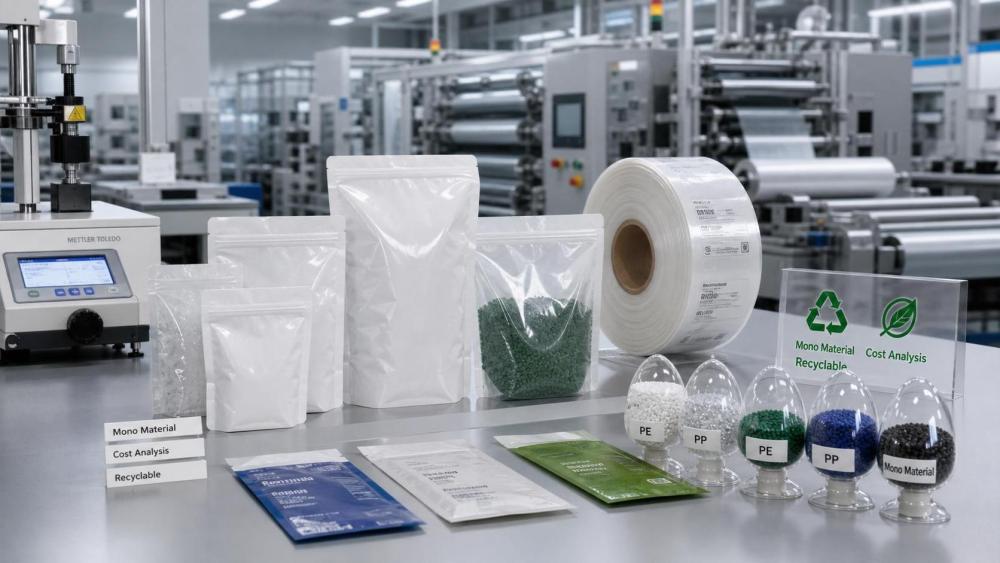
Mono material packaging uses one resin family across the main pack structure.
That sounds simple, but the commercial impact is wider than design language.
In practical terms, it can improve sortability, reduce recycling confusion, and support extended producer responsibility targets.
More importantly, mono material packaging gives procurement teams a clearer story around end-of-life handling.
Recent market shifts make that story harder to ignore.
Retailers want measurable packaging improvements, not broad sustainability claims.
Regulators are also pushing packaging toward design-for-recycling principles.
That creates a direct link between packaging format and future compliance cost.
For many converters and brand owners, the question is no longer whether mono material packaging matters.
The real question is where it works well enough to justify the switch.
Where Cost Pressure Really Shows Up
The cost of mono material packaging rarely sits in one line item.
It appears across resin choice, downgauging limits, machinery settings, testing cycles, and scrap behavior.
A simple resin replacement may look neutral on paper.
In production, however, seal windows, stiffness, and run speed can change quickly.
That is why total cost matters more than material price per kilogram.
Common cost drivers include:
- Resin premiums for specialized PE or PP grades
- Extra development work for barrier redesign
- Machine adjustments to maintain output and seal integrity
- Validation costs for shelf life, migration, and transport performance
- Possible pack weight increases when stiffness drops
Still, cost pressure can move in the other direction.
Mono material packaging may simplify structures, reduce adhesive complexity, and improve reclaim compatibility.
When scale improves, procurement teams sometimes gain stronger buying leverage through higher-volume single-polymer sourcing.
This becomes more relevant in high-volume flexible packaging programs.
Recycling Value Is Real, but It Is Not Automatic
Mono material packaging is often presented as recyclable by design.
That is directionally true, but real recycling outcomes depend on local collection and sorting infrastructure.
A PE-based pouch may fit recycling guidelines better than a mixed laminate.
Yet if the regional stream cannot capture flexible films, theoretical recyclability has limited economic value.
This is where procurement and sustainability teams need sharper screening criteria.
Ask whether the package is designed for recognized recycling streams, not just whether it uses one material family.
Also review inks, labels, closures, and barrier coatings.
These secondary elements can weaken the recycling profile of mono material packaging.
A more useful internal test looks like this:
- Can the structure enter an existing recycling stream?
- Can it be sorted with acceptable yield?
- Can recyclers recover resin with market value?
- Can the claim be supported across target sales regions?
Without those answers, mono material packaging can become a design signal without operational proof.
Performance Trade-Offs That Change the Business Case
The strongest argument against mono material packaging usually comes from performance limits.
Many traditional laminates combine different materials for a reason.
They balance barrier, puncture resistance, heat stability, optics, and sealability in one structure.
Mono material packaging asks one polymer family to do more work.
That can be achieved through orientation, coatings, additives, or layer engineering.
But the result is not always equal to a mixed-material laminate.
The trade-offs usually show up in these areas:
- Oxygen and moisture barrier for food and pharmaceutical packaging
- Rigidity and top-load performance in stand-up formats
- Heat resistance for hot fill or retort conditions
- Seal contamination tolerance in powder or liquid applications
- Print surface stability and visual appearance
This does not mean mono material packaging is limited to low-demand uses.
It means application matching becomes more important.
Dry goods, personal care, household products, and some secondary packaging formats often provide a better entry point.
Sensitive products with aggressive shelf-life targets require stricter evaluation.
How to Compare Mono Material Packaging Options More Rigorously
A sound sourcing decision needs more than a sample roll and a recyclability claim.
Mono material packaging should be reviewed through a commercial and technical scorecard.
The most useful evaluation areas are listed below.
This type of comparison prevents one common mistake.
Teams often overvalue theoretical circularity and undervalue conversion disruption.
A better business case balances both.
When Mono Material Packaging Makes the Most Sense
Mono material packaging is most attractive when sustainability pressure and technical feasibility overlap.
That overlap is growing, but it is still application specific.
Good-fit conditions usually include:
- High packaging volumes where material simplification can scale
- Products with moderate barrier requirements
- Markets facing packaging tax or recycling fee pressure
- Brands needing clearer environmental positioning with lower claim risk
- Operations that can support structured trials and qualification work
By contrast, the business case is weaker when product protection carries far greater value than recycling gains.
That can happen in demanding medical, retort, aroma-sensitive, or long shelf-life applications.
In those categories, material substitution should start with risk mapping, not sustainability messaging.
A Practical Buying Approach for the Next Packaging Review
The most useful approach to mono material packaging is staged, not ideological.
Start with formats where recyclability can improve without creating major product risk.
Then compare total delivered cost, operating efficiency, and claim credibility.
In real sourcing programs, the strongest candidates tend to be the ones that pass three tests together.
They run reliably, protect the product, and hold up under regulatory scrutiny.
That is the point where mono material packaging moves from a trend topic to a serious procurement option.
For the next packaging review, focus supplier discussions on measurable outcomes:
- Validated line performance at commercial speed
- Shelf-life data versus current structure
- Regional recyclability evidence and claim boundaries
- Net cost impact, including waste and qualification expense
That framework keeps the conversation grounded.
Mono material packaging can create real value, but only when recyclability, cost, and function are assessed together from the start.
Have questions about this sector analysis, or seeking best practices specific to your niche? Drop us a line below and let the senior consultants at APIM assist you.
We respect your privacy. Your information is strictly confidential.
Related News
- 00
0000-00
How does washing affect contamination in post-consumer recycled PP resins? - 00
0000-00
How does feedstock affect depolymerization equipment selection? - 00
0000-00
US Sets 213.44% Preliminary Antidumping Deposit on Chinese PTMEG - 00
0000-00
When should epoxy be used as a thermal interface material for semiconductors? - 00
0000-00
US Midterm Results Unlikely to Quickly Shift Recycled Plastics Market or Legislation