




How humidity affects transparent barrier packaging materials
Humidity can weaken the oxygen barrier of a transparent package even when the film remains clear and appears undamaged. The effect depends on the barrier chemistry, the surrounding layers, temperature, and how long the structure stays exposed to moisture. For transparent barrier packaging materials, a low oxygen transmission rate measured under dry conditions is therefore only part of the performance picture.
The first distinction is between oxygen barrier and moisture barrier. A material may resist oxygen very effectively while absorbing water or allowing water vapor to pass through it. Reliable selection requires separate measurements of both properties, followed by testing under conditions that represent the product, processing route, and storage environment.
Why absorbed water changes oxygen barrier performance
Oxygen moves through an intact polymer film by dissolving into the material and diffusing across it. Barrier performance depends on how readily oxygen enters the polymer and how easily it moves between polymer chains. Thickness matters, but so do molecular structure, crystallinity, temperature, and moisture content.
Ethylene vinyl alcohol, commonly called EVOH, illustrates the humidity problem. Its hydroxyl groups support strong interactions between chains, helping restrict oxygen transport in dry conditions. Those same groups attract water. As water enters the polymer, it changes the interactions between chains and increases molecular mobility. This process, called plasticization, generally allows oxygen to diffuse more easily.
The resulting increase in oxygen permeability can be substantial, but there is no universal humidity penalty that applies to every EVOH film. Ethylene content, barrier-layer thickness, processing history, and the complete layer arrangement influence the response. Grades that offer stronger dry oxygen barrier can also show greater moisture sensitivity, creating a tradeoff that dry data alone cannot resolve.
Polyamide and polyvinyl alcohol-based barrier materials also absorb moisture, although their responses differ by chemistry and formulation. Moisture uptake can affect flexibility and dimensions as well as gas transport. A film may retain acceptable appearance while its protective performance changes.
Some plasticization effects can reverse as the material dries. That does not mean every humid exposure is harmless: delamination, coating damage, or seal deterioration may persist. Reversible changes in the polymer and permanent structural damage require different corrective actions.
The product can expose the barrier to humidity from inside
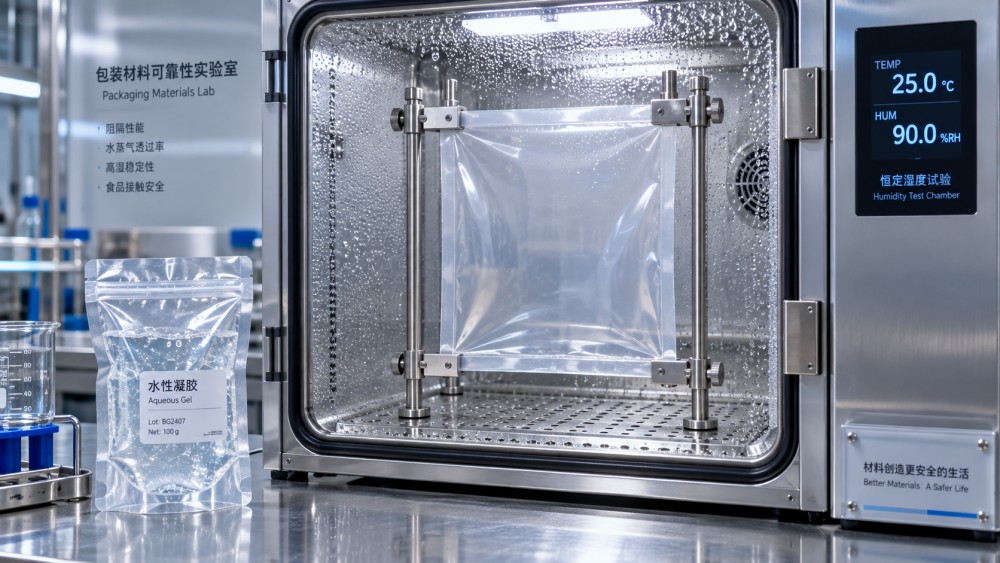
Warehouse humidity is only one moisture source. A wet food, gel, or aqueous formulation can maintain a humid package interior even when the external air is relatively dry. Testing only the outside surface under elevated humidity can therefore miss the more demanding exposure.
Product water activity helps describe this internal condition. At equilibrium and the same temperature, equilibrium relative humidity is approximately water activity multiplied by 100. A product with high water activity can consequently expose the inner packaging surface to high relative humidity. This relationship does not describe every transient condition, particularly during filling, cooling, or condensation.
In a multilayer film, the barrier layer experiences a moisture condition determined by transport through all surrounding layers. Its local humidity may differ from both the package interior and the external atmosphere. Layer thickness, water vapor resistance, temperature, and exposure time govern how quickly moisture reaches it.
Consider a structure with an EVOH layer between polyethylene layers. Polyethylene provides useful resistance to water vapor and can slow moisture uptake by the EVOH. It does not permanently isolate the barrier from water. During sustained exposure, moisture can still enter, and the layer arrangement determines its distribution.
A cross-sectional view of this structure should show moisture arriving from both sides, the protective layers, and the oxygen barrier layer. It explains why two films with the same EVOH grade and thickness can behave differently: their surrounding layers can create different moisture conditions at the barrier.
How common transparent barrier systems respond
Transparent packaging can use a polymer barrier layer, a thin inorganic coating, or a combination of technologies. These systems fail through different mechanisms, so one humidity test cannot explain every result.
Oxide-coated films do not undergo the same bulk plasticization mechanism as EVOH. Their performance depends heavily on coating continuity and the interfaces supporting the coating. A thin deposited layer can provide strong barrier on a flat specimen but lose protection after creasing, stretching, or repeated flexing.
Humidity may compound these effects by changing the substrate, adhesive, or coating interface. Protective topcoats and lamination can improve durability, but their benefit must survive conversion into the final package. Ranking oxide coatings above polymer barriers solely because they absorb less water overlooks mechanical damage.
PVDC-based materials can provide both oxygen and moisture resistance with comparatively limited humidity dependence. Their suitability still depends on processing, application requirements, and end-of-life goals. No chemistry automatically provides the best combination of barrier, clarity, sealing, durability, and recyclability.
Read OTR and WVTR data as measurements with conditions
Oxygen transmission rate (OTR) describes oxygen passing through a specimen over a stated area and time under specified conditions. Water vapor transmission rate (WVTR) describes water vapor passage. Lower values indicate stronger barrier under the conditions reported, but the two measurements answer different questions.
A low WVTR can help slow moisture reaching a sensitive oxygen barrier. It does not establish the film’s OTR. Equally, excellent dry OTR does not demonstrate protection against moisture gain or loss.
Before comparing supplier data, establish whether the results describe the resin, an individual layer, the finished laminate, or the complete package. A resin permeability value normalized for thickness cannot be directly compared with the transmission rate of a multilayer film. Package-level oxygen ingress may also include seals, closures, and other paths absent from a flat-film test.
A usable report should identify:
- Temperature and humidity on both sides: a single RH value may leave the actual exposure unclear.
- Specimen construction: total thickness, barrier-layer thickness where relevant, and which surface faced each test gas.
- Conditioning and measurement endpoint: whether the film was preconditioned and the reported value represents steady state or a defined exposure time.
- Method and units: including the gas conditions or pressure normalization needed for meaningful comparison.
- Specimen history: whether testing occurred before or after lamination, forming, sterilization, or mechanical stress.
Standardized methods provide a reproducible measurement framework. They do not establish a universal acceptance limit for packaging. The specification must connect the test conditions and measured result to the product’s protection requirements.
Temperature deserves separate attention. Increasing temperature generally increases molecular transport, while relative humidity describes water vapor relative to saturation at that temperature. Results collected at different temperatures cannot be treated as equivalent simply because the RH values match.
Build a test sequence around actual exposure
Start with the product and distribution conditions rather than the most convenient laboratory setting. Identify internal moisture, expected external humidity, storage temperature, shelf-life duration, and any filling or sterilization step. These conditions determine which exposures are useful for qualification.
A practical sequence combines four types of evidence:
- A controlled baseline. Measure the finished structure under a defined reference condition to support comparison and later quality control.
- Humid-condition performance. Include representative internal and external humidity, using asymmetric conditions where the application requires them.
- Performance after processing and handling. Repeat relevant measurements after forming, flexing, thermal processing, or other expected stresses.
- Finished-package protection. Assess seals and closures, then relate package performance to product stability over the required storage period.
Conditioning time matters because an initially dry barrier layer may take time to absorb moisture through surrounding layers. A short measurement can capture temporary protection before moisture distribution stabilizes. Conversely, a fully equilibrated test may not describe a brief distribution exposure. Steady-state data and time-dependent measurements serve different purposes.
Retort or steam exposure deserves its own evaluation. Combined heat and moisture can temporarily reduce the oxygen barrier of an EVOH-containing structure, and recovery depends on drying and layer design. Coatings and adhesive interfaces may respond differently. Testing after a thermal process should include the period when the product actually needs protection, rather than only a later result after drying.
Humidity cycling can also reveal weaknesses hidden by constant conditions. Movement between cold storage and warm air can produce condensation, exposing surfaces or interfaces to liquid water. A high-RH vapor test alone does not reproduce that exposure.
Match the structure to the protection requirement
For a moist, oxygen-sensitive product, prioritize OTR under humid internal conditions and after any thermal processing. EVOH may remain suitable when its grade, thickness, and protective layers are appropriately designed. A dry OTR advantage has limited value if it disappears during storage.
For a dry product that loses quality through moisture uptake, WVTR may drive the decision. Oxygen barrier can still matter for oxidation, but the lowest OTR does not necessarily prevent loss of crispness, powder caking, or other moisture-related changes.
For clear packaging that undergoes substantial folding or flexing, examine barrier retention after mechanical stress. An oxide-coated film with excellent initial measurements may need protective lamination or a different package geometry. Test the converted structure, since flat-film performance cannot establish resistance to damage during use.
Optical clarity should be evaluated alongside these measurements. Moisture-related haze, whitening, or delamination can make a package unacceptable, but unchanged transparency does not prove unchanged barrier. Appearance and gas transmission are separate acceptance criteria.
Recyclability requirements may constrain the layer choices, coatings, and adhesives available. Compare complete candidate structures against the same protection requirements. Reducing material complexity is useful only if the resulting package still preserves the product through its intended life.
Turn laboratory results into a package specification
The most useful next step is to define the package’s allowable oxygen ingress and moisture gain or loss under relevant storage conditions. Base those limits on product sensitivity, initial headspace oxygen, residual oxygen in the product, package area, and required shelf life.
Film OTR and package area can support an initial oxygen-ingress estimate when the measurement conditions represent use. That estimate needs refinement where oxygen concentration, temperature, or humidity changes over time, or where seals and closures contribute significant ingress. It cannot by itself establish shelf life.
A purchasing specification should therefore state the finished structure, test conditions, specimen preparation, and acceptance criteria after relevant processing. This makes a supplier’s barrier claim usable for qualification and routine control. It also prevents a dry laboratory result from becoming an unintended promise of protection in a humid package.
Have questions about this sector analysis, or seeking best practices specific to your niche? Drop us a line below and let the senior consultants at APIM assist you.
We respect your privacy. Your information is strictly confidential.
Related News
- 00
0000-00
Do polyolefin hot melt adhesives bond well to polyethylene? - 00
0000-00
Korean Study Finds PLA Barely Degrades in Landfill After 320 Days - 00
0000-00
How to assess batch consistency from a thermal potting compounds supplier - 00
0000-00
How much weight can carbon fiber reinforced plastics save in cars? - 00
0000-00
Switching from PS to ABS Sheet Extrusion: Equipment Checks