




How film converting technology improves seal consistency in EVOH packaging
How Film Converting Technology Improves Seal Consistency in EVOH Packaging
For technical teams evaluating EVOH barrier packaging, a strong seal is not enough. The more meaningful question is whether the seal remains consistent through normal variation in roll quality, machine speed, sealing dwell time, product contamination risk, humidity exposure, and operator adjustments. A pouch that seals well during a controlled trial but develops narrow sealing windows on a production line can quickly become a source of scrap, leak complaints, and difficult root-cause investigations.
Film converting technology has a direct influence on that outcome. It determines how a multilayer web is slit, rewound, printed, laminated, treated, tensioned, registered, cooled, and delivered to the filling line. In EVOH structures, these operations must be considered as part of seal engineering rather than as downstream finishing steps. The EVOH layer protects oxygen-sensitive products, but the sealant layer and the converted web ultimately determine whether that protection survives package formation.
This matters across food, pharmaceutical, medical, agricultural, industrial chemical, and specialty consumer packaging. The exact structure may differ, but the practical concern is similar: seal performance should be repeatable across the usable operating window, not dependent on a narrow “sweet spot” that disappears when production conditions move slightly.
EVOH is a barrier layer, not a sealant solution by itself
Ethylene vinyl alcohol copolymer is valued for its oxygen-barrier performance, particularly in multilayer packaging where product shelf life depends on limiting oxygen ingress. Yet EVOH is sensitive to moisture, and it is generally placed between protective polyolefin, polyester, polyamide, or other functional layers. Adhesive tie layers are commonly needed where material compatibility requires them. The resulting structure is a system, not a single material.
At the sealing interface, the package usually relies on a dedicated sealant layer such as polyethylene, polypropylene, an ionomer, or a tailored coextruded sealant formulation. Seal consistency therefore depends on more than the EVOH grade. It reflects sealant chemistry, layer distribution, surface condition, converting history, and the way the film behaves when heat and pressure are applied.
A frequent evaluation mistake is to treat oxygen-barrier data and seal-strength data as separate approval items. They are related in practice. A converting defect that causes web curl, uneven gauge, poor lamination, or thermal distortion may not immediately change oxygen transmission test results, but it can destabilize the sealing process. Conversely, aggressive sealing conditions used to compensate for weak seal initiation may affect appearance, distortion, or layer integrity near the seal area.
Where converting creates seal variation
The sealing jaws are often blamed first when seal strength varies. Sometimes that is justified. In many cases, however, the underlying issue entered the web earlier. Film converting technology shapes the mechanical and thermal history of the material before it reaches the packaging machine.
Slitting is a good example. Poorly controlled slitting can leave edge damage, loose trim, dust, or telescoped rolls. These may seem like handling issues, but they can lead to unstable web tracking and inconsistent contact between sealing surfaces. If a form-fill-seal machine repeatedly corrects web position, registration and jaw alignment may drift enough to affect seal geometry. For narrow pouches or sachets, the available seal land is already limited, so small tracking errors can matter more than teams expect.
Rewinding tension is equally important. Excessive tension can create roll hardness, entrapped stress, or curl that becomes visible only after the roll equilibrates in a different plant environment. Too little tension can produce loose rolls, air entrapment, and unstable unwinding. Neither condition automatically causes a seal failure, but both make the film less predictable at the point where a controlled temperature-pressure-time cycle is supposed to create a uniform bond.
Laminated EVOH structures add another layer of risk. Adhesive coating weight, drying performance, nip pressure, cure development, and residual solvent management can affect bond uniformity and web flatness. A laminate may look acceptable in a roll sample while still showing local stiffness differences or tunneling tendencies under heat. On a packaging line, those areas can resist conforming evenly to the sealing jaw, especially in patterned seals, fin seals, or packages with gussets and folds.
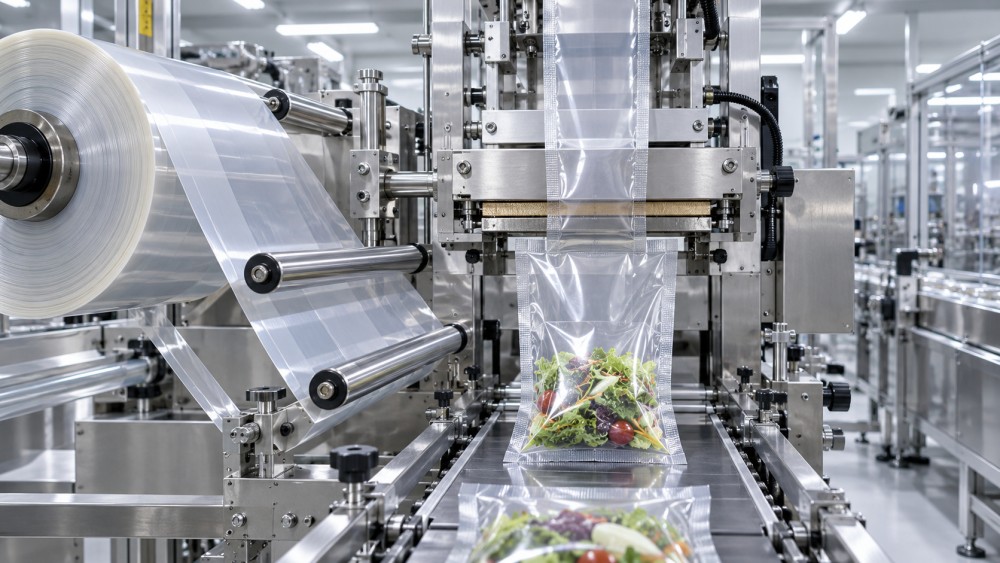
The link between web handling and the seal window
Technical evaluators should focus on the seal window rather than a single seal-strength result. The seal window describes the practical range of temperature, dwell time, and pressure in which the film produces an acceptable seal without unacceptable distortion, burn-through, blocking, or loss of peelability where peel performance is required.
A converted web with stable gauge, controlled tension, clean surfaces, and uniform layer distribution tends to provide a broader and more manageable process window. A web with local variation may still achieve acceptable results at one machine setting, but becomes sensitive to ordinary fluctuations in jaw temperature or line speed. That is why a packaging operation can report “random” seal defects even when machine settings appear unchanged.
This is also why thickness tolerance should not be viewed only as a cost-control metric. In a multilayer barrier film, total gauge may appear stable while the sealant layer or EVOH layer has local distribution variation. For sealing, the sealant-layer condition is especially relevant. For barrier retention, the continuity and protection of the EVOH layer deserve attention. A technical review should ask which layer is being controlled, how it is measured, and whether the conversion process can introduce localized stress or damage after extrusion.
Heat transfer is rarely as uniform as the machine display suggests
Seal-jaw setpoint temperature is useful, but it is not the same as the temperature experienced by every part of the seal interface. Real packages include wrinkles, gussets, product splash, folds, printing inks, coatings, and variations in web contact. The converted film must tolerate these realities.
Surface treatments and coatings deserve particular scrutiny. Corona treatment may be necessary for printability, adhesive anchorage, or coating adhesion, yet excessive or poorly controlled treatment can change surface behavior in ways that complicate downstream operations. Printed areas near a seal can also alter local heat transfer. If the design places heavy ink coverage, matte varnish, cold-seal material, or functional coating close to the heat-seal region, the packer should not assume the same settings will work as they do on an unprinted clear-web sample.
For this reason, seal validation should include representative converted material: final graphics, expected roll age, normal storage condition, intended package geometry, and realistic product conditions. Testing a laboratory laminate before its final converting steps can be useful for screening materials, but it does not fully verify production robustness.
Useful test methods, and what they do not answer
Standardized test methods provide a common language, but they should be selected to match the failure mode. ASTM F88/F88M is widely used to evaluate seal strength in flexible barrier materials. ASTM F2029 is commonly referenced when developing heat-seal curves and determining sealability under controlled conditions. Where seal-channel leaks are the concern, methods such as ASTM F1929 dye penetration or ASTM F2096 bubble emission may be relevant, depending on package construction and validation needs.
These methods are valuable, but none should be treated as a complete substitute for line trials. A peel-strength curve may show a comfortable sealing range in the laboratory while package formation on a high-speed line reveals wrinkle-related channels. A leak test may identify a defect but not distinguish whether the root cause is jaw contamination, web tension, poor registration, sealant variation, or an unsuitable package design. The test plan needs both material evidence and process evidence.
For medical packaging, additional requirements may apply depending on the package system, intended use, and market. Standards such as ISO 11607 are often part of the discussion, but the applicable validation approach must be defined for the specific device and regulatory context. It is not appropriate to assume that a food-packaging test program automatically transfers to a medical application.
A practical evaluation sequence for EVOH converted films
A disciplined review usually starts before the first production roll is ordered. Technical teams should map the full structure: outer web, printed or coated layers, adhesives or tie layers, EVOH position, protective layers, and sealant layer. They should then compare this map with the actual package format and sealing mechanics. A flat three-side pouch, a retortable stand-up pouch, a thermoformed lidding structure, and a vertical form-fill-seal sachet do not impose the same demands on the web.
During qualification, it is useful to examine more than average results. Look for variation across the roll width, from roll start to roll end, and across different slit rolls from the same parent roll. Observe whether seal appearance changes after machine stops, during speed changes, or when roll diameter becomes small. These are often the moments when a marginal converting condition becomes visible.
The most revealing questions are often practical ones: Does the material remain flat after a roll has been opened? Does it track consistently through the former or pouch machine? Does it create a stable seal before and after routine cleaning? Can operators stay within normal machine settings, or do they need repeated adjustments to maintain acceptable packages? A film that demands constant intervention may not be technically robust even if it passes an initial specification review.
Material decisions and converting decisions should be made together
Barrier packaging projects sometimes divide responsibility too sharply: resin suppliers focus on polymer performance, converters focus on appearance and roll supply, and packers focus on line output. EVOH packaging works better when these decisions are connected. Resin selection influences processing behavior; coextrusion and lamination influence layer protection; converting influences web stability; and package-line conditions determine whether the designed seal can actually be repeated.
This is the type of cross-functional interpretation that advanced-materials information platforms such as APIM are designed to support. Evaluating specialty films requires an understanding of polymer behavior, extrusion, co-extrusion, converting operations, application conditions, and procurement realities. A lower-cost structure is not necessarily a better choice if it narrows the sealing window, raises inspection burden, or makes line performance dependent on unusually tight operating control.
The practical target is not the highest isolated seal-strength value. It is a converted EVOH structure that delivers predictable sealing across the conditions the plant will genuinely encounter. When film converting technology is controlled as part of the package system, seal consistency becomes less of a recurring troubleshooting exercise and more of a design characteristic that can be verified before production pressure exposes its weaknesses.
Have questions about this sector analysis, or seeking best practices specific to your niche? Drop us a line below and let the senior consultants at APIM assist you.
We respect your privacy. Your information is strictly confidential.
Related News
- 00
0000-00
How does washing affect contamination in post-consumer recycled PP resins? - 00
0000-00
How does feedstock affect depolymerization equipment selection? - 00
0000-00
US Sets 213.44% Preliminary Antidumping Deposit on Chinese PTMEG - 00
0000-00
When should epoxy be used as a thermal interface material for semiconductors? - 00
0000-00
US Midterm Results Unlikely to Quickly Shift Recycled Plastics Market or Legislation