




How circular packaging material design can improve recyclability
How Circular Packaging Material Design Can Improve Recyclability
Circular packaging material design is becoming a critical evaluation point for manufacturers seeking to improve recyclability without sacrificing product protection, processing efficiency, or cost control.
For technical evaluators, effective design requires more than selecting recycled content. It requires reviewing material compatibility, barrier performance, adhesives, labels, inks, sorting conditions, and actual recycling pathways.
The central question is not whether a package contains sustainable materials. It is whether the complete structure can be collected, identified, sorted, processed, and converted into usable secondary material.
A package may appear circular on paper yet perform poorly in recycling systems. Small design choices, including pigment selection or incompatible sealant layers, can reduce recyclate quality.
Circular packaging material design therefore needs to begin with end-of-life requirements, then work backward through converting, filling, logistics, shelf-life, and consumer-use conditions.
Start With the Real Recycling Route
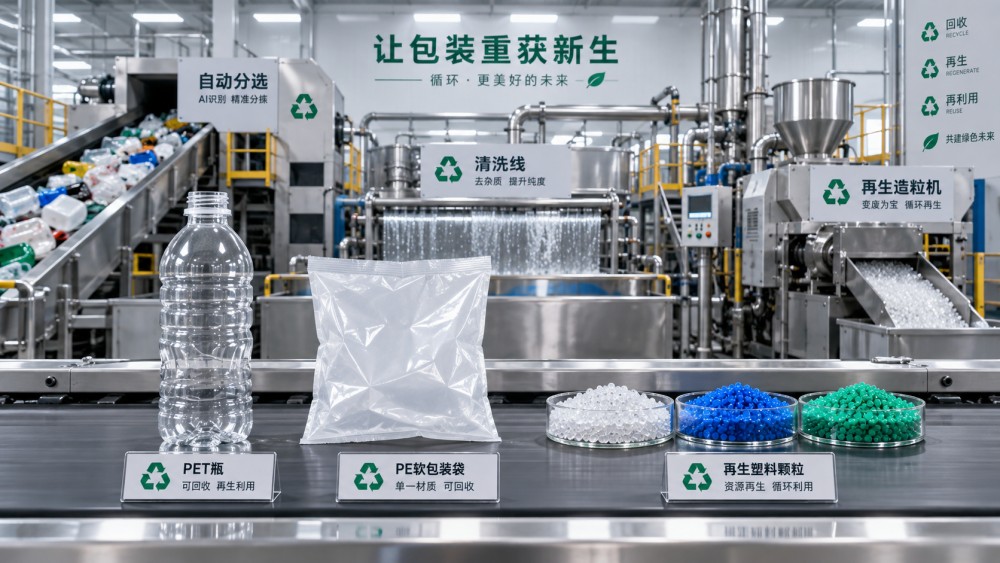
Technical teams should first identify the likely recycling route for the package. A theoretically recyclable structure has limited value when regional collection and sorting infrastructure cannot process it.
Mechanical recycling remains the primary route for many polyolefin, PET, HDPE, and PP packaging formats. It depends heavily on feedstock consistency and effective contamination removal.
Chemical recycling may handle certain mixed, contaminated, or difficult materials, but it should not automatically justify complex packaging structures without verified commercial access.
Evaluation should distinguish between laboratory recyclability, design-for-recycling guidance, local collection acceptance, and proven industrial recycling performance. These are related, but they are not identical measures.
A practical assessment asks where the package will be sold, how households or commercial users dispose of it, and which facilities receive those waste streams.
For example, a clear PET bottle with a compatible label can enter widely established recycling streams. A multilayer PET package with incompatible coatings may not achieve the same outcome.
Packaging engineers should also consider the output market. Recyclability improves materially when recovered resin can meet quality requirements for fibers, sheets, nonfood containers, or closed-loop applications.
Without stable end markets, collection alone does not create circularity. Material design must support both recovery efficiency and a commercially useful recycled polymer output.
Prioritize Mono-Material Structures Where Performance Allows
Mono-material packaging is often the most direct route to improved recyclability because it reduces separation challenges and creates more predictable recycling feedstocks.
A mono-material design does not always mean using one unmodified resin throughout the package. It means keeping functional layers and attached components compatible with the primary recycling stream.
Flexible packaging commonly uses polyethylene-based structures because PE can provide sealing, toughness, moisture resistance, and compatibility across several film layers.
Polypropylene-based structures can offer improved heat resistance and stiffness, making them relevant for certain retort, snack, personal-care, and household packaging applications.
However, mono-material conversion should not be treated as a simple resin substitution exercise. Barrier requirements, machinability, sealing windows, puncture resistance, and product sensitivity must still be validated.
Replacing a PET/PE laminate with a PE-based structure may improve recycling compatibility, but it can require changes to stiffness, print treatment, barrier coatings, and sealing conditions.
Technical evaluators should compare the total package function rather than individual material properties. The goal is a recyclable system that protects the product throughout its intended lifecycle.
Where mono-material structures cannot provide sufficient performance, teams should minimize incompatible content and evaluate whether alternative barrier technologies can maintain recyclability.
Thin compatible layers, functional coatings, or recyclable tie-layer solutions may provide a better balance than conventional multilayer combinations with difficult-to-separate polymers.
Manage Barrier Performance Without Creating Recycling Problems
Barrier performance is one of the most important constraints in circular packaging material design. Food, pharmaceutical, chemical, and moisture-sensitive products often require strict protection.
Oxygen barrier, water-vapor barrier, aroma retention, light protection, and chemical resistance can all influence material selection and package architecture.
Traditional multilayer films often combine PE, PET, PA, EVOH, aluminum, or metallized layers. These structures can protect products effectively but may complicate recycling.
The technical challenge is to determine whether each layer is essential, whether its thickness can be reduced, and whether it remains acceptable within the target recycling stream.
EVOH is frequently used as an oxygen barrier in recyclable polyolefin structures. Its suitability depends on concentration, layer configuration, recycling guidelines, and local processing capability.
Metallization can provide barrier and visual benefits, but metallized films may affect sorting, optical detection, recycling yield, or final recyclate appearance.
Clear high-barrier coatings may offer an alternative for some applications. Their performance must be tested under humidity, handling stress, thermal processing, and long storage periods.
Barrier redesign should be guided by product risk. Overengineering packaging can create avoidable recycling barriers, while underengineering can increase food waste or product failure.
A lifecycle-based decision weighs the environmental impact of packaging materials against the consequences of damaged, spoiled, contaminated, or prematurely discarded products.
Evaluate Adhesives, Inks, Labels, and Closures as System Components
Packaging recyclability is often weakened by secondary components rather than the main substrate. Adhesives, inks, labels, closures, sleeves, and coatings require technical review.
Lamination adhesives can affect melt filtration, odor, gel formation, discoloration, and recycled resin properties. Low-migration performance does not automatically mean recycling compatibility.
Adhesive suppliers should provide information on polymer compatibility, residue behavior, wash-off performance, thermal stability, and expected effects during mechanical recycling.
For rigid containers, label design can strongly influence sorting quality. Labels should be considered alongside label stock, adhesive chemistry, ink coverage, and removal behavior.
Full-body shrink sleeves can interfere with near-infrared sorting when they obscure the underlying container material. Perforation, compatible materials, or detectable sleeves may reduce this risk.
Dark carbon-black pigments have historically created sorting concerns because some optical systems cannot reliably identify them. Alternative detectable black colorants can improve sortability.
Heavy ink coverage, metallic inks, and non-compatible coatings may reduce the quality or appearance of recyclate. Technical teams should define acceptable decoration limits early.
Closures, dispensing pumps, and tamper-evident components should be evaluated separately. A recyclable bottle may lose value when attached components introduce incompatible materials or metal parts.
Design choices should account for realistic consumer behavior. Components that are theoretically removable may remain attached unless removal is simple, obvious, and consistently practiced.
Design for Sorting, Not Only for Polymer Compatibility
A compatible polymer combination is not sufficient when the package cannot be correctly identified and sorted. Sorting is a decisive stage in real recycling performance.
Material detection systems commonly use near-infrared technology, density separation, visual recognition, magnetic separation, and manual quality control, depending on the facility.
Packaging geometry can affect sorting behavior. Very small items, lightweight films, flexible pouches, and multi-component packs may be lost or misclassified during processing.
Technical evaluators should consider the minimum dimensions accepted by target material recovery facilities. Small-format packs may require collection solutions beyond standard curbside systems.
Color also matters. Clear and light-colored polymers usually retain more recycling value because they offer broader downstream color options for recycled-content applications.
Opaque white, strongly colored, or black packaging may be technically recyclable but can produce lower-value recyclate. This affects demand, pricing, and circularity economics.
Density compatibility is particularly important for labels and closures in rigid packaging. Float-sink separation can help remove certain materials, but design assumptions should be verified.
For flexible packaging, collection infrastructure remains uneven across markets. A recyclable PE pouch requires access to a film collection and recycling pathway to achieve practical circularity.
Claims should therefore be market-specific. Technical teams should avoid using universal recyclability language when collection and sorting conditions differ substantially across regions.
Use Recycled Content Without Sacrificing Process Stability
Recycled content supports circular demand by creating an end market for recovered material. Yet recycled polymer use introduces technical variability that packaging teams must manage.
Post-consumer recycled resin may vary in melt flow, color, odor, contamination level, moisture content, and mechanical properties depending on the feedstock and recycling process.
Technical qualification should include incoming-material specifications, traceability documentation, contamination controls, batch consistency, and supplier capability to maintain stable quality.
In food-contact packaging, recycled content must meet applicable regulatory requirements. Approved processes, decontamination performance, and regional compliance standards can determine feasible applications.
Recycled PET is widely used in beverage and food packaging where approved supply chains exist. Recycled PE and PP may require careful risk assessment for sensitive applications.
Packaging converters should test recycled-content formulations on actual equipment. Extrusion stability, die build-up, sealing strength, printability, haze, and odor performance can change during production.
Blending virgin and recycled resin may be necessary to meet performance targets. The appropriate ratio depends on product requirements, resin quality, package thickness, and process capability.
Using recycled content is most credible when it is supported by documented chain-of-custody systems, mass-balance rules where relevant, and clearly defined material specifications.
Circular packaging material design should create demand for recycled polymers while avoiding claims that exceed the material’s verified origin, compliance status, or technical performance.
Build a Practical Technical Evaluation Framework
Technical evaluators need a repeatable method for comparing packaging options. Decisions should not depend only on supplier claims, marketing language, or isolated recyclability scores.
A useful first step is defining the package’s functional requirements. These include product compatibility, shelf-life target, filling temperature, sealing method, transport conditions, and consumer-use expectations.
The next step is mapping every material component. Record the base resin, layer sequence, barrier materials, adhesive system, pigments, coatings, label stock, closure, and additives.
Each component should then be assessed against the intended recycling stream. Teams should identify whether it is compatible, removable, sortable, or likely to create contamination.
Material compatibility should be supported by recognized design guidelines, recycler feedback, sorting trials, or third-party testing where the commercial risk justifies deeper validation.
Processing data is equally important. A design that performs well in a recycling test but causes unstable extrusion, poor sealing, or excessive scrap may not be viable.
Cost evaluation should include more than resin price. Consider downgauging potential, line modifications, scrap rates, qualification testing, supply availability, and potential extended producer responsibility fees.
Risk review should include regulatory changes, recycled-content mandates, collection infrastructure, customer specifications, and brand commitments that may affect long-term material availability.
Documenting these factors creates a clearer decision record. It also helps procurement, R&D, sustainability, quality, and operations teams align around the same technical assumptions.
Test the Full Packaging System, Not Just the Resin
Recyclability cannot be confirmed through resin data sheets alone. The complete package should be tested under realistic converting, filling, use, collection, sorting, and recycling conditions.
Conversion trials should evaluate web handling, extrusion behavior, thickness control, lamination quality, print adhesion, winding stability, and seal consistency.
Pack performance tests should include drop resistance, compression strength, leak resistance, barrier retention, thermal exposure, chemical compatibility, and shelf-life validation where applicable.
Recycling-focused tests may examine sorting detection, wash behavior, grinding response, melt filtration, extrusion stability, odor, color, contamination, and final recyclate properties.
For complex packaging, pilot-scale recycling trials can reveal issues that laboratory tests do not capture. These include screen pack blockage, degraded melt quality, or residue accumulation.
Teams should define acceptance criteria before testing begins. Clear criteria prevent favorable but incomplete data from being interpreted as proof of commercial recyclability.
Supplier collaboration is important because resin producers, adhesive companies, converters, recyclers, and brand owners each hold different parts of the performance picture.
However, responsibility should remain clear. The company placing packaging on the market must validate that its final design aligns with its stated environmental and technical claims.
Conclusion: Circularity Depends on the Whole Design Decision
Circular packaging material design improves recyclability when it is treated as a system-level engineering task rather than a material substitution exercise.
The strongest designs begin with the available recycling route, favor compatible material structures, control barrier complexity, and account for sorting, decoration, and attached components.
Mono-material solutions can provide clear advantages, but they must still meet product protection, processing stability, regulatory compliance, and commercial performance requirements.
Recycled content strengthens circular demand, yet it requires disciplined supplier qualification and realistic testing. It should support, rather than compromise, package function and safety.
For technical evaluators, the most reliable decision is based on evidence from the complete packaging system. Material selection, conversion behavior, sorting outcomes, and recyclate quality must be considered together.
When these factors are assessed early, companies can reduce redesign risk, improve recycling credibility, and create packaging structures that are more practical for a circular materials economy.
Have questions about this sector analysis, or seeking best practices specific to your niche? Drop us a line below and let the senior consultants at APIM assist you.
We respect your privacy. Your information is strictly confidential.
Related News
- 00
0000-00
How does washing affect contamination in post-consumer recycled PP resins? - 00
0000-00
How does feedstock affect depolymerization equipment selection? - 00
0000-00
US Sets 213.44% Preliminary Antidumping Deposit on Chinese PTMEG - 00
0000-00
When should epoxy be used as a thermal interface material for semiconductors? - 00
0000-00
US Midterm Results Unlikely to Quickly Shift Recycled Plastics Market or Legislation