




How PE Mono-Material Films Affect Recyclability and Barrier Performance
What PE Mono-Material Films Really Change
The term PE mono-material films sounds straightforward, but in practice it is often misunderstood. It does not simply mean “a film made only from polyethylene and therefore easy to recycle.” In packaging and industrial converting, the more useful meaning is narrower: a film structure designed so that polyethylene remains the dominant and functionally compatible material family across the full laminate or coextruded construction. That distinction matters, because recyclability is determined less by marketing language and more by whether the structure fits established PE recycling streams, sorting behavior, reprocessing stability, and end-market expectations for recycled resin.
This is why technical teams rarely assess mono-material claims in isolation. They look at seal performance, stiffness, puncture resistance, optical properties, machineability, and, critically, barrier behavior. A film that recycles more easily but fails oxygen or moisture protection targets is not a better material solution. It is simply a different compromise.
The industry interest in PE-based structures comes from a familiar problem. Traditional flexible packaging often uses mixed-material laminates such as PET/PE, PA/PE, or structures that include aluminum, EVOH, or metallized layers to achieve strength and barrier performance. Those combinations can perform very well in use, but they are harder to recycle mechanically because incompatible layers reduce reprocessing quality or fall outside the intended waste stream. PE mono-material films try to reduce that mismatch by keeping the structure within a polyethylene-centered design logic.
Recyclability Is About Compatibility, Not Just Composition
A common mistake is to treat recyclability as a yes-or-no property. In reality, it is conditional. A PE film may be theoretically recyclable and still perform poorly in practice if collection systems do not capture flexible films, if the pack includes problematic inks or closures, or if barrier and tie layers interfere with the quality of recycled output. Technical evaluation therefore starts with compatibility thresholds rather than slogans.
For PE mono-material films, the central recycling advantage is that they can align with polyethylene reprocessing streams more closely than mixed-polymer laminates. When the structure is predominantly PE, washed and reprocessed material is more likely to behave like polyethylene during melt processing. That improves the chance of producing usable recycled pellets for secondary film, bags, or non-critical molded applications, depending on contamination level and local system capability.
Still, “mono-material” does not always mean chemically pure. Many commercial structures use small amounts of functional layers, compatibilizers, seal modifiers, or coatings. The technical question is whether those additions stay within recognized design-for-recycling guidance and whether they materially disrupt the recycling stream. In other words, recyclability is often a matter of tolerated complexity, not absolute simplicity.
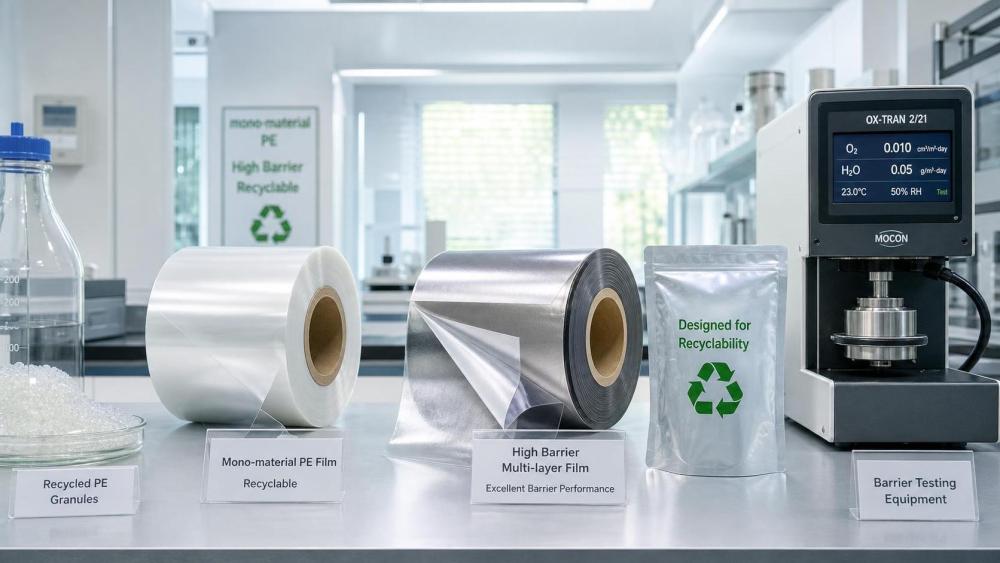
This is where evaluation frameworks from industry bodies become more useful than generic claims. Different regions and organizations use different design guidance, and those frameworks typically consider factors such as density, layer proportion, adhesive type, print coverage, and whether non-PE components exceed acceptable limits. A film supplier may present a structure as recyclable, but procurement and engineering teams still need to ask: recyclable in which system, under which guidance, and with what expected yield and recycled resin quality?
Why Barrier Performance Becomes the Hard Part
Polyethylene is well regarded for moisture resistance, sealability, toughness, and processability. It is not inherently strong as an oxygen barrier compared with materials commonly used in high-barrier packaging. That is the pressure point in PE mono-material design. Once a structure moves away from PET, PA, aluminum foil, or substantial EVOH-based barrier architectures, oxygen transmission can rise, aroma retention can weaken, and shelf-life design becomes more demanding.
This does not mean PE mono-material films are unsuitable for barrier packaging. It means the barrier target has to be matched carefully to the product’s sensitivity. Dry foods, frozen applications, detergents, some personal care products, and many non-food industrial packs may tolerate moderate barrier levels if seal integrity and mechanical robustness are good. Oxygen-sensitive foods, aggressive aroma products, pharmaceutical applications, or long-distribution shelf-life systems can be much less forgiving.
In practice, barrier performance in polyethylene-based structures is often improved through film orientation, density selection, multilayer PE design, special grades, mineral or functional formulations, surface coatings, or very limited use of compatible barrier approaches. Each route changes cost, processing window, downgauging potential, and recyclability profile. There is no single PE mono-material solution that covers all barrier requirements.
The Trade-Off Is Not One-Dimensional
Teams sometimes frame the choice too simply: either choose a recyclable PE structure or choose a high-barrier mixed laminate. Real projects are less binary. The decision usually involves at least four interacting variables: required shelf life, distribution conditions, packaging line speed, and the acceptability of downgauging or redesigning the pack format.
For example, a PE mono-material film may need greater thickness to recover stiffness or puncture resistance that a dissimilar-material laminate achieved more efficiently. If thickness increases, source reduction benefits may narrow. If the package switches from a high-barrier stand-up pouch to a lower-barrier PE structure, the fill product may need shorter shelf life, refrigerated distribution, or tighter seal control. None of those outcomes automatically disqualifies the material. They just move the conversation from material substitution to system redesign.
Another overlooked point is that poor barrier is not the only reason packaging fails. Seal contamination, pinholing, flex cracking, coefficient of friction problems, or weak hot tack can cause more practical losses than a lab barrier value alone would suggest. Some PE mono-material structures offset lower inherent gas barrier by offering better toughness and seal reliability in real converting and distribution conditions. That can be commercially meaningful, but it needs validation in the actual application rather than assumed in principle.
What Technical Evaluation Teams Usually Check
A serious review of PE mono-material films usually moves through a short list of questions:
- What is the actual structure: blown or cast film, MDO-PE, BOPE-based construction, laminated PE web, or multilayer coextrusion?
- Which barrier matters more in the end use: oxygen, water vapor, aroma, grease, or chemical resistance?
- Is the recyclability claim based on internal assessment, third-party guidance, or recognized design-for-recycling criteria?
- How much of the structure depends on coatings, adhesives, inks, or non-PE functional layers?
- Will the package run on existing filling and sealing equipment without major loss in speed or consistency?
- Does the new structure change shelf life, pack weight, drop resistance, haze, stiffness, or consumer handling?
These questions are more useful than asking whether PE mono-material films are “good” or “bad.” They force the discussion toward measurable fit.
Common Misreadings in the Market
One recurring misunderstanding is that a PE-based recyclable structure should match the barrier performance of a conventional high-barrier laminate with no penalty. That expectation is rarely realistic. If the incumbent pack relies on foil or a strong oxygen barrier layer, replacing it with a polyethylene-centered solution usually requires compromise somewhere: barrier level, thickness, cost, pack geometry, or product shelf-life assumptions.
A second misunderstanding is that recyclability can be claimed purely because the pack contains mostly PE. Sorting, collection, and reprocessing infrastructure still determine the outcome. Flexible packaging remains unevenly managed across regions. A technically recyclable structure may still have limited real recycling rates if local systems do not handle post-consumer films well.
There is also a tendency to compare barrier data from supplier literature without checking test conditions. Oxygen transmission rate and water vapor transmission rate depend on temperature, humidity, thickness, and test method. Without aligned conditions, comparisons can be misleading. Engineers know this, but commercial teams often circulate the numbers without enough context.
Where PE Mono-Material Films Make the Most Sense
The strongest fit is usually found where polyethylene already performs well and the existing pack uses mixed materials more for converting convenience than for extreme barrier need. Secondary packaging, frozen food, household goods, hygiene products, shipping films, heavy-duty liners, and some dry-food formats often provide practical entry points. In these areas, the value of stream compatibility, seal robustness, and mechanical toughness can outweigh the loss of premium barrier performance.
The fit becomes more complex in coffee, processed meat, medical packaging, or long-life oxygen-sensitive foods. Those sectors may still explore PE-centric designs, but qualification tends to be slower because the barrier requirement is more severe and regulatory or product-protection consequences are higher. Here, mono-material development is less about simple replacement and more about balancing multiple risk categories at once.
A Better Way to Judge the Concept
PE mono-material films should be treated as a design strategy, not a universal performance class. Their real contribution is that they push packaging development toward structures that are easier to integrate into polyethylene recycling pathways while preserving enough functional performance for defined uses. Whether that trade works depends on the product, the logistics chain, the converting process, and the local interpretation of recyclability.
For technical evaluation teams, the right question is not whether PE mono-material films are the future of all flexible packaging. It is whether a given application can accept the barrier profile, thickness, processing behavior, and shelf-life implications of a PE-centered structure without creating larger losses elsewhere. If that answer is yes, the material shift can be defensible. If not, the issue is not that mono-material design has failed; it is that the application still depends on a performance package polyethylene alone cannot fully replace.
That is the practical reading of the concept. Recyclability improves when material families are simplified and stream compatibility is protected. Barrier performance, however, does not disappear as a constraint. The engineering work lies in deciding where that compromise is acceptable, where it can be engineered around, and where it remains a hard limit.
Have questions about this sector analysis, or seeking best practices specific to your niche? Drop us a line below and let the senior consultants at APIM assist you.
We respect your privacy. Your information is strictly confidential.
Related News
- 00
0000-00
Do polyolefin hot melt adhesives bond well to polyethylene? - 00
0000-00
Korean Study Finds PLA Barely Degrades in Landfill After 320 Days - 00
0000-00
How to assess batch consistency from a thermal potting compounds supplier - 00
0000-00
How much weight can carbon fiber reinforced plastics save in cars? - 00
0000-00
Switching from PS to ABS Sheet Extrusion: Equipment Checks