




How Oxygen Barrier Materials Affect Drug Shelf Life
How Oxygen Barrier Materials Affect Drug Shelf Life
In pharmaceutical packaging, oxygen barrier materials protect stability, potency, and safety during storage and distribution.
That sounds straightforward, but the real impact on shelf life is often underestimated during packaging selection.
For oxygen-sensitive drugs, even low oxygen ingress can trigger oxidation, discoloration, potency loss, or unwanted degradation byproducts.
This makes oxygen barrier materials pharmaceutical packaging decisions closely tied to stability data, risk control, and regulatory expectations.
In practice, shelf life is not determined by formulation alone.
The package becomes part of the protection system, especially for biologics, solid doses, powders, and liquid drugs with oxidative sensitivity.
Why Oxygen Exposure Matters in Drug Stability
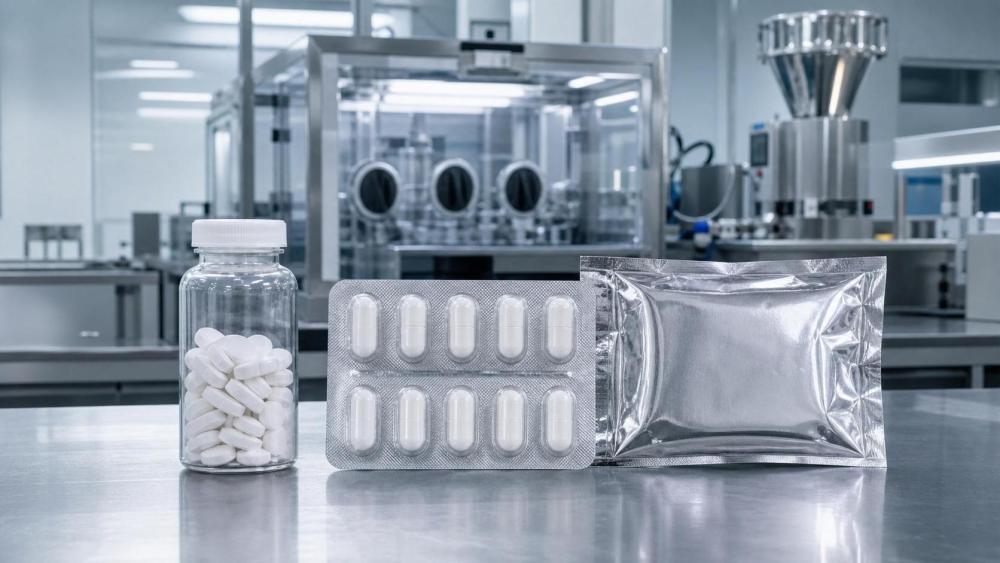
Oxygen is a reactive gas.
When it enters a pharmaceutical package, it can interact with active ingredients, excipients, coatings, and even residual solvents.
The result depends on formulation chemistry, storage temperature, headspace volume, and moisture conditions.
Some products degrade slowly. Others show measurable changes within accelerated stability studies.
Oxidation may reduce API strength, alter dissolution behavior, or generate impurities that affect compliance and patient safety.
This is why oxygen transmission rate, or OTR, matters so much in oxygen barrier materials pharmaceutical packaging evaluation.
A lower OTR generally means better resistance to oxygen ingress.
Still, lower is not automatically sufficient.
Performance must be judged against the product’s oxygen sensitivity and target shelf life.
How Oxygen Barrier Materials Actually Extend Shelf Life
Oxygen barrier materials slow the rate at which oxygen moves through packaging walls, seals, and closures.
That slower ingress delays oxidation and helps maintain the original product profile for longer.
In practical terms, they support three shelf-life goals.
- Maintain assay and potency over the intended storage period.
- Control impurity growth caused by oxidation pathways.
- Reduce variability across transport, warehousing, and market climates.
This also means fewer failures between lab stability data and real distribution conditions.
For many products, oxygen barrier materials pharmaceutical packaging performance becomes even more important after first opening is not allowed.
Unit-dose blisters, sachets, and sealed vials benefit because each dose remains protected until use.
Common Oxygen Barrier Materials Used in Pharmaceutical Packaging
Not all packaging polymers offer the same barrier performance.
Material choice depends on product sensitivity, format, processability, cost, and compliance requirements.
Common options include the following.
- EVOH: Excellent oxygen barrier in multilayer films, especially when dry conditions are maintained.
- PVDC-coated structures: Strong barrier performance for blister packs and flexible pharmaceutical packaging.
- Aluminum foil laminates: Near-total barrier against oxygen, moisture, and light when integrity is preserved.
- Cyclic olefin polymers and related high-performance plastics: Used where clarity, purity, and barrier balance are needed.
- Multilayer co-extruded films: Combine structural, sealing, and barrier layers in one system.
Among these, multilayer structures are especially common because one material rarely provides every required property.
That is a recurring theme in oxygen barrier materials pharmaceutical packaging design.
Barrier performance must work alongside sealing strength, machinability, sterilization tolerance, and extractables control.
Key Factors That Influence Barrier Performance
A high-barrier resin on a data sheet does not guarantee shelf-life protection in finished packs.
Real performance depends on the full package system and how it is processed.
The most important variables usually include these points.
- Material thickness: Thicker barrier layers often reduce oxygen transmission, but gains may level off.
- Humidity exposure: Some barrier polymers, especially EVOH, lose efficiency when moisture increases.
- Seal quality: Poor seals can defeat excellent film barrier performance.
- Closure system: Bottle caps, liners, and stopper systems may become oxygen entry points.
- Processing conditions: Orientation, coating uniformity, and lamination quality affect consistency.
- Distribution stress: Flex cracking, abrasion, and temperature cycling can weaken the barrier layer.
This is where technical review often becomes more detailed.
A package may pass a material specification but still underperform in filling, sealing, or transportation.
That gap matters in oxygen barrier materials pharmaceutical packaging risk assessment.
How to Evaluate Oxygen Barrier Materials in Practice
Evaluation should start from the drug product, not from the packaging catalog.
The first question is simple: how much oxygen exposure can the formulation tolerate across its intended shelf life?
Once that limit is understood, packaging options can be screened more rationally.
A useful evaluation workflow usually includes:
- Review oxidation pathways from formulation and forced degradation studies.
- Define oxygen sensitivity thresholds using stability and impurity targets.
- Compare OTR data under relevant temperature and humidity conditions.
- Assess package format, headspace, seal design, and opening profile.
- Confirm barrier retention after sterilization, shipping simulation, and aging.
- Link laboratory findings to commercial manufacturing capability.
This kind of structured review reduces late-stage surprises.
It also keeps oxygen barrier materials pharmaceutical packaging choices aligned with validation and supply continuity.
Standards, Testing, and Data Interpretation
Barrier claims should be supported by standard test methods and product-specific interpretation.
Common references include ASTM and ISO oxygen transmission testing methods, plus ICH stability guidance.
The important point is not just the reported number.
Test conditions must match the expected use environment as closely as possible.
For example, OTR values measured at one humidity level may mislead decisions for tropical distribution.
Likewise, flat film data may not represent a formed blister cavity or a filled container with sealing variability.
In oxygen barrier materials pharmaceutical packaging work, data context is often as important as data quality.
Without that context, teams may over-specify expensive barriers or under-specify critical protection.
Typical Failure Risks and Selection Mistakes
Several packaging failures repeat across product launches and supplier changes.
Most of them come from treating barrier performance as a single-material issue.
- Selecting films by nominal OTR without checking humidity sensitivity.
- Ignoring seal-channel leaks in blister and pouch systems.
- Assuming bottle wall performance equals total package performance.
- Switching suppliers without confirming equivalent barrier layer construction.
- Using accelerated data alone to predict long-term oxidation behavior.
More recently, sustainability programs have added another layer of complexity.
Some mono-material or downgauged structures improve recyclability but weaken oxygen protection.
That does not rule them out.
It simply means oxygen barrier materials pharmaceutical packaging decisions must balance shelf life, compliance, cost, and sustainability together.
What Strong Packaging Decisions Usually Look Like
Strong decisions usually come from connecting formulation science with packaging engineering early.
The most reliable teams treat oxygen barrier materials as part of a complete drug protection strategy.
That strategy often includes:
- A defined oxygen budget for the product across shelf life.
- Material selection based on actual use conditions, not generic claims.
- Validation of seals, closures, and formed structures.
- Backup supply options with equivalent technical performance.
- Ongoing monitoring when packaging components or processes change.
In the end, oxygen barrier materials pharmaceutical packaging is not just a packaging topic.
It is a shelf-life control issue, a quality issue, and often a commercial risk issue.
When barrier selection is grounded in stability science, test context, and package integrity, shelf life becomes more predictable.
That is usually the clearest path to practical, defensible pharmaceutical packaging decisions.
Have questions about this sector analysis, or seeking best practices specific to your niche? Drop us a line below and let the senior consultants at APIM assist you.
We respect your privacy. Your information is strictly confidential.
Related News
- 00
0000-00
How does washing affect contamination in post-consumer recycled PP resins? - 00
0000-00
How does feedstock affect depolymerization equipment selection? - 00
0000-00
US Sets 213.44% Preliminary Antidumping Deposit on Chinese PTMEG - 00
0000-00
When should epoxy be used as a thermal interface material for semiconductors? - 00
0000-00
US Midterm Results Unlikely to Quickly Shift Recycled Plastics Market or Legislation