




High Moisture Barrier Materials: Comparing EVOH, Coatings, and Laminate Options
Selecting high moisture barrier materials now reaches far beyond a routine packaging choice. In films, lids, pouches, labels, medical packs, and protective industrial substrates, moisture transmission can reshape product life, appearance, adhesion, electrical stability, and process yield.
That is why comparisons between EVOH, barrier coatings, and laminate structures matter. The best option is rarely the one with the lowest published permeability. It is the one that fits the humidity profile, converting method, regulatory target, and total cost of the application.
Across the broader materials sector, this topic connects with APIM’s focus on specialty films, extrusion systems, adhesives, and performance-driven material selection. Moisture barrier design sits at the intersection of polymer science, process control, and commercial decision-making.
Why moisture barrier performance deserves closer attention
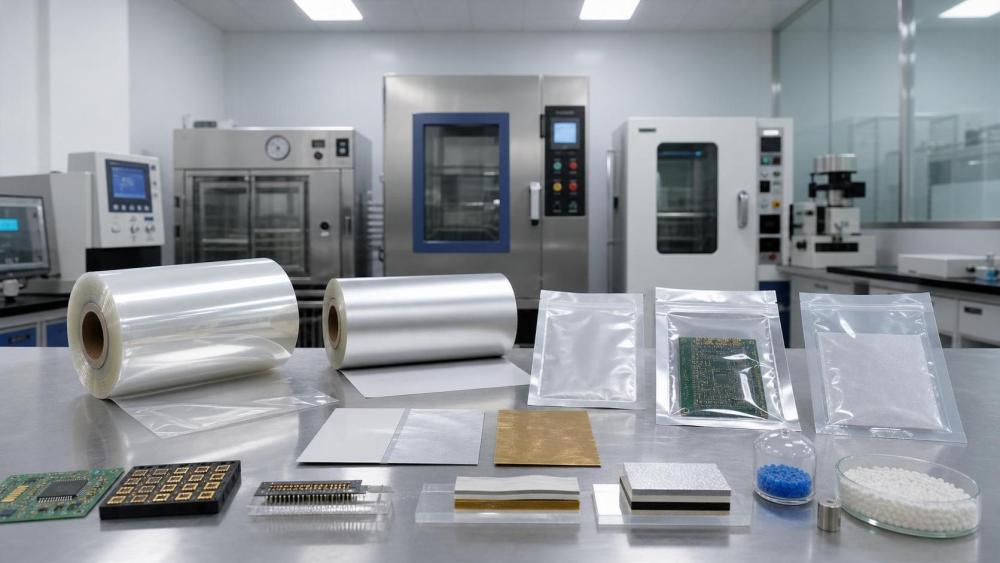
A moisture barrier is intended to slow water vapor movement through a material structure. Simple in theory, the practical result depends on resin chemistry, layer design, coating continuity, sealing quality, and environmental exposure.
High moisture barrier materials are increasingly relevant in food packaging, pharmaceutical packs, electronics protection, industrial parts storage, and high-value components shipped across humid climates. Small differences in transmission rate can change shelf life or reliability in meaningful ways.
The industry is also paying more attention because supply chains are tighter and sustainability targets are stricter. A barrier structure must now protect the product while remaining realistic for recycling, downgauging, or mono-material redesign.
EVOH, coatings, and laminates are not solving the same problem in the same way
EVOH is often discussed first because it is a familiar barrier resin in multilayer film. It is widely valued for oxygen barrier performance, yet its moisture response is more conditional and needs careful interpretation.
When humidity rises, EVOH can absorb moisture and lose part of its barrier efficiency. That does not make it unsuitable. It means the surrounding layers, expected climate, and end-use cycle become critical.
Barrier coatings work differently. They place a functional layer on a substrate such as PET, BOPP, paper, or foil replacement structures. Depending on chemistry, coatings may target water vapor, oxygen, grease, aroma, or multiple properties at once.
Laminate options take a structural route. They combine films, foils, sealants, primers, tie layers, and adhesives to build a more complete performance package. In practice, laminates are often chosen when one material alone cannot meet barrier, strength, sealing, and appearance targets together.
A quick comparison
Where technical evaluation usually becomes difficult
The first difficulty is confusing moisture barrier with oxygen barrier. Many high moisture barrier materials are not automatically the best oxygen barrier materials, and the reverse is also true. Performance priorities must be separated before screening starts.
The second issue is overreliance on lab values. Water vapor transmission rate is useful, but only when temperature, relative humidity, thickness, and test standard are understood. Two datasheets can look comparable while measuring very different conditions.
Processing is another blind spot. In coextrusion, tie-layer selection, melt temperature, residence time, and layer uniformity can affect final barrier consistency. In coated films, surface treatment and line cleanliness matter just as much as chemistry.
Laminates add their own variables. Adhesive cure, bond strength, delamination risk, seal initiation temperature, and curl behavior can all influence whether a nominally strong barrier remains reliable in shipment and storage.
How each option performs in real application settings
In dry or moderately controlled environments, EVOH-based structures can be efficient when paired with moisture-resistant outer layers such as polyolefins or PET. They are often selected when converters want barrier performance within established coextrusion lines.
Coatings become attractive when film downgauging, substrate flexibility, or transparency are priorities. Vacuum-coated, inorganic, or polymer-based barrier coatings can support compact structures, but they demand precise handling to avoid barrier defects.
Laminate structures are common where the product is sensitive, distribution is long, or multiple risks must be managed together. This includes retort formats, export pouches, device packaging, and pharmaceutical systems where barrier cannot be separated from seal integrity.
From an industrial materials perspective, high moisture barrier materials are not limited to consumer packaging. Protective films for electronics, insulation layers, component wraps, and specialty substrates also rely on moisture control to preserve dimensional and electrical performance.
Application factors that change the material choice
- Humidity exposure during storage, transit, and final use
- Required shelf life or protection period
- Need for transparency, printability, stiffness, or puncture resistance
- Compatibility with extrusion, coating, lamination, or thermoforming lines
- Seal performance after aging, sterilization, or transport stress
- Recycling pathway, material simplification, and regulatory pressure
Cost, sustainability, and supply chain tradeoffs are now part of barrier design
A lower-cost structure can become expensive if barrier drift creates waste, product return, or shortened shelf life. On the other hand, an overly complex laminate may exceed actual requirements and complicate sourcing or end-of-life handling.
This is one reason APIM’s broader materials coverage is relevant here. Barrier selection should be read alongside resin availability, coextrusion capability, adhesive chemistry, converting limits, and downstream application demands, not as an isolated film decision.
Sustainability has changed the evaluation framework. Many development teams are revisiting foil-heavy laminates, reducing layer count, or testing recyclable high moisture barrier materials that still protect sensitive products under realistic humidity conditions.
The key point is balance. Barrier performance, downgauging, recycled content, line speed, and package durability do not always improve together. Tradeoffs should be visible early, before qualification moves too far.
A practical way to compare high moisture barrier materials
A useful comparison starts with the product’s real moisture sensitivity, not the film category. The barrier target should reflect failure mode: caking, oxidation, electrical drift, adhesive weakening, clouding, or microbial risk.
Then define the exposure map. Include filling conditions, warehouse humidity, shipping route, retail storage, and post-opening behavior if relevant. Many barrier mismatches come from underestimating the distribution environment.
Next, compare structures at process level. Ask whether the selected option fits available coextrusion equipment, coating precision, adhesive system, sealing window, and quality control methods. A theoretically better material may be unstable on the actual line.
Finally, request evidence beyond headline specs. Transmission data under multiple humidity conditions, aging results, seal tests, laminate bond data, and application-specific trials usually reveal more than a standard marketing datasheet.
Useful screening questions
- Does the barrier remain stable at the highest expected relative humidity?
- Will the structure survive converting without microcracks or weak bonds?
- Is the chosen barrier layer protected by suitable outer materials?
- Do seal and puncture properties match transportation risk?
- Can the structure support recycling or simplification targets?
- Is supply continuity acceptable for the intended production scale?
What to do next with EVOH, coatings, and laminate options
Comparing EVOH, coatings, and laminates works best when the decision is framed around exposure, processing, and failure risk. High moisture barrier materials should be screened as full structures, not just as named resins or coating types.
A sensible next step is to build a shortlist using three filters: required barrier under real humidity, fit with current converting capability, and end-of-life direction. That approach usually narrows the field faster than chasing the lowest permeability number.
From there, pilot trials, data normalization, and supplier discussions can move the comparison from theory to qualification. In many cases, the strongest decision comes from matching the barrier concept to the full material system around it.
Have questions about this sector analysis, or seeking best practices specific to your niche? Drop us a line below and let the senior consultants at APIM assist you.
We respect your privacy. Your information is strictly confidential.
Related News
- 00
0000-00
Do polyolefin hot melt adhesives bond well to polyethylene? - 00
0000-00
Korean Study Finds PLA Barely Degrades in Landfill After 320 Days - 00
0000-00
How to assess batch consistency from a thermal potting compounds supplier - 00
0000-00
How much weight can carbon fiber reinforced plastics save in cars? - 00
0000-00
Switching from PS to ABS Sheet Extrusion: Equipment Checks