




High Barrier Films for Cheese: Shelf Life vs Sealing Performance
High Barrier Films for Cheese: Shelf Life vs Sealing Performance
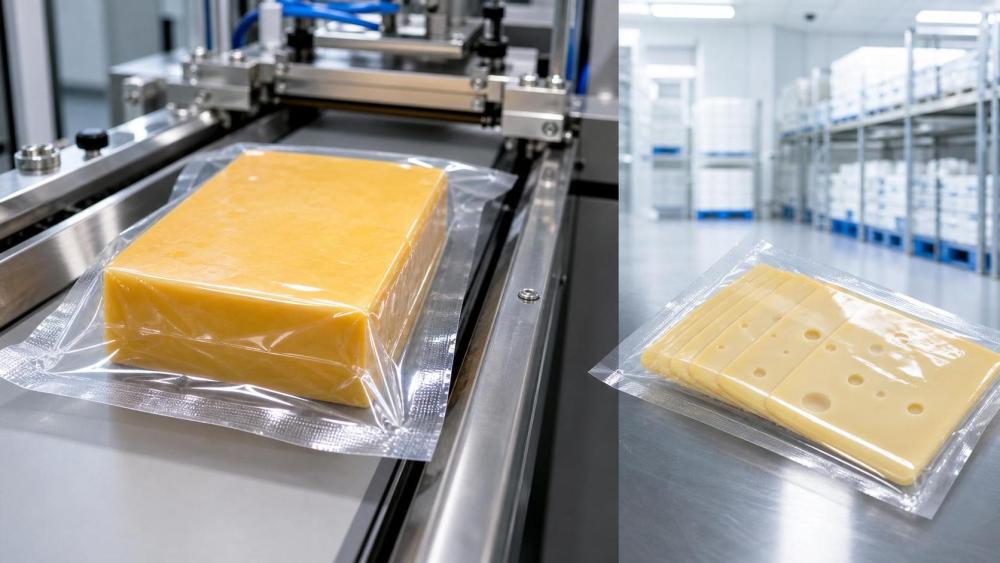
For cheese packaging, barrier performance and seal reliability are tightly linked. One without the other creates risk.
High barrier films for cheese are often selected to slow oxygen ingress, reduce aroma loss, and support longer distribution windows.
Yet in actual production, sealing performance often decides whether that barrier value survives the line, the truck, and the shelf.
A strong film structure can still fail if contamination reaches the seal area, if sealing temperature drifts, or if shrink tension becomes too aggressive.
That is why high barrier films for cheese should be evaluated as a packaging system, not as a datasheet claim.
In practice, the best decision balances oxygen barrier, moisture control, machinability, puncture resistance, seal window, and product-specific storage conditions.
Why cheese needs more than just low oxygen transmission
Cheese is not a uniform product category. Hard cheese, sliced cheese, shredded cheese, and soft ripened cheese behave very differently.
Some formats mainly need oxygen control. Others are more sensitive to moisture migration, mold growth, oil release, or package deformation.
This changes how high barrier films for cheese should be specified.
- Hard and semi-hard cheese often prioritize oxygen barrier and mechanical strength.
- Shredded cheese usually needs clean seals despite particles near the sealing edge.
- Soft cheese may need a different balance of gas control and pack flexibility.
- Vacuum packs and thermoformed packs place different stress on the seal layer.
From a quality perspective, shelf life is not only about time. It is about keeping texture, flavor, microbiological stability, and visual acceptability inside target limits.
That also means the wrong film can create hidden failure modes. A very high barrier film may look ideal until sealing becomes inconsistent on a fast line.
How high barrier films for cheese are built
Most high barrier films for cheese use multilayer structures. Each layer handles a specific function in the package.
Typical outer layers support toughness, printability, and abrasion resistance. Core layers deliver oxygen barrier. Inner layers provide heat sealing and food contact performance.
EVOH is common in cheese packaging because it offers strong oxygen barrier. Polyamide may improve puncture resistance. Polyethylene often supports sealability.
However, the structure alone does not tell the full story. Thickness distribution, tie-layer quality, and orientation also influence final behavior.
A useful buying question is simple. Does the structure match the actual cheese format and the line conditions, or only the target shelf life on paper?
Where sealing performance usually breaks down
In many plants, seal failure is not caused by one dramatic defect. It comes from small process deviations that build up over time.
With high barrier films for cheese, these deviations matter more because multilayer structures may have narrower processing windows.
Common failure points include poor jaw temperature control, short dwell time, uneven pressure, product contamination, and insufficient cooling after sealing.
Fat, salt, and cheese fines can reduce seal integrity. This is especially relevant for shredded and grated products.
More importantly, seal strength data from a lab test may not predict real line performance if machine speed changes or pack geometry introduces stress.
- Check the usable seal window, not only the peak seal strength.
- Review hot tack when packs move immediately after sealing.
- Confirm seal through contamination where product particles are expected.
- Test under actual line speed, product load, and storage temperature.
For quality and safety teams, this is the turning point. Shelf life claims lose value quickly if the seal is the weak link.
How to compare shelf life and sealing tradeoffs in real applications
The practical way to evaluate high barrier films for cheese is to compare risks side by side.
A film with stronger barrier may support longer shelf life. But if it needs tighter sealing control, the operational risk may increase.
On the other hand, a slightly lower barrier film with a broader seal window may deliver better overall product protection in a demanding production environment.
This is why validation should combine material tests and line trials.
- Measure oxygen transmission rate under relevant humidity conditions.
- Run burst, peel, dye, and leak testing on finished packs.
- Track seal failures by shift, machine, operator, and product type.
- Review package appearance after cold storage and transport simulation.
- Monitor complaints linked to mold, off-flavor, pack swelling, or opening defects.
In actual business decisions, the best film is often the one with the most stable total performance, not the most extreme barrier number.
What to ask suppliers before approving high barrier films for cheese
Supplier discussions should move beyond generic claims. High barrier films for cheese need application-specific evidence.
A good technical review focuses on consistency, process compatibility, and documented performance under realistic use conditions.
- What is the barrier performance at the humidity range expected during storage?
- What seal initiation temperature and seal window are typical?
- How does the film perform with fat or particle contamination?
- What are the thickness tolerances across production lots?
- Has the structure been validated for vacuum, MAP, or thermoforming conditions?
- Which migration, food contact, and compliance documents are available?
More revealing signals often come from supply consistency. Film variation can show up first as sealing instability, not as visible defects on the roll.
That is why incoming inspection, retained samples, and lot-level traceability remain important, even with an established supplier.
A practical qualification workflow
A workable qualification process for high barrier films for cheese should stay simple enough for routine use, but strict enough to prevent recurring failures.
- Define the cheese format, target shelf life, distribution route, and storage profile.
- Set minimum requirements for oxygen barrier, seal strength, hot tack, and puncture resistance.
- Run controlled machine trials using standard and worst-case conditions.
- Validate finished packs after transport simulation and refrigerated aging.
- Approve with clear control limits for line settings and incoming film checks.
This approach helps connect packaging material choice with operational control. It also makes supplier comparisons more objective.
For teams managing product integrity, high barrier films for cheese should support both shelf life and predictable sealing performance, every day, not only during qualification.
The most reliable result usually comes from matching film structure, sealing behavior, equipment capability, and cheese-specific risks into one controlled packaging decision.
When those factors are aligned, high barrier films for cheese become a practical solution for reducing waste, protecting safety, and delivering stable shelf life across the supply chain.
Have questions about this sector analysis, or seeking best practices specific to your niche? Drop us a line below and let the senior consultants at APIM assist you.
We respect your privacy. Your information is strictly confidential.
Related News
- 00
0000-00
How does washing affect contamination in post-consumer recycled PP resins? - 00
0000-00
How does feedstock affect depolymerization equipment selection? - 00
0000-00
US Sets 213.44% Preliminary Antidumping Deposit on Chinese PTMEG - 00
0000-00
When should epoxy be used as a thermal interface material for semiconductors? - 00
0000-00
US Midterm Results Unlikely to Quickly Shift Recycled Plastics Market or Legislation