




Flexible Mono-Material Packaging: Barrier Tradeoffs and Recyclability Limits
Flexible Mono-Material Packaging: Why Simpler Recycling Is Not a Simple Material Decision
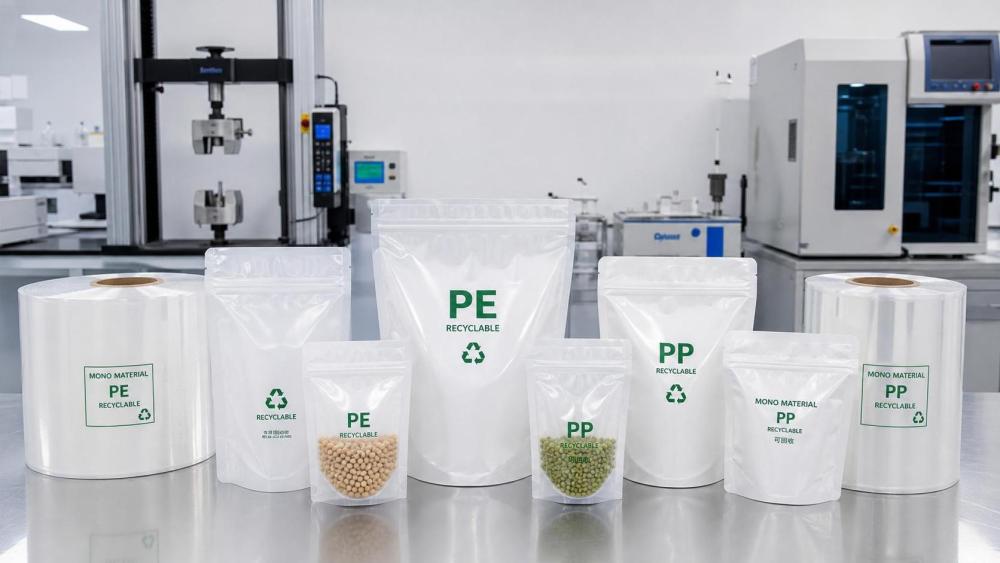
Flexible mono-material packaging is moving from sustainability concept to procurement topic. Brands want recyclable formats, but performance gaps still shape what is commercially realistic.
That gap matters most in food, personal care, medical, and industrial packaging. In these segments, barrier failure can create product loss, recall risk, and shorter shelf life.
Traditional multilayer films solved this through material stacking. PET, PA, EVOH, aluminum, PE, and adhesives each handled a specific function inside one structure.
Flexible mono-material packaging tries to simplify that structure by keeping the pack within one polymer family, usually PE or PP, to improve recycling compatibility.
The idea is attractive. Collection, sorting, and reprocessing become easier in theory. Yet in practice, barrier tradeoffs and recyclability limits remain the real decision points.
For companies comparing material pathways, the question is not whether flexible mono-material packaging is good or bad. The question is where it truly fits.
What Flexible Mono-Material Packaging Actually Means
The term is often used loosely. That creates confusion during sourcing, technical review, and sustainability reporting.
In most cases, flexible mono-material packaging means a package built mainly from one resin family. The structure may still include coatings, inks, tie layers, or functional additives.
So mono-material does not always mean chemically pure. It usually means the package stays within recycling tolerance limits for a target stream.
PE-based pouches, all-PP retort concepts, and recyclable barrier films are common examples. Each aims to replace mixed-material laminates without fully losing converting performance.
This also means claims should be checked carefully. A pack described as recyclable may still face limited collection, poor sorting recognition, or downgraded output quality.
The Core Tradeoff: Barrier Performance Versus Recyclability
The strongest argument against flexible mono-material packaging is simple. High recyclability intent does not automatically deliver high barrier performance.
Multilayer laminates became standard because different polymers do different jobs. One layer seals. Another adds stiffness. Another blocks oxygen, aroma, grease, moisture, or light.
When those layers are removed, the remaining polymer family must carry more functions. That usually creates compromises in one or more performance areas.
Typical barrier gaps to assess
- Oxygen barrier for snacks, coffee, meat, dairy, and pharmaceutical products.
- Moisture barrier for powders, dry foods, and hygroscopic formulations.
- Aroma retention for premium foods, home care, and personal care formats.
- Chemical resistance for aggressive fills or industrial products.
- Heat resistance for hot fill, sterilization, or retort conditions.
This is where flexible mono-material packaging often works best in medium-barrier applications, not in the most demanding shelf-life environments.
From a business angle, the tradeoff should be measured against waste risk. A recyclable pouch that shortens shelf life too much can create a worse overall outcome.
Where Material Science Is Closing the Gap
Recent development is making flexible mono-material packaging more credible. But most progress comes from engineered compromise, not from eliminating all technical limits.
Converters are using orientation, sealant design, specialty coatings, and carefully controlled co-extrusion to improve functional performance inside PE or PP platforms.
Barrier coatings can help, especially where oxygen sensitivity is moderate. Yet coating durability, process compatibility, and recycling acceptance still need validation.
Down-gauging also changes the equation. Lighter structures may improve material efficiency, but they can reduce puncture resistance, abuse tolerance, and machine stability.
In actual operations, flexible mono-material packaging must run well on existing filling lines. Seal window, curl, slip, stiffness, and register control matter as much as recyclability language.
The Recycling Reality: Recyclable Design Is Not the Same as Recycled Outcome
This is the point many packaging projects underestimate. Flexible mono-material packaging can be designed for recycling and still fail to be recycled at scale.
Collection systems vary widely by country and region. Store drop-off systems, curbside acceptance, and film recovery economics are not consistent.
Sorting adds another filter. Flexible films are harder to capture than rigid packaging. Small formats, contamination, and dark prints can reduce actual recovery rates.
Then comes reprocessing quality. Even when the structure enters a recycling stream, inks, closures, labels, additives, and residue can lower the value of the recyclate.
So the practical question is broader than design compliance. It is whether flexible mono-material packaging supports a viable end-of-life pathway in the target market.
Key limits that often remain
- Limited film collection infrastructure.
- Low sortation efficiency for lightweight flexible packs.
- Contamination from food or product residue.
- Poor economics for post-consumer flexible film recycling.
- Restricted high-value end uses for recycled output.
How to Decide Where Flexible Mono-Material Packaging Fits
The most effective decision process starts with application segmentation. Not every SKU should move to the same packaging architecture.
A practical review should compare product sensitivity, distribution conditions, shelf-life target, machine requirements, and regional recycling access at the same time.
In many portfolios, flexible mono-material packaging works first in dry goods, secondary pouches, refill packs, or moderate-barrier consumer applications.
It may be less suitable for products needing extreme oxygen barrier, retort resistance, or long export shelf life without cold chain support.
Decision criteria worth ranking early
- Barrier requirement by product category.
- Line compatibility and sealing robustness.
- Package appearance and shelf presentation.
- Total delivered cost, not only film price.
- Local recyclability evidence and certification basis.
- Risk of waste, complaint, or return caused by downgraded performance.
Questions to Ask Suppliers Before Conversion Starts
Supplier conversations should move beyond generic sustainability claims. Flexible mono-material packaging needs data that supports conversion, filling, use, and recovery.
Ask for oxygen and moisture transmission data under relevant conditions. Request seal performance windows, puncture test results, and evidence from commercial runs.
Check whether the recyclability claim is based on design guidelines, lab tests, or actual sorting and reprocessing trials. Those are very different proof levels.
It is also useful to ask how inks, zippers, spouts, labels, and barrier treatments affect the recycling stream. Secondary components often decide the final outcome.
A More Realistic Strategy for Adoption
The strongest strategy is usually phased adoption. Start where flexible mono-material packaging can meet performance requirements with limited operational disruption.
Pilot projects should include shelf-life testing, transport validation, machine trials, and end-of-life review in target markets. One success case should not be copied blindly.
More importantly, sustainability teams and packaging teams should use the same scorecard. Recyclability gains only create value when product protection remains commercially sound.
Flexible mono-material packaging is a serious direction, not a universal answer. It works best when material choice, converting design, and recycling reality are evaluated together.
For companies making packaging investment decisions now, the best move is clear: map the barrier need first, test the recyclable structure second, and validate the end-of-life claim before scaling.
Have questions about this sector analysis, or seeking best practices specific to your niche? Drop us a line below and let the senior consultants at APIM assist you.
We respect your privacy. Your information is strictly confidential.
Related News
- 00
0000-00
How does washing affect contamination in post-consumer recycled PP resins? - 00
0000-00
How does feedstock affect depolymerization equipment selection? - 00
0000-00
US Sets 213.44% Preliminary Antidumping Deposit on Chinese PTMEG - 00
0000-00
When should epoxy be used as a thermal interface material for semiconductors? - 00
0000-00
US Midterm Results Unlikely to Quickly Shift Recycled Plastics Market or Legislation