




EVOH Film Lead Times Stretch as Orders Surge
The timing of the event is not clearly specified in the available information, but the latest supply-chain monitoring points to a sharp change in delivery conditions for EVOH high-barrier packaging film. A rapid increase in orders from European food and pharmaceutical packaging buyers, combined with temporary output cuts at a major German EVOH resin supplier, has turned lead time from a commercial term into an immediate procurement and supply assurance issue for importers, converters, and packaging buyers that depend on stable batch performance and predictable shipment schedules.
What has been confirmed so far
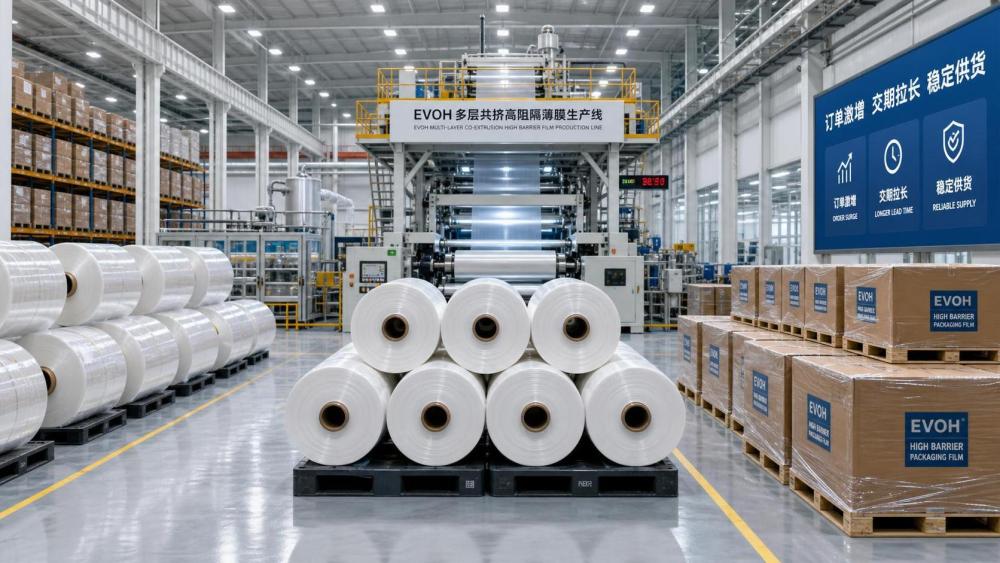
According to supply-chain monitoring data cited from Plastics Europe and APIM, demand from European food and pharmaceutical packaging customers for EVOH high-barrier packaging film rose by 37% month on month in the second week of July 2026. At the same time, a major German EVOH resin supplier temporarily reduced output. Under these conditions, Chinese EVOH film manufacturers with multilayer co-extrusion capability moved into a saturated order position, and standard lead times extended from six weeks to twelve weeks. Importers are being prompted to secure capacity earlier and to confirm the stability of batch transition.
Where delivery and compliance pressure may now concentrate
Procurement teams facing longer commitment windows
From an industry perspective, buyers of food and pharmaceutical packaging materials may be affected first because longer lead times change when purchase decisions need to be made. The main pressure point is no longer only price or availability, but whether production slots can be booked early enough to support downstream packaging schedules. What deserves closer attention is the need to review delivery commitments, batch acceptance criteria, and any technical documentation tied to material change control before orders are finalized.
Converters and packaging manufacturers managing batch transition risk
For processors and packaging manufacturers, the issue is not simply delayed supply. Analysis shows that when batch transition becomes a specific point of attention, production planning, quality consistency review, and internal release procedures may all need closer control. Companies working with regulated or specification-sensitive packaging applications should pay attention to whether their existing qualification files, incoming inspection routines, and technical approval records remain aligned with the materials actually being delivered during a period of tight capacity.
Importers and trade operators under stricter execution discipline
Importers and trading parties may feel the impact through contract timing, shipment coordination, and supplier confirmation processes. Observably, the extension from six to twelve weeks changes the practical meaning of standard delivery terms and raises the importance of confirming available production capacity before finalizing commercial commitments. Attention may also be needed around order documents, product specifications, and any buyer-side approval requirements related to lot continuity or substitution control.
Supply-chain service providers dealing with schedule volatility
Logistics coordinators and other supply-chain service providers may also be affected because longer manufacturing lead times can compress later stages of booking and delivery execution. From an operational standpoint, closer coordination may be needed between production milestones, shipment planning, and receiving schedules, especially where downstream users are working to fixed packaging runs or regulated release timelines.
Practical points companies should watch now
Lock capacity earlier than normal planning cycles
Analysis shows that the clearest near-term change is timing. Companies relying on EVOH high-barrier film should assess whether their usual ordering cycle still matches current supplier lead times. Where procurement has been based on a six-week assumption, planning may now need to reflect a twelve-week window.
Verify how batch transition is being controlled
What deserves closer attention is batch migration stability, which is explicitly highlighted in the available information. Buyers should focus on how suppliers describe batch transition, what technical records are available, and whether internal acceptance procedures are sufficient for production continuity. This is particularly relevant where packaging performance or release standards depend on consistent material behavior.
Check technical and quality documentation before delivery pressure builds
Observably, longer lead times can push technical review into a later and more compressed stage if companies do not act early. Firms should therefore pay attention to the readiness of specifications, quality documents, and any application-specific supporting records that may be needed before material release or customer acceptance. The available information does not provide detailed execution rules, so this should be treated as a control point to monitor rather than a confirmed new formal requirement.
Track whether buyer requirements start changing in contracts or tenders
It is more appropriate to understand the current situation as a market signal that may influence execution language in procurement documents. Companies should watch for changes in delivery clauses, supplier qualification conditions, batch consistency language, or other technical requirements appearing in commercial negotiations, order confirmations, or tender files.
Why this matters beyond a simple supply spike
Analysis shows that this development is more than a short-term order increase because it shifts attention toward execution reliability. The combination of stronger demand and reduced resin output does not by itself confirm a new formal policy or regulatory measure, but it does signal tighter operating conditions around supply assurance, qualification continuity, and delivery planning. It is more appropriate to understand this as an execution-level warning for the packaging supply chain, especially for businesses serving food and pharmaceutical uses where material consistency can carry greater practical weight.
How the market is best reading this development
The most balanced reading at this stage is that the market is seeing a concrete delivery and procurement adjustment rather than a fully defined new rules framework. The confirmed facts support a clear change in lead time expectations and in the urgency of capacity reservation. Beyond that, further interpretation should remain cautious. Current industry attention is best directed toward how buyers, importers, and manufacturers adjust procurement timing, technical review, and supply-chain coordination under tighter availability conditions.
Basis of this article and what still needs verification
This article is generated from the user-provided news title, event timing, and event summary. The specific official source link was not provided in the input and still requires ongoing verification. For events of this kind, source types commonly relevant to later verification include official announcements, regulatory releases, customs or trade authority information, industry association updates, standards documents, and reporting from established trade media. Further observation is still needed on any detailed execution guidance, buyer-side qualification language, certification expectations, tender document changes, market feedback, and how companies ultimately implement procurement and delivery adjustments.
Have questions about this sector analysis, or seeking best practices specific to your niche? Drop us a line below and let the senior consultants at APIM assist you.
We respect your privacy. Your information is strictly confidential.
Related News
- 00
0000-00
NAPCOR Report: US PET Bottle Recycling Rate Fell to 29% in 2025 - 00
0000-00
How does washing affect contamination in post-consumer recycled PP resins? - 00
0000-00
How does feedstock affect depolymerization equipment selection? - 00
0000-00
US Sets 213.44% Preliminary Antidumping Deposit on Chinese PTMEG - 00
0000-00
When should epoxy be used as a thermal interface material for semiconductors?