




EVOH Film Lead Times Stretch as Export Prices Rise
The timing of this development is not specified in the available information, but the signal is clear: a regulatory change tied to the revised EU food-contact framework under EU No 10/2011, combined with stronger cold-chain packaging demand from North American fresh e-commerce, is now affecting ordering, pricing, and delivery conditions in the global EVOH high-barrier packaging film market. For exporters, brand owners, converters, and procurement teams, the issue is no longer only material availability; it now also touches compliance review, launch timing, supplier scheduling, and cost control.
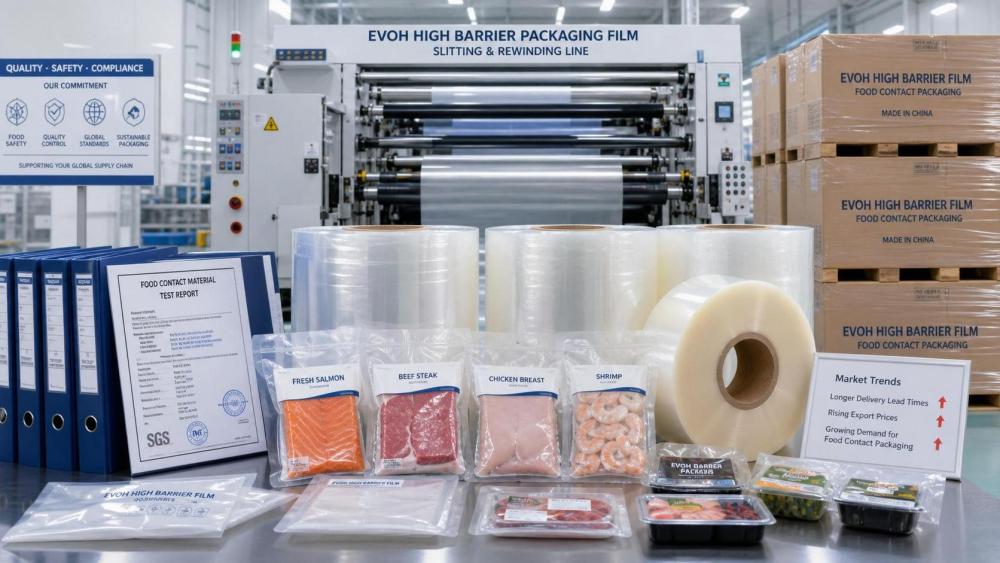
What has been confirmed in the current market signal
Confirmed information shows that global EVOH high-barrier packaging orders increased by 47% quarter on quarter in 2026 Q2. The demand increase is described as being driven by the revised EU food-contact regulation under EU No 10/2011 and by cold-chain packaging demand from North American fresh e-commerce.
The same information states that the average delivery cycle at China’s top three EVOH co-extruded film production lines has extended to 12 weeks. Mainstream export FOB quotations are also reported to have increased by 8% to 12% compared with early June.
In addition, some orders for high-end five-layer co-extruded structures have reportedly been scheduled as far out as 2027 Q1. The available summary further states that this trend is directly affecting overseas brand owners’ new product launch schedules and packaging cost budgets.
Where the pressure is now appearing across the chain
Export quoting is becoming more tightly linked to compliance-led demand
From an industry perspective, exporters may be affected first through quotation validity, order confirmation speed, and delivery commitments. When demand rises alongside a regulatory-driven shift in material selection, export contracts can face greater pressure around lead-time promises and pricing windows. What deserves closer attention is whether technical documents, product specifications, and compliance-related material declarations are aligned early enough to avoid re-quotation or shipment delays.
Brand owners and buyers face a timing issue, not only a cost issue
Analysis shows that overseas buyers and brand owners are likely to feel the impact in product launch planning, packaging budget allocation, and procurement sequencing. A 12-week average lead time, together with reports that some higher-end structures are already booked into 2027 Q1, suggests that packaging decisions may need to be finalized earlier in the development cycle. In practical terms, buyers should pay closer attention to specification lock-in, order scheduling, and the completeness of compliance documentation tied to food-contact use.
Converters and manufacturing planners may need stricter material coordination
Observably, processing and manufacturing participants may be affected through production planning, film structure selection, and substitution risk management. If a required EVOH structure is subject to longer lead times or higher FOB pricing, the immediate operational issue may not be demand itself, but whether the selected packaging design can still be delivered within the target commercial schedule. The relevant change to watch is the interaction between compliance expectations and production-slot availability.
Testing and documentation work may become more time-sensitive
For testing-related and compliance-support functions, the pressure may center on document readiness rather than on any newly confirmed enforcement result. Because the reported demand increase is linked in part to a revised food-contact framework, market participants should closely monitor whether customers, tenders, or internal approval processes begin asking for more detailed technical files, declarations, or supporting test materials. The current information does not confirm a unified execution outcome, but it does suggest a stronger compliance screening environment around food-contact packaging decisions.
What companies should track in the next round of execution
Review technical files before purchase commitments tighten
Analysis shows that companies using EVOH high-barrier packaging should verify early whether their material specifications, declarations, and supporting compliance records are complete for the intended market and application. The available information does not provide detailed execution requirements, so this should be understood as a precautionary focus rather than a confirmed new filing obligation.
Reassess lead-time assumptions in sourcing plans
What deserves closer attention is the gap between existing purchasing calendars and the newly reported 12-week average delivery cycle. For teams working with launch windows, promotional packaging, or seasonal fresh-chain demand, a longer supply cycle can quickly become a planning constraint. It is more appropriate to understand this as an execution risk in procurement and scheduling, especially where higher-specification film structures are involved.
Watch how customer documents and tender language evolve
Observably, one practical signal of rule implementation may appear in customer-side procurement language before it appears in broader market narratives. Companies should monitor whether bid documents, packaging specifications, quality clauses, or purchase contracts start reflecting more explicit food-contact compliance expectations or more detailed material requirements. The current information does not confirm that such changes are already standardized, but it indicates that this is an area worth tracking closely.
Prepare for pricing discussions to include both regulation and availability
From an industry perspective, the reported 8% to 12% increase in mainstream export FOB quotations means pricing discussions may increasingly combine compliance-driven demand arguments with supply availability constraints. Companies involved in exports, sourcing, or downstream packaging procurement should pay attention to quote validity periods, change-control procedures, and documentation consistency when negotiating orders under tighter capacity conditions.
Why this looks more like an execution signal than a one-day headline
Analysis shows that this development is better understood as an operational market signal tied to regulatory adjustment and downstream demand, rather than as a standalone price story. The key point is not only that orders rose sharply, but that compliance-linked demand and cold-chain application growth are now appearing in measurable trade and delivery indicators such as lead times, FOB pricing, and booking horizons for higher-end structures.
At the same time, it would be premature to describe the situation as a fully settled enforcement outcome across all markets or all applications. Observably, the more reasonable reading is that the market is responding to a change in requirements and purchasing behavior, while the detailed execution path still needs continued observation through customer specifications, certification practice, procurement documents, and supplier response.
How this development is best understood for now
The confirmed facts point to a concrete shift in the EVOH high-barrier packaging film market: stronger demand, longer lead times, and higher export quotations are already visible in the available information. For affected businesses, the immediate relevance lies in procurement timing, compliance readiness, and delivery planning rather than in broad market narratives.
It is more appropriate to understand this development as an early but tangible execution-stage signal. The commercial effects are already visible, but the full shape of rule implementation and market standardization still requires observation through follow-up documents, buying behavior, and industry feedback.
Basis of this article and points still requiring verification
This article is based on the user-provided news title, event timing, and event summary. The specific official source link was not provided in the input, so it still needs ongoing verification against formal materials where available.
For this type of development, market participants would typically continue checking source categories such as official announcements, regulatory publications, customs or trade authority information, industry association updates, standards documents, and reporting from authoritative trade media. Further observation is still needed on policy detail, compliance interpretation, tender document changes, industry feedback, and how companies are executing procurement and delivery adjustments in practice.
Have questions about this sector analysis, or seeking best practices specific to your niche? Drop us a line below and let the senior consultants at APIM assist you.
We respect your privacy. Your information is strictly confidential.
Related News
- 00
0000-00
Do polyolefin hot melt adhesives bond well to polyethylene? - 00
0000-00
Korean Study Finds PLA Barely Degrades in Landfill After 320 Days - 00
0000-00
How to assess batch consistency from a thermal potting compounds supplier - 00
0000-00
How much weight can carbon fiber reinforced plastics save in cars? - 00
0000-00
Switching from PS to ABS Sheet Extrusion: Equipment Checks
Tag