




EU Rule Adds Dual Labels for EVOH Food Packaging
On August 2, 2026, the European Commission published Regulation (EU) 2026/1489 in the Official Journal, introducing a new compliance condition for food-contact packaging containing EVOH barrier layers. From November 1, 2026, covered products will need both a declaration aligned with FDA 21 CFR §177.1595 and a declaration aligned with REACH Annex XVII, Entry 68, together with verifiable supply-chain traceability documents. This matters not only to manufacturers of multilayer films, co-extruded sheets, and thermoformed containers, but also to exporters, distributors, customs-facing teams, and buyers whose packaging approval, labeling, and shelf-entry processes depend on document readiness.
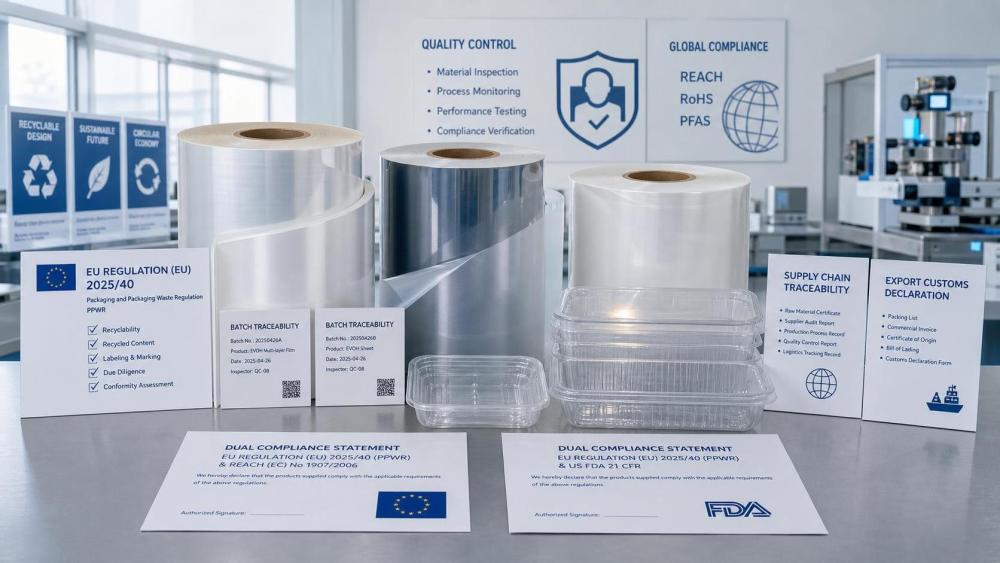
What the new rule formally requires
The confirmed facts are limited but clear. Regulation (EU) 2026/1489 was published by the European Commission in the Official Journal on August 2, 2026. The regulation will become mandatory on November 1, 2026. Its scope covers food-contact packaging that contains an EVOH high-barrier layer, including multilayer composite films, co-extruded sheets, and thermoformed containers.
Under the published requirement, the covered packaging must be accompanied by dual compliance declarations: one meeting FDA 21 CFR §177.1595 and another meeting REACH Annex XVII, Entry 68. In addition, verifiable supply-chain traceability documentation is required. The event summary also confirms that the rule directly affects customs clearance, labeling, and end-market shelf placement for Chinese EVOH composite film exporters and overseas distributors.
Where the pressure is likely to appear first
Export shipments and customs-facing documentation
From an industry perspective, exporters handling EVOH-based food-contact packaging are likely to feel the impact first because the rule ties market access to documentation that must accompany the product. The practical pressure point is not only whether a product uses EVOH, but whether the shipment file can show the required dual declarations and traceability records in a form that can be checked during trade and clearance processes.
Converters and packaging manufacturers in the supply chain
Manufacturers of multilayer composite films, co-extruded sheets, and thermoformed containers may be affected because the rule applies directly to those packaging formats when an EVOH barrier layer is present. What deserves closer attention is the connection between material composition, declaration preparation, and the traceability chain. For these businesses, compliance may become a documentation and coordination issue across sourcing, production records, technical files, and delivery documents.
Distributors and downstream market access
Overseas distributors are also named in the event summary as directly affected. Analysis shows that their exposure sits in labeling control, customs-related coordination, and terminal shelf-entry workflows. Even where product supply remains unchanged, missing or inconsistent declarations and traceability records could become a bottleneck in product release and downstream acceptance.
Buyers and procurement teams reviewing supplier qualification
Buyers and procurement teams may need to pay closer attention to supplier qualification because the new rule combines certification statements with traceability evidence. Observably, this shifts part of the review burden toward document completeness, supplier responsiveness, and the ability to connect purchased packaging to verifiable upstream records rather than relying only on product specifications or routine commercial paperwork.
What companies should review before the rule takes effect
Check whether current declarations match the new dual format
Analysis shows that companies dealing in covered EVOH packaging should first confirm whether their existing compliance statements can meet the newly required dual structure referencing FDA 21 CFR §177.1595 and REACH Annex XVII, Entry 68. The summary confirms the need for both declarations; it does not provide the detailed implementation format, so companies should treat this as a near-term compliance review item rather than assume that current templates will be accepted unchanged.
Re-examine traceability files across the supplier chain
What deserves closer attention is the traceability requirement. Because the rule explicitly asks for verifiable supply-chain traceability documents, businesses should review whether upstream material records, batch-linked files, and supplier-provided support documents can be connected clearly to the finished packaging delivered to customers. The input does not define the exact verification method, so this remains an area for continued monitoring.
Review labeling, clearance, and product release workflows
For companies already exporting or distributing EVOH composite packaging, the rule should also be read as a workflow issue. The event summary directly links the regulation to customs clearance, labeling, and terminal shelf placement. It is therefore reasonable to review where document checks occur in order processing, shipment preparation, import handling, and downstream release, especially for products that move through multiple trading or distribution steps.
Watch for execution language in commercial and technical documents
Observably, tender files, purchasing specifications, customer qualification checklists, and shipment document requirements may start reflecting the new rule before or shortly after the November 1, 2026 start date. Since the input does not provide detailed enforcement language, companies should monitor how the requirement is restated in customer-facing and trade-facing documents rather than assume a single uniform market practice from day one.
How this should be read at this stage
Analysis shows that this is more appropriately understood as an implemented rule change with immediate execution implications, not merely as a policy signal under discussion. The publication in the Official Journal and the stated mandatory date indicate that affected businesses should treat the requirement as a concrete compliance condition. At the same time, the available input does not include detailed enforcement guidance, accepted document formats, or market-specific review practice, so part of the operational impact still needs to be observed through implementation.
From an industry perspective, the most important signal is that compliance for EVOH food-contact packaging is being framed not only around material suitability but also around cross-regime declarations and traceable supporting records. That combination may influence how suppliers are screened, how export files are assembled, and how downstream partners assess release readiness.
Why the development deserves continued attention
In practical terms, this development is best understood as a rule that has already crossed into the execution phase, with the strongest immediate effect likely to appear in documentation, customs coordination, labeling review, and downstream product release for covered EVOH packaging. It would be premature to claim a fixed market outcome based on the current input alone, but it is reasonable to conclude that businesses handling these products should not treat the change as a background regulatory update.
Current observation suggests that the market significance of Regulation (EU) 2026/1489 lies less in abstract policy language and more in how dual declarations and traceability records become part of routine delivery and acceptance conditions. That is why the development merits continued tracking through implementation practice rather than one-time notice.
Basis of this article and points still to verify
This article is generated from the user-provided news title, event date, and event summary. The writing is based on the stated publication of Regulation (EU) 2026/1489 by the European Commission on August 2, 2026, the stated mandatory date of November 1, 2026, the stated dual declaration requirement tied to FDA 21 CFR §177.1595 and REACH Annex XVII, Entry 68, and the stated impact on customs clearance, labeling, and shelf-entry processes.
For this type of development, relevant source categories usually include official notices, releases from regulatory authorities, customs or trade administration information, industry association updates, standards-related documents, and reporting by established trade media. No specific official source link was provided in the input, so the exact official link remains to be verified. What still requires continued checking includes detailed implementation language, certification execution practice, changes in tender or procurement documents, industry feedback, and how affected companies and downstream channels apply the documentation requirement in practice.
Have questions about this sector analysis, or seeking best practices specific to your niche? Drop us a line below and let the senior consultants at APIM assist you.
We respect your privacy. Your information is strictly confidential.
Related News
- 00
0000-00
How does washing affect contamination in post-consumer recycled PP resins? - 00
0000-00
How does feedstock affect depolymerization equipment selection? - 00
0000-00
US Sets 213.44% Preliminary Antidumping Deposit on Chinese PTMEG - 00
0000-00
When should epoxy be used as a thermal interface material for semiconductors? - 00
0000-00
US Midterm Results Unlikely to Quickly Shift Recycled Plastics Market or Legislation