




EU REACH Adds EVOH Packaging Substances to the SVHC Candidate List
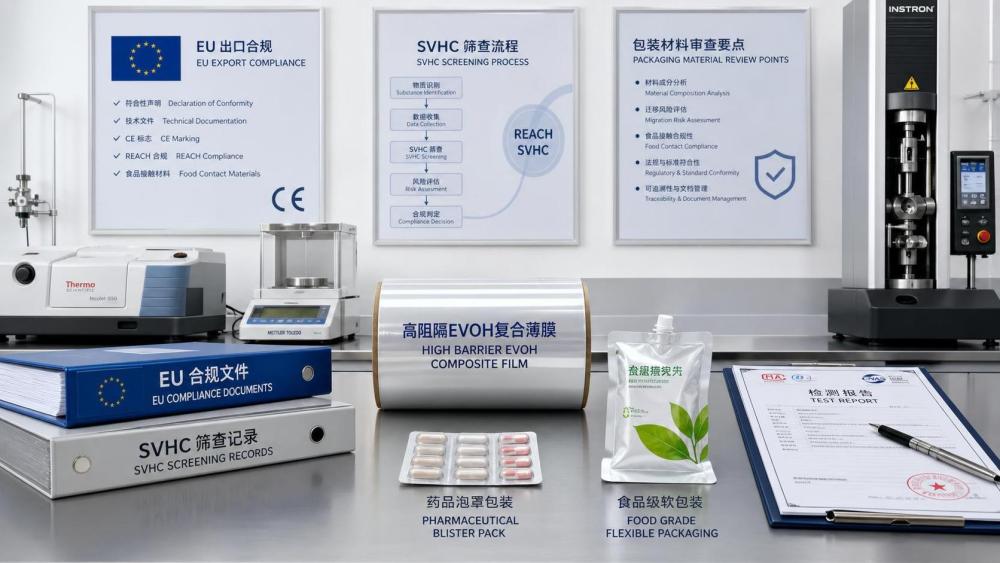
On August 14, 2026, the European Chemicals Agency formally added two epoxy-type additives used in EVOH copolymer synthesis to the SVHC Candidate List under REACH. Based on the information provided, this creates a direct compliance issue for EVOH high-barrier packaging materials exported to the EU when the listed substances are present above 0.1%, with SCIP notification and downstream document obligations set to apply from February 2027. For EVOH film producers, flexible packaging converters, and exporters using EVOH as a barrier layer in food or pharmaceutical packaging, the development is worth close attention because it affects not only material composition review, but also documentation, customer communication, and delivery preparation.
What Has Been Confirmed in This REACH Update
The confirmed facts are limited but commercially significant. According to the input information, on August 14, 2026, ECHA placed two epoxy-type additives used in EVOH copolymer synthesis on the SVHC Candidate List. The same input states that from February 2027, EVOH high-barrier packaging materials containing the relevant substances at concentrations above 0.1% and exported to the EU will need to meet SCIP notification obligations and provide safety data sheets and compliance declarations to downstream importers.
This confirmed change directly concerns global EVOH film manufacturers, composite packaging suppliers, and foreign trade companies that use EVOH as a barrier layer in food and pharmaceutical packaging. No further policy number, source link, or enforcement detail was provided in the input, so those points cannot be treated as confirmed facts here.
Where the Immediate Pressure May Appear in the Supply Chain
Material producers may face composition and disclosure checks
From an industry perspective, the most immediate pressure is likely to fall on producers of EVOH films and related barrier materials. The reason is straightforward: the rule change described in the input links market access to the presence and concentration of specific substances. Analysis suggests that these companies may need to verify whether the listed additives are present in their formulations, whether the relevant threshold is exceeded, and whether existing technical files are sufficient to support SCIP notification and downstream disclosure.
Converters and packaging suppliers may need tighter document coordination
For composite packaging suppliers, the likely impact is not limited to the resin layer itself. Observation suggests that converters supplying multilayer structures may need closer coordination with upstream raw-material providers and downstream importers, especially where EVOH is only one layer within a broader packaging construction. In practical terms, the change may affect compliance statements, SDS preparation, customer declarations, and document handover before shipment or delivery.
Exporters serving food and pharmaceutical packaging may see added transaction risk
Companies exporting packaging products that use EVOH as a barrier layer may need to pay closer attention to trade execution risk. Analysis suggests that when a listed substance is present above the stated concentration threshold, missing or incomplete compliance documentation could affect customs preparation, importer acceptance, or shipment readiness. The input does not confirm specific enforcement outcomes, but it is reasonable to view documentation readiness as a key business checkpoint.
Import-side buyers and service partners may request earlier confirmation
Buyers, sourcing teams, and supply-chain service providers may also be affected indirectly. What deserves closer attention is that the stated obligations involve communication to downstream importers, which may lead customers to ask for substance declarations, SDS, or compliance statements earlier in the order cycle. This is an analytical judgment rather than a confirmed market outcome, but it aligns with how documentation-sensitive packaging supply chains typically respond to new substance-listing risks.
What Companies Should Review Now
Check whether affected EVOH formulations are within scope
A practical first step is to verify which EVOH-based materials, intermediate structures, or finished packaging products may contain the listed substances and whether the concentration could exceed the 0.1% level mentioned in the input. This is not a confirmed requirement for every product category, but it is a necessary screening step for companies with EU-bound shipments involving EVOH barrier layers.
Prepare for SCIP and downstream document requests
Because the input explicitly mentions SCIP notification as well as SDS and compliance declarations for downstream importers, companies should review whether their current documentation workflows can support those obligations. At this stage, it is more appropriate to frame this as preparation and gap-checking rather than assume that every operational detail has already been clarified.
Reassess supplier communication and procurement planning
Companies that buy EVOH materials or outsource multilayer packaging production may need to ask suppliers for updated composition information and compliance support. Analysis suggests that procurement teams should pay attention to whether current supplier qualifications, technical data packages, and contract documents are detailed enough to support future declarations tied to SVHC content.
Evaluate substitute material or formulation options carefully
The input does not confirm any mandatory substitution requirement. Even so, companies with sensitive export exposure may reasonably begin evaluating whether alternative materials, alternative formulations, or adjusted product structures need technical verification. This remains a business-response option, not a confirmed regulatory obligation stated in the source information.
Why This Looks Like More Than a Routine Listing
In editorial terms, this development is better understood as an execution signal with a defined trade-compliance consequence, not merely a watch-list event. The reason is that the input already points to a stated application point from February 2027 and identifies concrete obligations involving SCIP notification and downstream documentation. At the same time, it would be premature to treat every enforcement detail or customer-side implementation practice as settled, because the input does not provide those specifics.
What still deserves continued observation is how consistently importers, suppliers, and service providers translate the listing into document requirements, product screening expectations, and purchasing decisions. For affected companies, the practical question is less about headline interpretation and more about when counterparties begin asking for evidence, declarations, and reformulation assessments.
How the Market Should Read This Stage
The immediate significance of this update lies in its direct connection between substance status and export-facing compliance work for EVOH high-barrier packaging materials. A measured reading is appropriate: this is neither a complete picture of future enforcement nor a development that can be ignored as a distant regulatory signal. Based on the information provided, it is more appropriate to treat the change as a concrete compliance trigger that requires product screening, document review, and closer supply-chain coordination ahead of the stated 2027 application point.
Basis of This Article and What Still Needs Verification
This article is based solely on the user-provided news title, event date, and event summary. For events of this type, companies would typically continue to verify information against source categories such as official announcements, regulatory authority releases, trade or customs updates, industry association information, standards-related documents, and reporting by established professional media.
No specific official source link was provided in the input, so the exact underlying notice and any detailed implementation text still need to be checked separately. Continued attention should be given to later policy clarifications, compliance interpretation, customer documentation requirements, trade execution practice, industry feedback, and how affected companies implement the change in actual supply contracts and export workflows.
Have questions about this sector analysis, or seeking best practices specific to your niche? Drop us a line below and let the senior consultants at APIM assist you.
We respect your privacy. Your information is strictly confidential.
Related News
- 00
0000-00
Do polyolefin hot melt adhesives bond well to polyethylene? - 00
0000-00
Korean Study Finds PLA Barely Degrades in Landfill After 320 Days - 00
0000-00
How to assess batch consistency from a thermal potting compounds supplier - 00
0000-00
How much weight can carbon fiber reinforced plastics save in cars? - 00
0000-00
Switching from PS to ABS Sheet Extrusion: Equipment Checks