




ECHA PFAS Rule Triggers New Compliance Review for EVOH Exports
On July 23, 2026, the European Chemicals Agency (ECHA) formally published an amendment to REACH Annex XVII that brings PFAS under mandatory restriction and explicitly reaches EVOH co-extruded high-barrier films and composite packaging materials using PFAS-related additives. For exporters serving the EU market, this is not just a regulatory update: it directly affects product documentation, testing readiness, purchasing reviews, and supply chain checks, especially in packaging used for food, pharmaceutical, and electronics applications where importer scrutiny is typically more stringent.
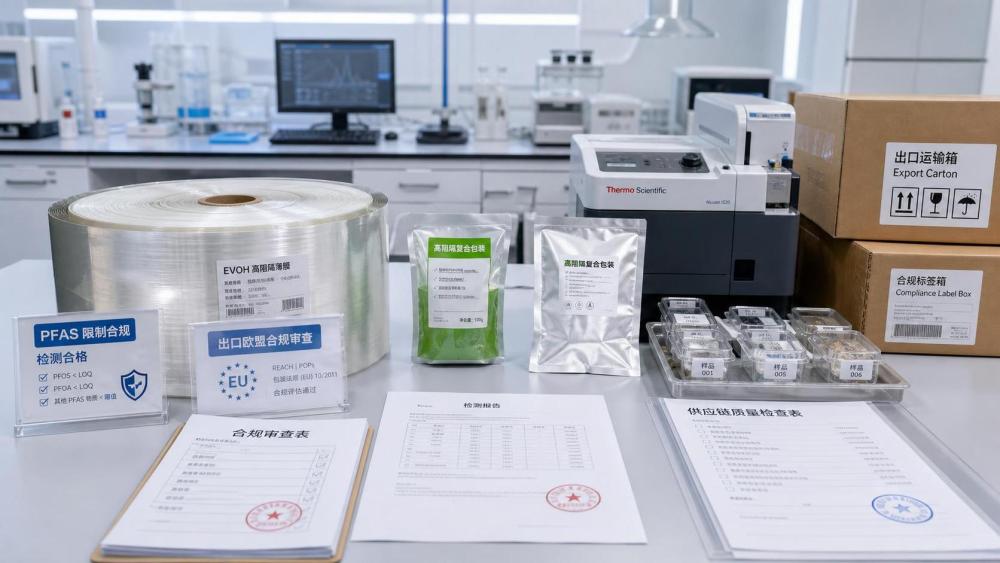
What the published rule change confirms
According to the provided event summary, ECHA published the REACH Annex XVII amendment in its official bulletin on July 23, 2026. The amendment places per- and polyfluoroalkyl substances (PFAS) within the scope of mandatory restriction.
The confirmed scope expressly includes EVOH co-extruded high-barrier films and composite packaging materials that contain PFAS additives. The new rule is scheduled for phased implementation starting October 1, 2026.
The same summary also states that all EVOH-based packaging products exported to the EU will be required to provide a PFAS content test report and a declaration of conformity. The adjustment is described as having a direct impact on importer purchasing decisions and supply chain audit procedures in highly sensitive sectors including food, pharmaceuticals, and electronics.
Where the pressure will appear across the supply chain
Export documentation moves closer to the transaction itself
From an industry perspective, exporters of EVOH-based packaging are likely to feel the most immediate impact because the rule change is tied to market access documentation. The practical pressure point is not only whether a product is sold into the EU, but whether the shipment can be supported by PFAS testing records and a conformity statement that align with customer and import review requirements.
What deserves closer attention is the link between compliance files and delivery execution. Where documentation is incomplete or inconsistent, the commercial effect may appear first in quotation reviews, pre-shipment checks, or customer approval steps rather than only at the border.
Procurement teams will have to revisit material and supplier screening
For raw material buyers and procurement teams, the change matters because the rule explicitly refers to PFAS additives in EVOH high-barrier structures and composite packaging. Analysis shows that purchasing functions may need to reassess how they screen formulations, request supplier declarations, and verify whether upstream materials can support the required PFAS content reporting.
This does not by itself confirm a uniform purchasing outcome across the market, but it does indicate that supplier qualification and material traceability are likely to become more visible in sourcing discussions tied to EU-bound products.
Converters and packaging manufacturers face a tighter review path
For processors and packaging manufacturers, the impact is likely to concentrate in product formulation review, technical file preparation, and shipment release processes. Because the confirmed requirement includes both PFAS content test reports and declarations of conformity, manufacturers serving EU export programs may need to check whether their current internal records are sufficient for customer review and whether product-specific evidence can be assembled in time for phased implementation.
Observably, this is especially relevant where the same production lines serve multiple end uses and where high-barrier packaging is supplied into sectors with stricter audit expectations.
Testing and compliance service demand may shift toward timing and consistency
Testing providers and compliance-related service firms may also be affected because the new requirement creates a direct need for PFAS content verification for EVOH-based packaging exported to the EU. Analysis shows that the main issue is not simply laboratory demand in the abstract, but whether exporters and manufacturers can obtain documentation that matches customer review timelines, procurement checkpoints, and conformity expectations.
At the same time, the provided information does not define detailed enforcement practice, so any assumption about final market behavior should remain cautious.
What companies should watch now
Check whether existing files can support EU-bound shipments
Companies involved in EU exports should review whether current technical documentation for EVOH-based packaging can support the newly stated requirement for PFAS content test reports and declarations of conformity. Analysis shows that this is a file-readiness issue as much as a product issue, particularly for products already moving through recurring customer programs.
Track customer-side updates in specifications and tender language
Because the summary points directly to importer purchasing decisions and supply chain audits, companies should watch for changes in customer specifications, approval checklists, bid documents, and supplier onboarding materials. It is more appropriate to understand this as an execution signal that may first appear through commercial and audit documents before a company sees a broader market pattern.
Review supplier qualification for PFAS-related inputs
Where EVOH packaging structures involve additives or multilayer combinations, procurement and compliance teams should pay attention to how supplier statements, supporting records, and traceability materials are collected and maintained. The provided information does not set out detailed documentation formats, so the immediate task is to identify gaps rather than assume that one document set will satisfy every downstream buyer.
Prepare for phased implementation rather than a single compliance date
The rule will be implemented in phases starting October 1, 2026. Observably, that means companies should not treat the date only as a formal deadline; they should also monitor how customers, auditors, and supply chain partners begin applying the requirement in advance or in stages. The input does not provide further timing detail, so execution practice still needs continued verification.
Why this looks like an execution signal, not just a headline
Analysis shows that this development is better understood as a concrete compliance trigger than as a general policy direction. The reason is straightforward: the provided summary already links the rule change to named product categories, a phased implementation start date, and explicit documentation requirements for EU exports.
At the same time, it would be premature to treat all downstream consequences as settled. Observably, the market will still need to watch how customer audit expectations, conformity review practices, and procurement language evolve once the rule enters implementation. In that sense, the update carries both a confirmed compliance change and a continuing need for execution-level observation.
How the market may need to read this update
In practical terms, the July 23, 2026 publication should be read as a confirmed rule change with near-term operational relevance for EVOH-based packaging exported to the EU. The clearest immediate meaning is that PFAS-related compliance evidence becomes more central to export readiness, customer qualification, and supply chain review.
A balanced reading is still necessary. The information provided supports the view that the rule has moved beyond a purely abstract policy discussion, but it does not yet answer every question about execution detail. For that reason, the most reasonable interpretation today is that companies should treat this as an active compliance signal and continue monitoring how it is applied in trade, procurement, and audit practice.
Basis of this article and points that still require verification
This article is based on the user-provided news title, event date, and event summary. For events of this kind, commonly relevant source types may include official regulatory notices, publications from supervisory agencies, customs or trade authority updates, industry association notices, standard-setting documents, and reporting from established professional media.
No specific official source link was provided in the input, so the exact original publication link still requires follow-up verification. Observably, the areas that remain worth monitoring include detailed policy wording, certification and conformity interpretation, tender document updates, customer audit practices, industry feedback, and how companies implement the requirement in actual export operations.
Have questions about this sector analysis, or seeking best practices specific to your niche? Drop us a line below and let the senior consultants at APIM assist you.
We respect your privacy. Your information is strictly confidential.
Related News
- 00
0000-00
How does washing affect contamination in post-consumer recycled PP resins? - 00
0000-00
How does feedstock affect depolymerization equipment selection? - 00
0000-00
US Sets 213.44% Preliminary Antidumping Deposit on Chinese PTMEG - 00
0000-00
When should epoxy be used as a thermal interface material for semiconductors? - 00
0000-00
US Midterm Results Unlikely to Quickly Shift Recycled Plastics Market or Legislation