




ECHA PFAS Review Tightens EVOH Packaging Timeline
On July 24, 2026, the European Chemicals Agency (ECHA) announced the start of a unified restriction assessment covering the full PFAS category, with fluorinated surface treatment agents used as processing aids or additives in EVOH high-barrier packaging placed in a priority review scope. For exporters, importers, and buyers in food, pharmaceutical, and electronic packaging, this matters because the compliance window for certain EVOH composite films and multilayer co-extruded barrier packaging is narrowing ahead of an expected legislative outcome by Q2 2027.
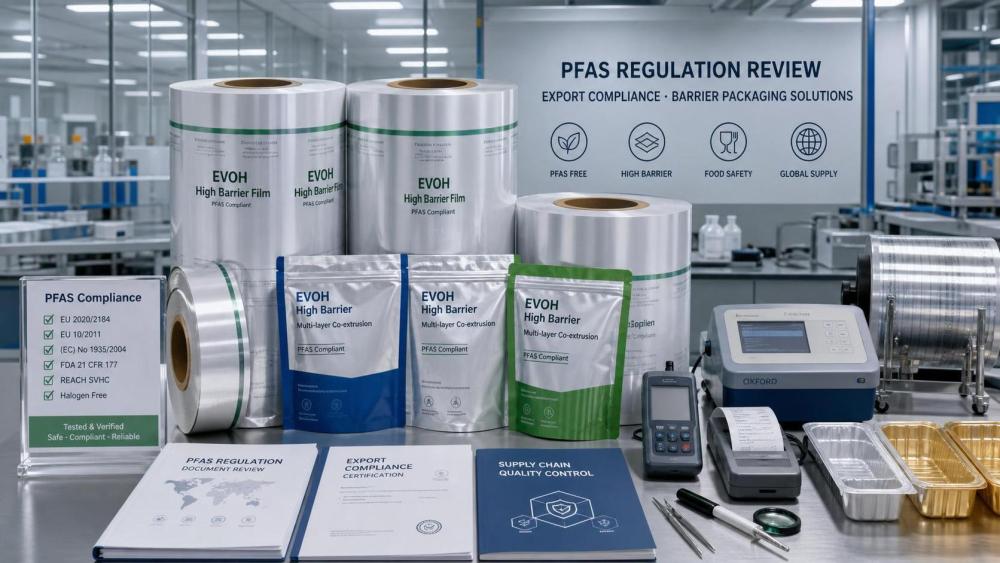
What ECHA Has Confirmed So Far
According to the information provided, ECHA formally launched its assessment procedure for a unified restriction on the entire PFAS class on July 24, 2026. Within that process, fluorinated surface treatment agents used in EVOH high-barrier packaging materials as processing aids or additives were identified for priority review.
The same information indicates that legislation is expected to be completed before Q2 2027. If no exemption is granted, EVOH composite films and multilayer co-extruded barrier packaging within the affected scope may face either an export ban or a requirement to obtain certification for substitute solutions.
Where the Pressure Is Likely to Appear First
Export-facing packaging suppliers may see compliance checks move forward
From an industry perspective, companies directly exporting EVOH-based barrier packaging are likely to feel the earliest impact because the announcement links the regulatory process to possible export restrictions. The most immediate pressure points are likely to be product screening, customer documentation, and contract discussions tied to PFAS-related material declarations.
Importers and procurement teams will have to revisit supplier screening
The information provided explicitly points to effects on global importers' supply chain audits and purchasing decisions in food, pharmaceutical, and electronic packaging. Analysis shows that buyers in these sectors may need to pay closer attention to whether fluorinated treatment agents are present in packaging structures, how supplier statements are framed, and whether current sourcing plans remain usable if exemptions are not secured.
Converters and manufacturers may need to review formulation exposure
For processing and manufacturing businesses, the issue is not limited to the final package format. Observably, the review also reaches upstream material use where fluorinated agents serve as processing aids or additives in EVOH high-barrier materials. That means formulation review, internal material traceability, and communication between production and compliance teams could become more important in affected product lines.
End-use sectors may face delivery and qualification questions
Food, pharmaceutical, and electronic packaging users may be affected through purchasing continuity and qualification cycles. If substitute solutions require certification, the practical impact may extend beyond raw material substitution into approval timing, supply continuity, and customer acceptance processes.
What Companies Should Track Now
Watch the wording of the legislative process, not only the headline
Analysis shows that the current announcement is a regulatory starting point with clear compliance implications, but the operational impact will depend on how the final legislative text defines scope, exemptions, and substitution requirements. Businesses should therefore monitor later official wording rather than relying only on the broad signal of PFAS restriction.
Identify product lines exposed to fluorinated treatment agents
What deserves closer attention is whether specific EVOH composite films or multilayer co-extruded barrier packaging rely on fluorinated surface treatment agents as processing aids or additives. Companies with EU-linked business should separate affected and unaffected product lines as early as possible to avoid treating the entire portfolio as a single risk category.
Prepare for procurement and customer-side document requests
Because the announcement directly affects supply chain audits and procurement decisions, businesses should expect more detailed requests from customers and importers. In practice, this may center on supplier qualifications, material declarations, product documentation, and communication around whether alternatives or exemptions may be relevant.
Distinguish policy direction from immediate shipment status
Observably, the news sends a strong policy signal, but it does not by itself confirm that all current shipments are already prohibited. Companies should avoid treating a pending legislative process and a completed legal restriction as the same thing, while still preparing for shorter decision cycles in sales, sourcing, and delivery planning.
Why This Reads as a Regulatory Signal With Near-Term Business Consequences
Analysis shows that this development is more than a routine policy update because it names a specific area within EVOH high-barrier packaging for priority review and sets an expected legislative timeline before Q2 2027. At the same time, it is more appropriate to understand this as a tightening compliance window rather than a fully settled end state, since exemptions and final legal wording are not described in the provided information.
From an industry perspective, the practical importance lies in timing. Once procurement teams, importers, and downstream users begin adjusting audit standards before final legislation is completed, commercial decisions can change earlier than the legal deadline itself. That makes the period between announcement and legislation a business-relevant phase, not simply a waiting period.
How This Development Should Be Read at This Stage
At this stage, the announcement should be understood as a concrete regulatory escalation for PFAS-related compliance in EVOH high-barrier packaging, especially for export-oriented and EU-linked trade flows. It does not yet settle every commercial outcome, but it clearly raises the level of scrutiny around affected materials, documentation, and sourcing decisions.
A neutral reading is that this is neither a short-lived headline nor a completed market result. It is a developing regulatory event with defined direction, a visible legislative timetable, and immediate relevance for companies that depend on EVOH composite films and multilayer co-extruded barrier packaging in food, pharmaceutical, and electronic applications.
Basis of This Article and What Still Needs Verification
This article is based on the user-provided news title, event date, and event summary. For this type of industry update, relevant source categories typically include official agency announcements, company disclosures, industry association information, authoritative media reporting, and standard-setting or regulatory documents.
No specific official source link was provided in the input, so the exact official text and later procedural updates still need ongoing verification. Continued attention should focus on subsequent ECHA wording, the legislative timetable toward Q2 2027, the treatment of exemptions, and any formal requirements tied to substitute-solution certification.
Have questions about this sector analysis, or seeking best practices specific to your niche? Drop us a line below and let the senior consultants at APIM assist you.
We respect your privacy. Your information is strictly confidential.
Related News
- 00
0000-00
Do polyolefin hot melt adhesives bond well to polyethylene? - 00
0000-00
Korean Study Finds PLA Barely Degrades in Landfill After 320 Days - 00
0000-00
How to assess batch consistency from a thermal potting compounds supplier - 00
0000-00
How much weight can carbon fiber reinforced plastics save in cars? - 00
0000-00
Switching from PS to ABS Sheet Extrusion: Equipment Checks