




ECHA PFAS Proposal Starts EVOH Export Compliance Countdown
On July 25, 2026, the European Chemicals Agency (ECHA) submitted a proposal to the European Commission to revise REACH Annex XVII with a broad PFAS restriction scope. For exporters of EVOH high-barrier packaging, especially in food and pharmaceutical applications, the development matters because it shifts the issue from general substance monitoring to an approaching import compliance deadline, with direct implications for material review, testing schedules, certification planning, supplier selection, and delivery arrangements.
What the proposal now puts on the table
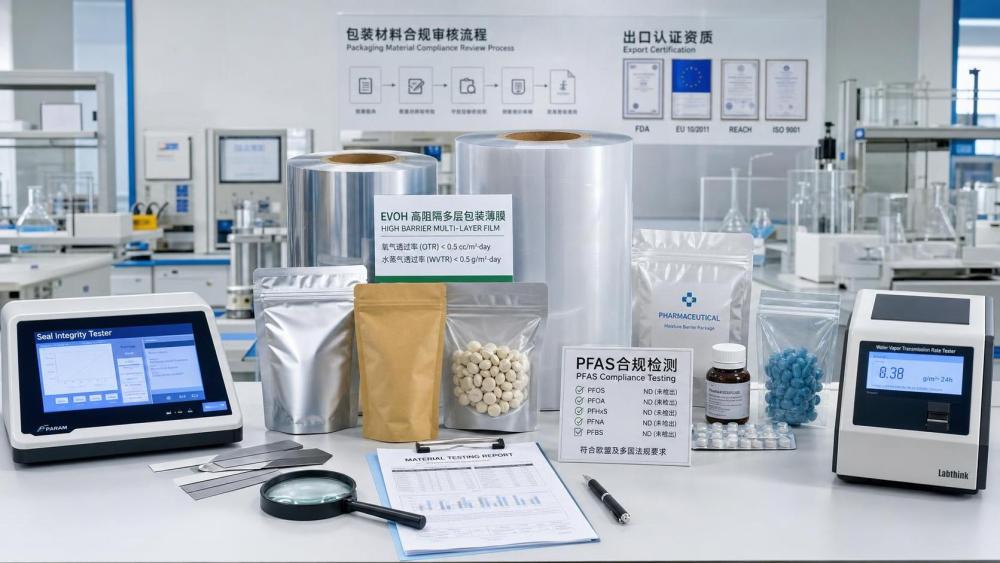
The confirmed information is limited but clear on several points. ECHA submitted the PFAS universal restriction proposal to the European Commission on July 25, 2026. The proposal is framed as a REACH Annex XVII revision and states that all fluorinated polymers will be covered. The scope explicitly includes possible fluorinated processing aids and surface treatment agents that may be present in EVOH co-extruded films. The proposal also states that, from Q3 2027, food and pharmaceutical high-barrier packaging containing PFAS would face an import ban. Based on the information provided, the proposal directly affects the compliance pathway, testing and certification timing, and supply chain substitution choices for exporters of multilayer EVOH co-extruded films.
Where the pressure is likely to appear first
Export shipments tied to food and pharmaceutical packaging
From an industry perspective, exporters are likely to face the earliest pressure because the proposal links material composition directly to market access. The key business impact is not only whether a finished film contains PFAS, but whether supporting documentation, supplier declarations, and test evidence can demonstrate conformity before the proposed import restriction timing becomes commercially relevant.
Procurement decisions inside multilayer film production
Manufacturers and raw material purchasing teams may be affected at the input-selection stage. Analysis shows that the scope described in the proposal draws attention not only to core resin systems but also to processing aids and surface treatment agents that may sit deeper in the supply chain. That means procurement teams may need to pay closer attention to supplier disclosures, formulation transparency, and whether alternative inputs can support the same barrier and processing requirements without creating later export compliance problems.
Testing, certification, and document review cycles
Testing service providers, certification-related firms, and internal compliance teams are also likely to see pressure on timing. What deserves closer attention is that the proposal is already shaping the expected review path for high-barrier packaging intended for regulated end uses. Even without detailed execution language in the provided information, companies may need to reassess how test reports, technical files, declarations, and customer-facing compliance documents are prepared and updated for export programs.
Delivery planning and customer qualification
Supply chain service providers, converters, and overseas buyers may be affected through lead-time and approval risk. Observably, once a proposal introduces a future import ban tied to substance content, purchasing and qualification discussions tend to move earlier in the order cycle. In practice, this can affect booking decisions, customer approval milestones, and the willingness of buyers to continue with materials whose compliance path is not yet fully documented.
What companies should review now
Check whether PFAS risk sits beyond the main resin layer
Analysis shows that companies should not limit review work to the headline EVOH layer alone. The provided event summary specifically points to possible fluorinated processing aids and surface treatment agents in co-extruded film structures. That makes formulation mapping and supplier-level material tracing a practical priority.
Rebuild compliance files around traceability and timing
What deserves closer attention is the relationship between technical documentation and the proposed Q3 2027 import ban timeline. Exporters may need to review whether existing declarations, test reports, technical data, and customer compliance files are sufficient for future customer audits or import reviews. Since the detailed execution approach is not provided, this should be treated as a compliance preparation issue rather than a settled documentation standard.
Review substitution options against delivery risk
From an industry perspective, supply chain substitution is no longer only a formulation question. It also affects validation time, procurement continuity, and delivery commitments. Companies involved in food and pharmaceutical packaging may need to compare replacement options not just by material performance, but by how quickly they can be verified and integrated into existing export and approval workflows.
Follow official wording and downstream commercial documents
Observably, the next area to monitor is how the proposal is reflected in later official wording, customer requirements, tender documents, and compliance questionnaires. The information provided does not establish final enforcement detail, so companies should avoid treating every operational assumption as settled. The more practical approach is to track how the proposal begins to influence transaction documents and qualification criteria.
Why this is more a compliance signal than a closed rule
Analysis shows that this development is best understood as a strong regulatory and market signal rather than a fully completed execution framework. The proposal introduces a clear direction of travel: PFAS content in food and pharmaceutical high-barrier packaging is moving closer to a trade-access restriction issue. At the same time, the provided information does not include full implementation detail, certification interpretation, or downstream enforcement practice. That is why continued attention to official follow-up language, testing expectations, and buyer-side document requests remains necessary.
How the market is likely to read this development
At this stage, it is more appropriate to understand the event as the start of a practical countdown for compliance preparation in EVOH high-barrier packaging exports. The significance lies less in headline policy language and more in the way it may reshape sourcing choices, internal reviews, qualification timelines, and export readiness. The rule direction is clear from the information provided, but the exact operational burden still requires continued observation.
Basis of this article and what still needs verification
This article is based on the user-provided news title, event date, and event summary. For developments of this kind, commonly relevant source categories include official regulatory announcements, releases from supervisory authorities, customs or trade authority information, industry association updates, standard-setting documents, and reporting by established professional media. A specific official source link was not provided in the input, so the underlying text and subsequent rule development still require ongoing verification. Further observation should focus on detailed policy wording, certification and testing interpretation, tender document changes, market feedback, and how companies implement compliance in practice.
Have questions about this sector analysis, or seeking best practices specific to your niche? Drop us a line below and let the senior consultants at APIM assist you.
We respect your privacy. Your information is strictly confidential.
Related News
- 00
0000-00
Do polyolefin hot melt adhesives bond well to polyethylene? - 00
0000-00
Korean Study Finds PLA Barely Degrades in Landfill After 320 Days - 00
0000-00
How to assess batch consistency from a thermal potting compounds supplier - 00
0000-00
How much weight can carbon fiber reinforced plastics save in cars? - 00
0000-00
Switching from PS to ABS Sheet Extrusion: Equipment Checks
Tag