




ECHA Adds 3 SVHCs, Including an EVOH Packaging Additive
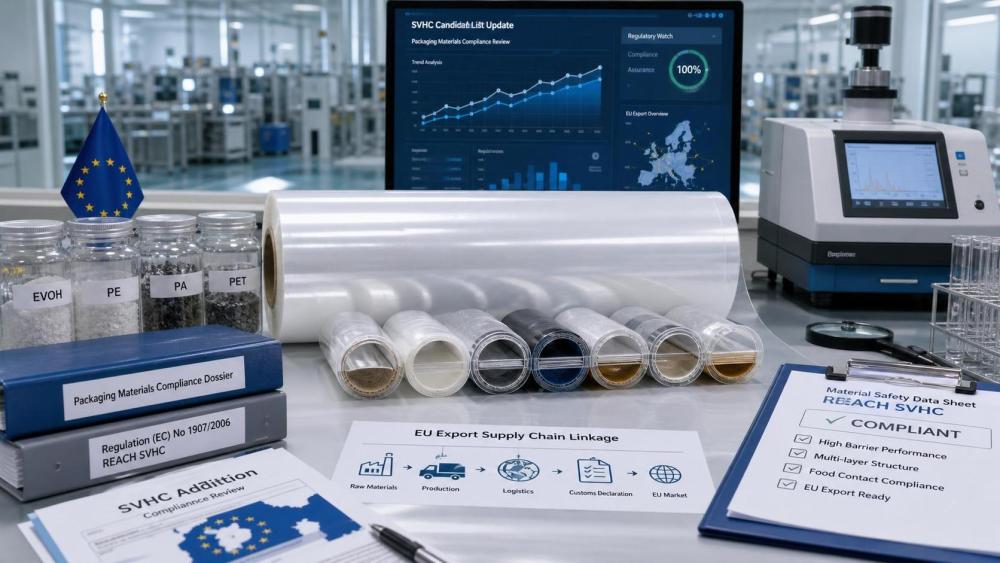
On August 1, 2026, the European Chemicals Agency (ECHA) added three new substances to the SVHC Candidate List. Among them is an epoxy-based crosslinking aid used in the production of EVOH high-barrier multilayer packaging films. Because the substance has been identified as having endocrine-disrupting properties, the update is relevant not only as a chemicals compliance development but also as a practical trade and supply-chain issue for companies exporting EVOH laminated film and food- or pharmaceutical-grade high-barrier packaging to the EU. What deserves closer attention is that this change can affect compliance review, supply-chain communication, and delivery preparation across multiple business links.
What the listing change confirms
The confirmed facts are limited but commercially important. ECHA formally included three additional substances on the SVHC Candidate List on August 1, 2026. One of those substances is described as an epoxy-type crosslinking aid widely used in EVOH high-barrier multilayer packaging film production. The substance has been identified as having endocrine-disrupting properties. The event summary also indicates that this listing may lead to future REACH authorization requirements and supply-chain notification obligations. The direct compliance impact identified in the input concerns Chinese suppliers exporting EVOH composite film and food- or pharmaceutical-grade high-barrier packaging to the EU, as well as overseas importers involved in those flows.
Where the pressure is likely to appear first
Export transactions tied to EU-facing packaging supply
From an industry perspective, exporters dealing in EVOH composite films or high-barrier packaging for the EU market may feel the effect first because the listed substance is connected to an input used in production. The pressure point is not only the material itself, but also how product composition is reviewed during order intake, customer communication, and shipment preparation. Companies in this position should pay closer attention to whether their existing compliance files, material declarations, and customer-facing documentation are sufficient for EU-related inquiries triggered by the new SVHC status.
Procurement and material approval inside converting and manufacturing operations
Processors and packaging manufacturers may be affected through raw-material selection and internal approval workflows. If a production formula or multilayer structure involves the relevant crosslinking aid, procurement teams and technical reviewers may need to reassess supplier information, formulation visibility, and the completeness of supporting technical records. Observably, the issue is less about a general market reaction and more about whether purchasing and manufacturing teams can quickly determine where the substance is present and how that affects downstream compliance commitments.
Importers and downstream buyers under documentation pressure
Overseas importers and downstream buyers may face immediate questions around product declarations, supplier disclosures, and contractual responsibility for compliance information. The event summary specifically points to possible supply-chain notification obligations, which means import-side participants should watch for changes in document requests, supplier questionnaires, and acceptance conditions during procurement or delivery. For buyers of food- and pharmaceutical-grade high-barrier packaging, the practical concern is whether documentation remains aligned with the expectations attached to EU market access.
Testing, certification, and supply-chain service functions
Certification-related service providers, testing support organizations, and broader supply-chain partners may also see changes in client demand. Analysis shows that once a substance used in a packaging-related application enters the SVHC Candidate List, companies often need clearer technical confirmation and better document control even before any later rule development becomes fully defined. In this case, the focus is likely to center on how substance presence is identified, documented, and communicated rather than on any single completed enforcement outcome.
What companies should review now
Check where the substance may sit in product and material files
Companies linked to EVOH high-barrier packaging should first identify whether the listed epoxy-based crosslinking aid is present in relevant material systems, production inputs, or finished packaging supplied to the EU. This is a practical screening step. It is more appropriate to understand it as a document and traceability review rather than as proof that every related product is immediately non-compliant.
Revisit compliance statements and customer communication
Where EU-bound business is involved, existing declarations, technical files, and customer communications may need review for consistency. Analysis shows that the main near-term risk lies in mismatched information across sales, procurement, regulatory, and logistics teams. If a customer, importer, or distributor raises questions linked to SVHC status, incomplete or inconsistent responses can create avoidable delays in qualification or delivery.
Watch for changes in REACH-related wording and supply-chain expectations
The event summary states that future REACH authorization requirements and supply-chain notification obligations may be triggered. That means companies should monitor subsequent official wording, downstream customer requirements, and any updates in commercial specifications or tender documents. At this stage, the available information supports careful monitoring, but it does not support treating every later compliance consequence as already finalized.
Assess timing risks in orders and delivery planning
For exporters and importers, the operational issue may extend into order confirmation, supplier approval, and shipment readiness. Observably, when a newly listed SVHC is tied to packaging materials used in sensitive applications such as food or pharmaceutical packaging, counterparties may slow approvals until internal compliance checks are completed. Businesses should therefore review whether pending orders, replacement material options, and supplier response times could affect delivery schedules.
Why this reads as an execution signal
Analysis shows that this development is more than a routine update to a chemicals list for companies active in high-barrier packaging. The commercial relevance comes from the combination of three elements already present in the input: formal inclusion on the SVHC Candidate List, the identified endocrine-disrupting property, and the stated possibility of future REACH authorization and supply-chain notification consequences. At the same time, it would be premature to treat the event as a fully settled end-state for every affected product flow. It is more appropriate to understand this as a confirmed compliance signal with immediate documentation and communication implications, while some downstream execution details still require observation.
How the market should read the development
In practical terms, this update should be read as a rule change that has already landed at the listing level and that can now influence supply-chain behavior around EU-bound EVOH high-barrier packaging. The near-term significance lies in compliance verification, supplier disclosure, and order-side scrutiny rather than in any single universal market outcome. A rational reading is that affected businesses should act on traceability and documentation now, while continuing to track how later REACH-related expectations and customer requirements take shape.
Basis of this article and what still needs verification
This article is based on the user-provided news title, event date, and event summary. For developments of this kind, relevant source categories typically include official regulatory notices, releases from supervisory authorities, trade or customs-related updates, industry association communications, standards-related documents, and reporting by authoritative industry media. No specific official source link was provided in the input, so the exact official reference still needs to be verified on an ongoing basis. Further observation is also needed on later policy wording, certification and compliance interpretations, tender-document changes, market feedback, and how affected companies implement the new requirements in practice.
Have questions about this sector analysis, or seeking best practices specific to your niche? Drop us a line below and let the senior consultants at APIM assist you.
We respect your privacy. Your information is strictly confidential.
Related News
- 00
0000-00
How does feedstock affect depolymerization equipment selection? - 00
0000-00
US Sets 213.44% Preliminary Antidumping Deposit on Chinese PTMEG - 00
0000-00
When should epoxy be used as a thermal interface material for semiconductors? - 00
0000-00
US Midterm Results Unlikely to Quickly Shift Recycled Plastics Market or Legislation - 00
0000-00
When should you choose carbon fiber over glass fiber composites for lightweight parts?