




ECHA Adds 3 EVOH Packaging Additives to SVHC List
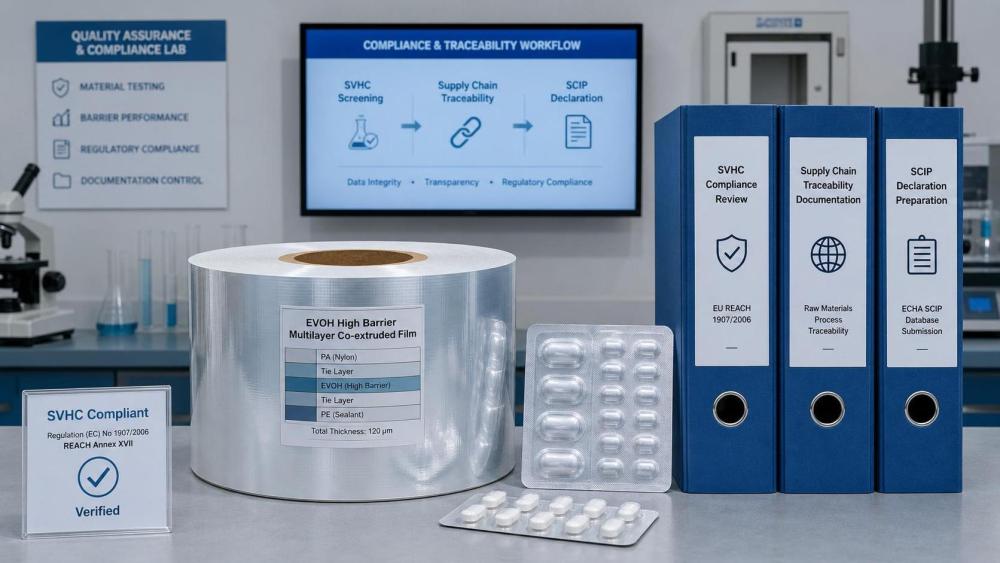
On July 13, 2026, the European Chemicals Agency (ECHA) added three processing additives used in EVOH multilayer co-extruded packaging to the SVHC Candidate List, including certain epoxy-based crosslinking promoters and migration stabilizers. For suppliers exporting EVOH high-barrier films to the EU for food, pharmaceutical, and electronics packaging, this is not just a chemical listing update; it changes the immediate compliance workload around declarations, supply-chain traceability, and SCIP-related documentation ahead of the October 2026 update deadline for importers.
What Has Formally Changed
The confirmed change is that ECHA officially placed three additives used in EVOH multilayer co-extruded packaging on the SVHC Candidate List on July 13, 2026. The substances referenced in the provided information include specific epoxy-based crosslinking promotion additives and migration stabilizers used in this packaging application.
The provided event summary also confirms two direct consequences. First, suppliers exporting packaging containing EVOH high-barrier films to the EU will face changed compliance declaration obligations and stronger supply-chain traceability requirements. Second, importers are required to complete SCIP database updates by October 2026 and assess the feasibility of substitute options.
Where the Pressure Will Appear First in the Supply Chain
Export packaging suppliers will face a narrower compliance window
From an industry perspective, companies shipping EVOH high-barrier film products into the EU are likely to feel the impact first because the rule change is tied directly to declaration obligations. The main pressure point is whether product-level material information, supporting technical files, and substance communication records can be aligned quickly enough for customers and importers.
Importers will need faster data collection and SCIP alignment
The event summary explicitly points to a 2026 deadline for SCIP updates, which means importers will need to obtain more complete upstream information from suppliers. What deserves closer attention is not only the database update itself, but whether internal documentation, supplier confirmations, and traceability records are consistent enough to support that update without delaying market access or order handling.
Converters and manufacturers may see procurement and formulation reviews move forward
For processors and manufacturers using EVOH multilayer co-extruded structures in food, pharmaceutical, or electronics packaging, the change may affect purchasing reviews, material approval workflows, and formulation screening. Analysis shows that once listed substances are involved, procurement teams and technical teams may need to recheck whether existing material selections remain acceptable within customer compliance expectations and downstream documentation requirements.
Supply-chain and compliance service providers may be drawn into verification work
Observably, traceability requirements tend to shift part of the workload onto testing, documentation, and supply-chain support functions. In this case, the operational impact is likely to center on document completeness, material disclosure coordination, and the ability to support importer-facing compliance files rather than on a simple one-time notification exercise.
What Companies Should Watch Now
Check substance mapping in affected packaging structures
Companies involved in EVOH high-barrier packaging for the EU market should first determine whether the listed additives are present in relevant multilayer structures. The practical issue is not a general policy review, but product-specific mapping tied to the materials already being supplied or sourced.
Re-examine declaration files and traceability records
Analysis shows that the immediate risk area is incomplete or inconsistent compliance documentation. Businesses should pay close attention to technical declarations, supply-chain substance communications, and traceability records that may be required to support importer updates and downstream customer inquiries.
Prepare for substitute feasibility reviews without assuming immediate replacement
The provided information confirms that substitute feasibility must be assessed. It is more appropriate to understand this as a current compliance and sourcing review requirement, not as proof that replacement pathways are already settled. Companies should therefore focus on evaluation readiness rather than present substitution as a completed outcome.
Track how customers and procurement documents begin to respond
Observably, regulatory changes of this type can show up in commercial execution through revised customer questionnaires, tighter supplier qualification checks, and updated tender or purchasing documentation. Since no detailed enforcement wording beyond the provided summary is available here, companies should treat this as an area for active monitoring rather than a fixed execution standard.
Why This Looks More Like an Execution Signal Than a Distant Watch Item
Analysis shows that this development is better understood as an applied compliance signal rather than a purely preliminary policy headline. The reason is that the provided information already links the SVHC listing to concrete importer action by October 2026 and to immediate traceability and declaration implications for exporters and suppliers.
At the same time, it would be premature to treat all downstream commercial effects as fully defined. Observably, the market still needs to see how customers, importers, and related compliance functions interpret documentation expectations, substitution reviews, and procurement adjustments in practice.
How This Event Is Best Understood at This Stage
At this stage, the development should be read as a confirmed regulatory change with near-term operational consequences for EU-bound EVOH high-barrier packaging supply chains. The key significance is not only that three additives have been added to the SVHC Candidate List, but that declaration duties, traceability discipline, and SCIP-related preparation now move closer to day-to-day trade execution.
From an industry perspective, the most balanced reading is that this is already a landed compliance change, while the exact shape of downstream execution still requires continued observation through customer requirements, documentation practice, and substitute assessment activity.
Basis of This Article and What Still Needs Verification
This article is based on the user-provided news title, event date, and event summary. For developments of this kind, commonly relevant source categories may include official notices, regulatory authority releases, customs or trade administration information, industry association updates, standards-related documents, and reporting by established professional media.
No specific official source link was provided in the input, so the underlying official publication path still needs to be verified on an ongoing basis. What also remains worth monitoring includes any further implementation detail, compliance interpretation, certification-related practice, changes in tender or procurement documents, industry feedback, and how affected companies carry out SCIP updates and substitute feasibility reviews.
Have questions about this sector analysis, or seeking best practices specific to your niche? Drop us a line below and let the senior consultants at APIM assist you.
We respect your privacy. Your information is strictly confidential.
Related News
- 00
0000-00
NAPCOR Report: US PET Bottle Recycling Rate Fell to 29% in 2025 - 00
0000-00
How does washing affect contamination in post-consumer recycled PP resins? - 00
0000-00
How does feedstock affect depolymerization equipment selection? - 00
0000-00
US Sets 213.44% Preliminary Antidumping Deposit on Chinese PTMEG - 00
0000-00
When should epoxy be used as a thermal interface material for semiconductors?
Tag