




Design for Recyclability in Rigid Packaging: Common Tradeoffs
Design for Recyclability in Rigid Packaging: Common Tradeoffs
Design for recyclability rigid packaging requires balancing barrier performance, product protection, cost, processing efficiency, and end-of-life recovery.
For packaging teams, the challenge is rarely technical in only one direction.
A pack may recycle well on paper, yet fail in filling, transport, shelf life, or appearance.
That is why design for recyclability rigid packaging has become a decision framework, not a simple material switch.
In practice, the best solution often involves controlled compromise.
Why the Tradeoffs Are Getting Harder
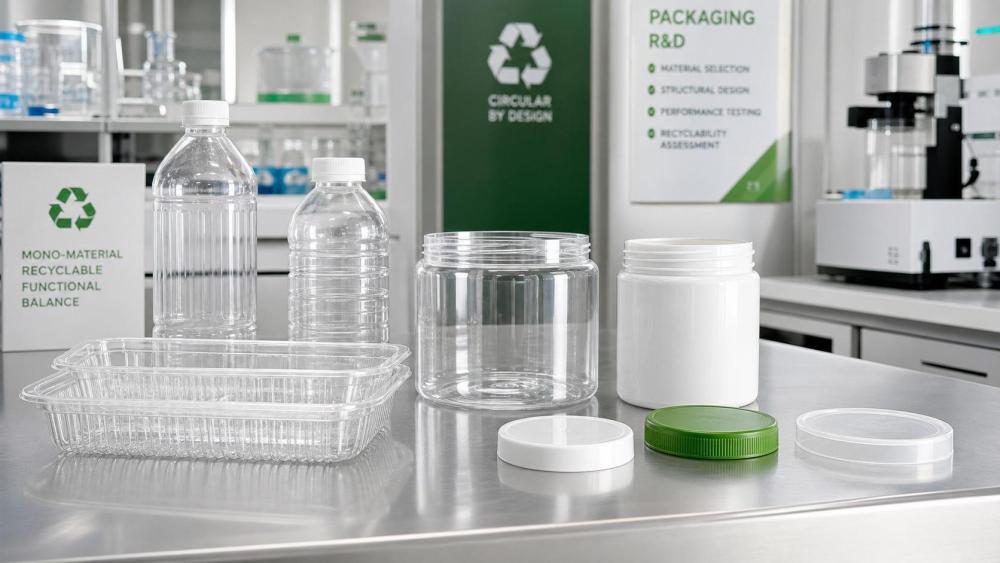
Rigid packaging serves food, personal care, chemicals, healthcare, electronics, and industrial products.
Each application asks for different barrier, strength, clarity, sealing, and logistics performance.
At the same time, recycling systems prefer simpler structures and cleaner material streams.
This creates the central tension in design for recyclability rigid packaging.
The packaging has to perform well before disposal and separate well after disposal.
From a project perspective, that means early choices affect compliance, tooling, conversion cost, and recovery value later.
A resin grade, color system, label format, or closure design may seem minor.
Yet each one can change sorting yield and recyclate quality.
Mono-Material Simplicity vs Functional Performance
One of the most common rules in design for recyclability rigid packaging is to simplify the structure.
Mono-material bottles, jars, trays, and caps are easier to identify, sort, and reprocess.
But simple structures do not always deliver the needed protection.
Barrier-sensitive products often rely on multilayer designs, coatings, or inserts.
Examples include EVOH barriers, oxygen scavengers, and dissimilar closures or liners.
These features protect product quality, but they can reduce compatibility in mechanical recycling streams.
The real question is not whether complexity is bad.
The better question is whether the added function is essential, limited, and accepted by the intended recycling system.
- Use mono-material structures when shelf life and filling conditions allow it.
- Keep barrier layers below accepted thresholds where local guidelines define them.
- Test whether downgauging plus product reformulation can replace a complex pack.
Recycled Content vs Processing Stability
Another major tradeoff in design for recyclability rigid packaging is the use of recycled resin.
Adding recycled content supports circular targets and often improves environmental positioning.
Still, recycled polymers may introduce variation in odor, color, melt flow, and impact strength.
That variation matters in injection molding, blow molding, and thermoforming.
It also matters when the package must meet tight dimensional or cosmetic standards.
This is where many programs struggle.
They target high recycled content without matching the specification to real processing windows.
A practical route is to define acceptable property ranges, not a symbolic percentage alone.
In design for recyclability rigid packaging, quality consistency can be as important as recycled content volume.
What to Check Before Scaling
- Melt flow consistency across supply lots.
- Color drift under production conditions.
- Odor risk for sensitive applications.
- Seal, drop, and stacking performance after aging.
- Availability of backup virgin or blended grades.
Labels, Adhesives, and Closures vs Recovery Efficiency
A recyclable bottle can still fail recovery if secondary components are poorly selected.
Labels, sleeves, pressure-sensitive adhesives, closures, and liners all influence sorting behavior.
Full-body sleeves may block optical sorting.
Heavy inks and incompatible adhesives may contaminate wash streams.
Closures made from incompatible polymers may reduce recyclate purity when they do not separate well.
This part of design for recyclability rigid packaging is often underestimated because each item seems small.
Yet small components are exactly where avoidable losses happen.
Teams should review component compatibility as a system, not as separate sourced items.
Color and Brand Impact vs Sortability
Brand teams often want distinctive color, opacity, and strong shelf presence.
Recyclers usually prefer clear or lightly tinted packaging.
Dark colors, carbon black, and heavy pigmentation can reduce detection and lower end-market value.
This is a classic design for recyclability rigid packaging conflict.
The package needs to communicate quality while staying useful in recycling streams.
More companies are now treating natural, clear, or near-clear formats as part of the sustainability story.
That shift creates more room to simplify pigment choices without losing market logic.
Lightweighting vs Mechanical Reliability
Lightweighting is often linked to sustainability, and sometimes for good reason.
Less resin can mean lower material use and transport emissions.
But aggressive lightweighting may create paneling, creep, drop failure, or pallet instability.
Those failures increase waste and rework, which can erase environmental gains.
In design for recyclability rigid packaging, the best result is not always the lightest pack.
The better result is the lightest pack that survives filling, distribution, use, and collection.
That means lightweighting should be validated with real logistics and storage conditions.
How to Make Better Packaging Decisions Early
The most effective design for recyclability rigid packaging programs start upstream.
They do not wait until tooling is frozen or artwork is approved.
They build recyclability into the initial specification and supplier discussion.
In practical terms, teams should compare options across five filters.
- Material compatibility with local recycling streams.
- Performance under actual filling and distribution conditions.
- Processing stability at commercial production speed.
- Cost impact across resin, scrap, tooling, and quality loss.
- Future flexibility for regulation and recycled content targets.
This kind of review avoids the false choice between sustainability and operations.
It turns design for recyclability rigid packaging into a measurable engineering decision.
Final Takeaway
Design for recyclability rigid packaging is not about removing every tradeoff.
It is about making the tradeoffs visible early, then managing them with data.
The strongest projects usually simplify where they can and justify complexity where they must.
When material choice, component design, processing limits, and recovery pathways are reviewed together, better outcomes follow.
That approach supports product protection, operational control, and more credible circular packaging decisions.
Have questions about this sector analysis, or seeking best practices specific to your niche? Drop us a line below and let the senior consultants at APIM assist you.
We respect your privacy. Your information is strictly confidential.
Related News
- 00
0000-00
How does washing affect contamination in post-consumer recycled PP resins? - 00
0000-00
How does feedstock affect depolymerization equipment selection? - 00
0000-00
US Sets 213.44% Preliminary Antidumping Deposit on Chinese PTMEG - 00
0000-00
When should epoxy be used as a thermal interface material for semiconductors? - 00
0000-00
US Midterm Results Unlikely to Quickly Shift Recycled Plastics Market or Legislation