




China Tightens Export Checks on EVOH Barrier Films
On June 30, 2026, China’s General Administration of Customs moved to tighten export quality and safety oversight for EVOH high-barrier packaging materials. From July 15, EVOH multilayer films exported to the EU, South Korea, and Canada must be accompanied by raw migration testing data for ethylene alcohol monomer issued by a CNAS-accredited laboratory, and the shipments will also be subject to port inspections. For exporters, film manufacturers, testing partners, and supply chain teams serving these destination markets, the development matters because compliance is no longer limited to a test conclusion alone; the underlying records themselves have become part of the review focus.
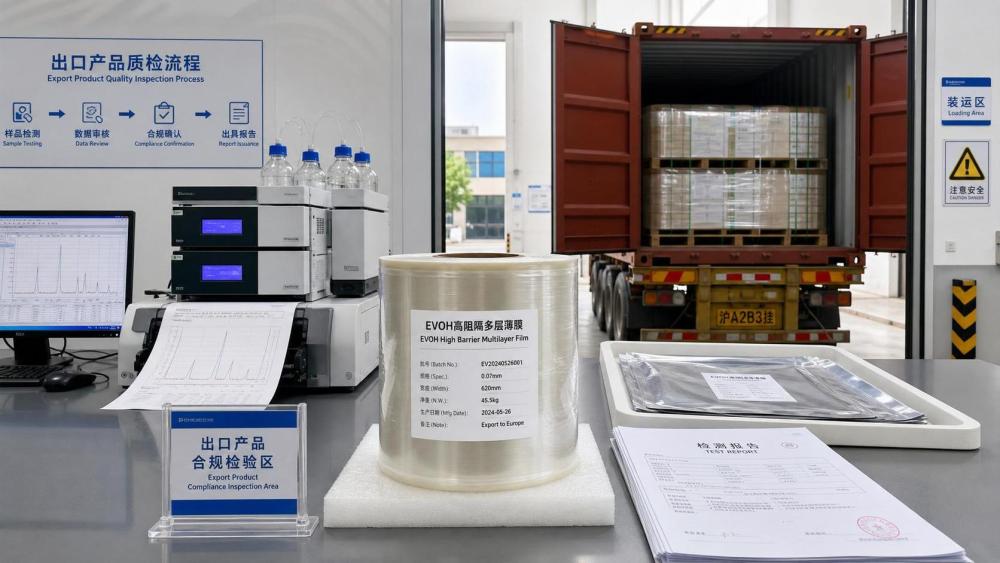
What the new customs notice requires
According to the information provided, China’s General Administration of Customs issued the Notice on Strengthening Export Quality and Safety Supervision of EVOH High-Barrier Packaging Materials on June 30, 2026, under reference 署监发〔2026〕88号.
The notice states that, starting July 15, all EVOH multilayer films exported to the EU, South Korea, and Canada must carry original data for ethylene alcohol monomer migration testing from a CNAS-accredited laboratory.
The required materials include sample pretreatment records, LC-MS/MS spectra, and matrix spike recovery data. The same notice also indicates that these exports will be subject to spot checks at ports.
The stated purpose of the measure is to respond to the latest limit requirements from ECHA.
Where the operational pressure is likely to appear
Export-facing film suppliers may face tighter document readiness requirements
From an industry perspective, the most immediate impact is likely to fall on companies directly shipping EVOH multilayer films to the EU, South Korea, and Canada. Their exposure is straightforward: if raw testing records are now part of shipment compliance, export preparation may need to cover not only whether a report exists, but whether the underlying data package is complete and aligned with customs review expectations.
What deserves closer attention is the handoff between laboratory output and export documentation. The practical pressure point may be document completeness, especially where shipment timelines are tight or where testing files are managed separately from customs paperwork.
Manufacturing teams may need closer coordination with testing functions
Analysis shows that manufacturers producing EVOH multilayer films may also be affected through internal quality workflows. Because the required materials explicitly include sample pretreatment, LC-MS/MS spectra, and matrix spike recovery, the issue is not only obtaining a pass result but retaining traceable supporting records that can travel with export business.
The likely impact area is coordination across production, quality, and compliance teams. Companies serving the named export markets may need to confirm whether the testing package generated for each shipment or batch is sufficient for customs review and available within delivery windows.
Laboratory and supply chain service partners may become more central to delivery timing
Observably, CNAS-accredited laboratories and service providers supporting export execution may become more important in the short term. The reason is that the notice ties admissible documentation to CNAS-accredited testing output and also introduces port spot checks.
For logistics, customs clearance, and external compliance support teams, the main change may not be a new product rule in itself, but a higher documentation dependency in shipment release and exception handling. Any mismatch between testing records and shipment files could become a practical issue during export processing.
What companies should watch right now
Whether existing test files include all required raw records
One immediate checkpoint is whether current laboratory deliverables already contain the specific raw data elements named in the notice, rather than only summary conclusions or certificates. The required scope given in the provided information is explicit enough that companies should compare existing file sets against it.
Whether destination-market shipments are clearly separated in internal workflows
Because the requirement applies to exports to the EU, South Korea, and Canada, businesses should pay close attention to product routing and customer destination management. This is especially relevant where the same EVOH multilayer film specifications are sold into multiple markets under shared operational processes.
The gap between formal compliance and port-level execution
Analysis shows that there is a practical distinction between having a valid test arrangement and being ready for a port spot check. Companies may need to pay attention to how quickly original records can be retrieved, how they are linked to the shipment, and whether internal teams and external agents are working from the same documentation set.
Customer communication and lead-time planning
What deserves closer attention is not only compliance itself but how the new review requirement affects delivery communication. Where shipments to the named markets are time-sensitive, exporters and suppliers may need to align testing schedules, documentation release, and customer expectations more closely after July 15.
Why this looks like more than a filing detail
Observably, this update is not just about adding one more attachment to export paperwork. The emphasis on original migration testing data suggests that regulatory attention is moving closer to the underlying evidence chain behind compliance claims, at least for the covered product and destination markets.
Analysis shows that this should be understood as a concrete short-term operational change, because an effective date and documentation scope have already been specified. At the same time, it also reads as a longer-term regulatory signal: authorities are indicating that traceable test evidence may carry greater weight in cross-border quality and safety supervision when overseas limit requirements change.
That said, it is still too early to treat this as a broader rule affecting all packaging materials or all export destinations. Based on the provided information, the current scope is specific to EVOH multilayer films shipped to the EU, South Korea, and Canada.
How to read this development at this stage
At this stage, it is more appropriate to understand the notice as a targeted compliance tightening around EVOH high-barrier packaging exports, rather than as a generalized shift across the entire packaging sector. The immediate consequence is procedural: exporters and their partners need to ensure that accredited testing output and raw data records can support shipment release and possible port inspection.
From an industry perspective, the broader significance lies in the direction of scrutiny. The market should watch whether similar documentation depth becomes relevant in other material categories, other destination markets, or future export controls tied to updated overseas limit requirements. For now, the clearest message is that documentation quality and traceability have moved closer to the center of export execution for the covered products.
Basis of this article and points for ongoing verification
This article is based on the user-provided news title, event date, and event summary. The confirmed facts used here come from the provided description of the June 30, 2026 notice issued by China’s General Administration of Customs and the stated July 15 enforcement requirement.
For this type of development, commonly relevant source categories may include official notices, company disclosures, industry association updates, authoritative media reporting, and documents from standards or regulatory bodies. No specific official source link was provided in the input, so the exact official link remains to be verified on an ongoing basis.
Further observation should focus on any follow-up official wording, implementation clarifications at ports, and whether the documentation requirement remains limited to the named destinations and product category or is later interpreted more broadly.
Have questions about this sector analysis, or seeking best practices specific to your niche? Drop us a line below and let the senior consultants at APIM assist you.
We respect your privacy. Your information is strictly confidential.
Related News
- 00
0000-00
How does washing affect contamination in post-consumer recycled PP resins? - 00
0000-00
How does feedstock affect depolymerization equipment selection? - 00
0000-00
US Sets 213.44% Preliminary Antidumping Deposit on Chinese PTMEG - 00
0000-00
When should epoxy be used as a thermal interface material for semiconductors? - 00
0000-00
US Midterm Results Unlikely to Quickly Shift Recycled Plastics Market or Legislation