




Can EVOH Barrier Films Be Recycled With the Packaging They Protect?
Can EVOH Barrier Films Be Recycled With the Packaging They Protect?
Can barrier films be recycled together with the primary packaging they protect? The answer depends on the film structure, material compatibility, recycling infrastructure, and the role of EVOH within multilayer packaging. For packaging engineers, converters, and sustainability teams, the issue is less about whether EVOH is “recyclable” in isolation and more about whether the complete package can enter a defined collection, sorting, and recycling stream without creating an unacceptable risk for the recovered material.
EVOH, or ethylene vinyl alcohol copolymer, is widely used because it provides strong oxygen-barrier performance at relatively low thickness. It helps protect foods, beverages, pharmaceuticals, personal-care products, agricultural chemicals, and other oxygen-sensitive goods. In many applications, a thin EVOH layer can extend shelf life, reduce oxidation, preserve flavor, or support product safety. Yet that same functional layer complicates a packaging conversation increasingly centered on mono-material design and circularity.
The practical question is therefore not simply, “Does EVOH prevent recycling?” In many cases, it does not. But recyclability should be evaluated at the packaging-system level: resin family, EVOH loading, tie layers, inks, adhesives, closures, labels, package format, contamination, and the capabilities of the local recycling system all matter.
Why EVOH Is Used in Packaging Structures
EVOH is often described as a high-barrier resin, but its value is best understood in the context of a multilayer structure. It is rarely the only material in a package. A typical coextruded film, sheet, bottle, tray, or tube may combine polyethylene (PE), polypropylene (PP), polyethylene terephthalate (PET), polyamide, adhesive tie layers, and EVOH. Each layer is assigned a task: sealability, stiffness, puncture resistance, printability, moisture protection, or oxygen protection.
EVOH performs particularly well as an oxygen barrier under suitable humidity conditions, but it is sensitive to moisture. For that reason, it is commonly protected between polyolefin layers or combined with other materials that help preserve barrier performance during storage and use. The design logic is technically sound: a very thin functional layer can replace heavier or more complex barriers in certain applications. The end-of-life challenge begins when these layers do not behave identically during sorting and reprocessing.
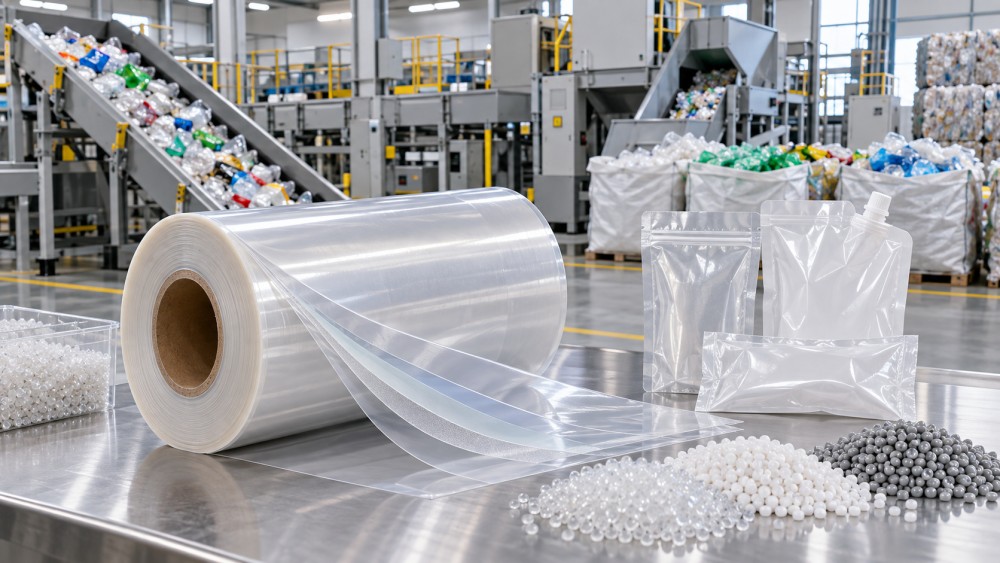
For buyers and product developers, this creates an important trade-off. Removing EVOH may simplify a structure, but it can also reduce shelf life or require a thicker alternative material. If the result is more product waste, more packaging mass, or weaker performance on a high-speed filling line, the sustainability claim becomes less straightforward. A recycling-compatible design still has to protect the product effectively.
Can EVOH Stay in a PE or PP Recycling Stream?
In principle, many EVOH-containing polyolefin packages can be mechanically recycled with the dominant PE or PP material when the EVOH layer is limited and the overall structure has been designed with the target recycling stream in mind. This is why EVOH is often considered a more practical barrier option than some materially dissimilar alternatives in flexible and rigid polyolefin packaging.
That statement needs careful qualification. “Can be recycled” does not automatically mean that every recycling facility will accept it, that the package will be sorted correctly, or that the resulting recyclate will be appropriate for every downstream use. Mechanical recyclers process mixed feedstock, not ideal laboratory specimens. Their outcomes are affected by incoming composition, melt filtration, temperature history, odor, residual contents, print coverage, contamination, and the quality requirements of the final recycled resin.
For PE- or PP-based packages, the relevant issue is often the proportion of EVOH and other non-polyolefin components. At low levels, the barrier layer may be tolerated in the broader recycling stream. At higher levels, or when combined with substantial quantities of incompatible polymers, adhesives, metallization, or fillers, its influence on processing and properties can become more significant. The threshold is not universal. It depends on the intended recycled product, the processing route, and the specifications used by the recycler or recycling-design framework in the market concerned.
A package that is acceptable for a mixed polyolefin recyclate may not be suitable for a demanding application requiring high consistency, appearance, impact strength, or repeatable sealing behavior. This distinction is often missed in early packaging discussions. Recycling compatibility is not a binary label; it is a material-quality question.
The Whole Structure Matters More Than the Barrier Layer Alone
When evaluating whether EVOH barrier films can be recycled with their primary packaging, teams should map the complete bill of materials. The core substrate may be PE, PP, PET, or another polymer. The EVOH may be a thin central layer. But the package could also contain tie resins needed to bond otherwise incompatible layers, a printed outer web, a pressure-sensitive label, a zipper, a spout, a cap, a sealing lacquer, or a residue-prone product formulation.
Each component can affect the real recycling outcome. In flexible packaging, sorting is already difficult in many regions because films are lightweight, variably collected, and often contaminated after use. In rigid packaging, labels, closures, pigments, and multilayer wall construction may influence density separation and recyclate appearance. A technically favorable EVOH concentration cannot compensate for a package design that is not captured, sorted, or accepted in practice.
PET-based structures require a separate assessment. EVOH may be used in certain PET containers or multilayer applications, but the compatibility expectations, sorting pathways, and end-market requirements for PET recyclate differ from those for polyolefins. It is not sound practice to assume that an EVOH design acceptable in a PE stream will produce the same result in a PET stream. Resin family, package form, and local recycling guidance need to be reviewed together.
Questions that should be answered before claiming recyclability
- What is the primary resin family, and which recycling stream is the package intended to enter?
- What proportion of the finished structure is EVOH, including the effect of any compatible or incompatible tie layers?
- Is the package flexible, rigid, thermoformed, blow-molded, or part of a mixed-material assembly?
- Can the package be collected and sorted in the countries where it will be sold?
- What properties must the recycled output retain: color, odor, melt flow, toughness, stiffness, or food-contact suitability?
- Have labels, inks, adhesives, pigments, and product residues been reviewed rather than treated as secondary details?
Recyclable Design Is Not the Same as Recycled Content
Packaging teams often manage two related but distinct objectives: designing a package that can be recycled and incorporating recycled content into new packaging. EVOH may be compatible with the first objective under certain structural conditions, while the second objective introduces further questions about recycled resin quality, regulations, contamination control, and the performance needs of the new package.
For example, a converter may be able to use recycled PE or PP in a non-contact layer while retaining a virgin functional barrier layer. That may support material circularity, but it requires attention to extrusion behavior, gel formation, odor, color variation, and thickness control. If recycled content is introduced into a structure that must achieve a precise oxygen barrier or demanding seal integrity, process consistency becomes as important as material selection.
This is where broad claims can become risky. A package might be designed for a recycling stream but still not contain recycled content. Conversely, a package with recycled content may not be readily recyclable after use. Clear internal language helps procurement, sustainability, regulatory, and product teams avoid treating these different claims as interchangeable.
Process Decisions Can Change the End-of-Life Outcome
Film design is not finalized when the resin specification is selected. Coextrusion conditions, layer distribution, melt temperatures, residence time, filtration, and gauge control can affect whether a thin EVOH layer remains consistent across production. A layer that varies substantially in thickness can create both barrier-performance uncertainty and a less predictable material composition.
Converters also need to consider how downstream converting changes the package. Lamination may add adhesive mass and additional substrates. Surface treatment can influence print and bonding performance. High-coverage inks, metallized effects, or difficult-to-remove labels may undermine an otherwise well-considered recyclable structure. Packaging development works best when sustainability review begins before artwork, closure design, and line trials are locked.
Recyclers face their own process constraints. During mechanical recycling, multilayer materials are ground, washed where applicable, dried, melted, filtered, and repelletized. The process can reduce some contamination, but it cannot make every incompatible component disappear. The recovered material may be directed into applications with broader tolerance for mixed composition rather than into high-clarity or highly specified packaging. This is a normal feature of recycling economics and material science, not evidence that a package has failed.
Avoid the “Mono-Material at Any Cost” Trap
Mono-material packaging is often a sensible direction because it can simplify sorting and improve compatibility with established recycling streams. However, it should not become a design shortcut. Some products need oxygen protection that a single resin layer cannot provide at practical thickness, cost, or processing conditions. In those cases, a thin EVOH layer within a largely PE or PP structure may offer a balanced route: strong protection during use and a more manageable end-of-life profile than a more complex laminate.
The right comparison is not “one material versus several materials” in the abstract. It is the total package-system outcome. Teams should compare product loss risk, barrier requirement, packaging weight, conversion yield, filling-line performance, transport conditions, collection realities, and the likely destination of the recovered material. A design that appears simpler on a material list may perform poorly if it causes premature spoilage or requires excessive thickness.
A More Reliable Decision Path for Packaging Teams
A useful starting point is to define the package’s non-negotiables: oxygen transmission target, moisture exposure, shelf-life expectation, product sensitivity, filling temperature, distribution conditions, sealing window, and required appearance. Only then should the team assess whether EVOH is necessary, whether the barrier layer can be minimized, and which primary resin family offers the most credible recycling route in the intended market.
Next, engage the relevant parties early. Resin suppliers can clarify material behavior and recommended processing windows. Film producers and converters can assess layer design and line feasibility. Recycling partners can comment on practical feedstock tolerance and likely recyclate destinations. Brand owners should verify that consumer-facing claims reflect actual collection and sorting conditions, rather than laboratory compatibility alone.
This is also a situation where structured technical information matters. APIM follows specialty films, EVOH multilayer structures, recycled polymers, compounding, and extrusion technologies because material decisions are rarely isolated. A barrier resin may solve a shelf-life problem, but its value must be assessed alongside processing stability, package construction, recovery pathways, and supply-chain requirements.
The Practical Answer
EVOH barrier films can, in many packaging designs, be recycled together with the primary packaging they protect—particularly when EVOH is a controlled, thin functional layer within a predominantly PE or PP structure. That does not make every EVOH-containing package universally recyclable, nor does it guarantee equivalent recyclate quality across markets or applications.
The most defensible approach is to evaluate the complete structure against the intended recycling stream, rather than judging EVOH in isolation. Before approving a design or making an environmental claim, confirm the layer composition, intended end market, collection pathway, sorting behavior, and applicable recycling-design requirements. In barrier packaging, the best answer is usually the one that protects the product effectively while creating the fewest avoidable obstacles after use.
Have questions about this sector analysis, or seeking best practices specific to your niche? Drop us a line below and let the senior consultants at APIM assist you.
We respect your privacy. Your information is strictly confidential.
Related News
- 00
0000-00
NAPCOR Report: US PET Bottle Recycling Rate Fell to 29% in 2025 - 00
0000-00
How does washing affect contamination in post-consumer recycled PP resins? - 00
0000-00
How does feedstock affect depolymerization equipment selection? - 00
0000-00
US Sets 213.44% Preliminary Antidumping Deposit on Chinese PTMEG - 00
0000-00
When should epoxy be used as a thermal interface material for semiconductors?